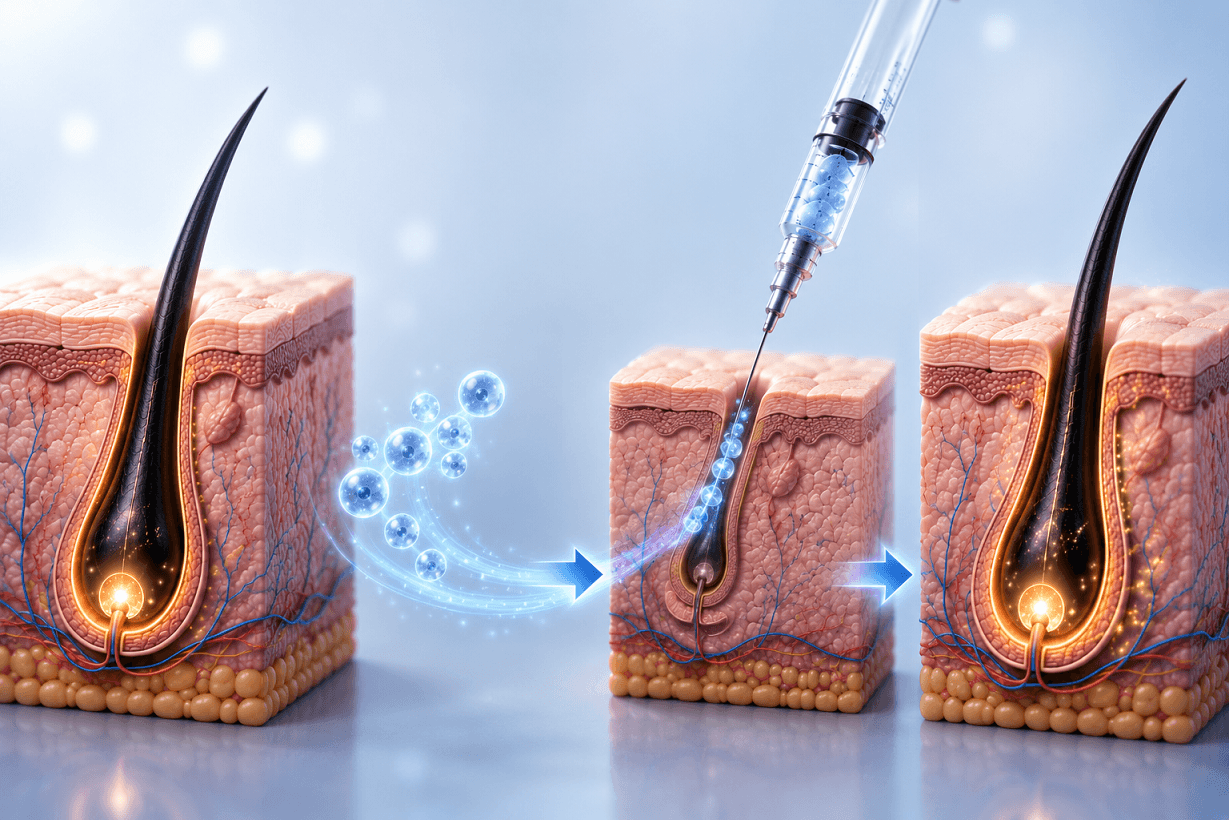
Hair follicles that have shrunk due to hair loss often do not recover through nutritional support alone. Recently, a treatment that uses stem cells within the hair (Hair Follicle Stem Cells) to reactivate miniaturized hair follicles has been published in an international academic journal, showing a new treatment possibility.
Source: Garg AK, Garg S.
“Enzymatic Dissociation and Identification of Hair Follicle Stem Cells for Reversing Miniaturization in Androgenetic Alopecia.”
Hair Transplant Forum International. 2025;35(3):88–93.
Links: ishrs-htforum.org/content/35/3/88 · doi:10.33589/35.3.88
What Is Hair Follicle Stem Cell Therapy?
Hair follicle stem cell therapy is a regenerative treatment in which stem cells present in healthy hair follicles are isolated and injected into areas where hair loss has progressed.
While conventional medication aims to slow the progression of hair loss,
hair follicle stem cell therapy aims to
✔ enhance the regenerative capacity of the hair follicle itself, and
✔ improve thinning hair (miniaturization).
This possibility was also introduced in a recent study published in Hair Transplant Forum International (2025).
Why Are Hair Follicle Stem Cells Important?
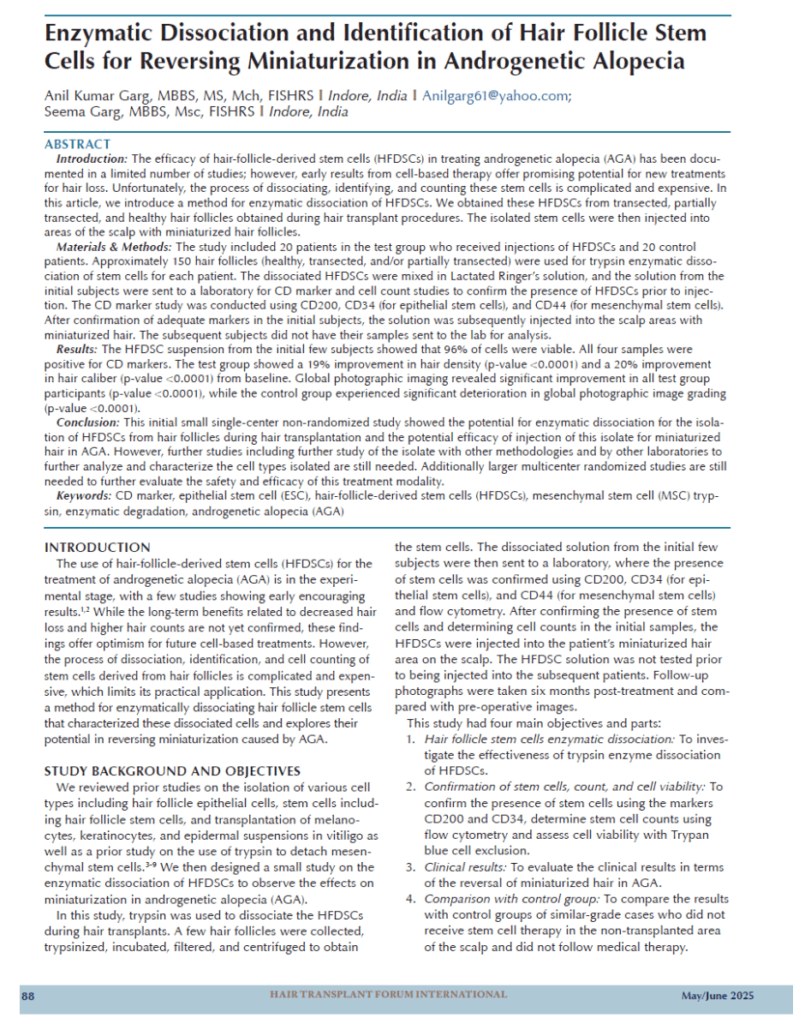
In androgenetic alopecia, hair follicles gradually shrink over time, and thick hair changes into thin, vellus-like hair.
This is called follicular miniaturization.
The problem is that once a hair follicle has miniaturized, it is difficult to restore through nutritional support alone.
For this reason, research on using stem cells within hair follicles to induce the regeneration of miniaturized follicles has recently been actively conducted.
What Treatment Was Performed in the International Study?
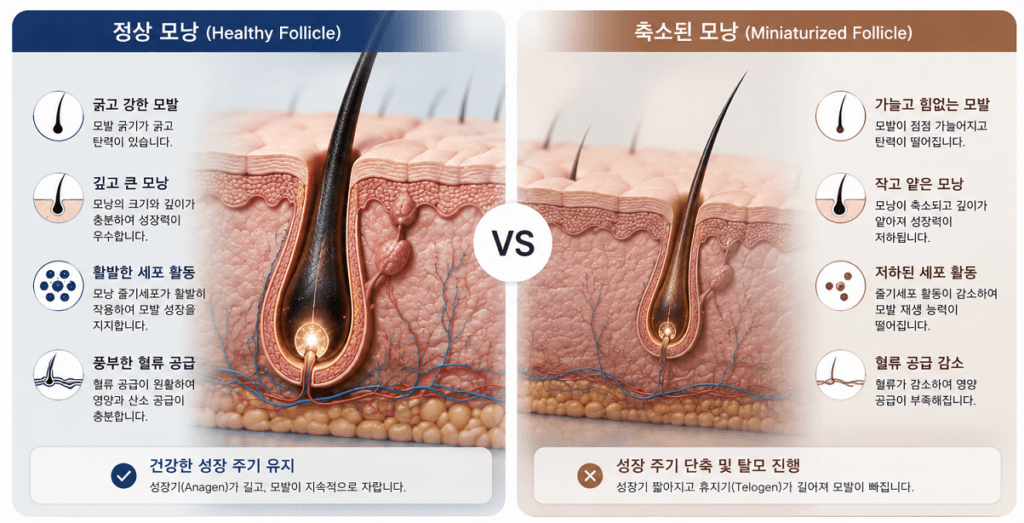
The study used healthy hair follicles obtained during the hair transplant procedure.
Hair follicle stem cells (HFDSC) were isolated from them using an enzyme (trypsin),
and then injected directly into areas where hair loss had progressed.
The study subjects consisted of
- Treatment group: 20 participants
- Control group: 20 participants
.
The isolated cells were used after
CD200,
CD34,
CD44, and other stem cell markers were checked
to analyze whether stem cells were actually present.
Study Results
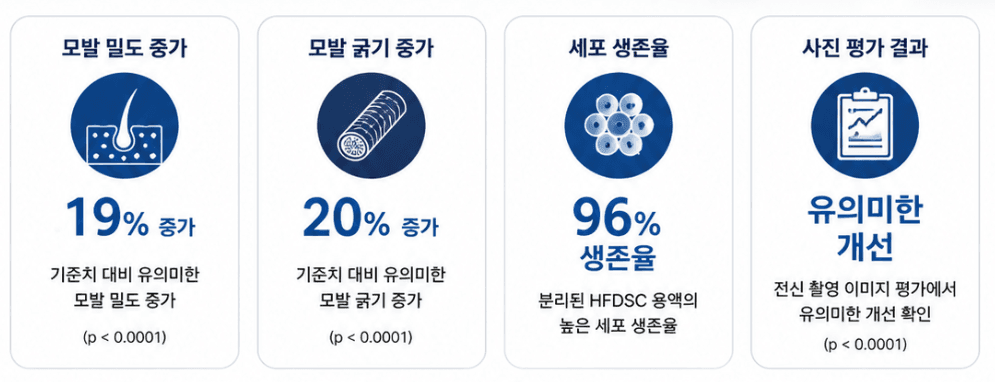
The results after 6 months were quite meaningful.
Increase in Hair Density
Approx. 19% increase
Increase in Hair Thickness
Approx. 20% increase
Cell Viability
Approx. 96%
Photographic Assessment
Significant improvement was observed in all participants in the treatment group.
In contrast, hair loss progressed further over time in the control group.
How Are Stem Cells Isolated?
This study used trypsin.
However, in recent stem cell research,
methods using collagenase are also widely used.
Each enzyme has its advantages and disadvantages.
| Item | Trypsin | Collagenase |
|---|---|---|
| Reaction speed | Fast | Slow |
| Cell damage | Some | Low |
| Stem cell preservation | Moderate | Excellent |
| Tissue dissociation | Simple | Precise |
Collagenase can dissociate hair follicle tissue more gently,
and is known to have advantages in terms of stem cell viability and preservation of function.
| Enzyme | Advantages | Disadvantages | Recommended Use |
| Trypsin | Fast and inexpensive, simple cell isolation | Cell surface damage | Harvesting cultured cells, monolayer cells |
| Collagenase | Excellent extracellular matrix degradation, high cell viability | Expensive, long processing time | Hair follicle dermis, stem cell isolation |
How Is Modi Hair Plant's Hair Follicle Stem Cell Therapy Different?
At Modi Hair Plant, we focus on the regenerative capacity of hair follicles, based on our experience in hair transplantation.
In particular, by applying hair transplant and hair follicle stem cell therapy together, we provide treatment that considers both the engraftment environment for transplanted hair and the maintenance environment for existing hair.
After thoroughly evaluating the patient's hair loss and scalp condition,
we establish an individualized treatment plan.
※ Treatment methods may vary depending on the patient's condition.
This May Be Helpful for:
- Early-stage androgenetic alopecia
- Hair that is gradually becoming thinner
- Those who wish to improve the engraftment environment after a hair transplant
- Those not satisfied with medication alone
- Those who wish to preserve as much existing hair as possible
Frequently Asked Questions (FAQ)
Q. Is hair follicle stem cell therapy possible without a hair transplant?
It depends on the patient's hair loss condition and treatment goals. In some cases, it may be possible as a standalone treatment, and in other cases, better results may be expected when combined with a hair transplant.
Q. When do the effects begin to appear?
Results vary by individual, but changes in hair thickness and density may generally appear over several months.
Q. Has the effectiveness been proven by the study results alone?
Although this paper showed very encouraging results, the researchers themselves note that larger-scale, multicenter studies are needed. Therefore, at present, it is important to apply it together with existing treatments in accordance with the patient's condition.
Conclusion
Hair follicle stem cell therapy goes beyond simply slowing hair loss; it is a new approach that investigates the regenerative potential of miniaturized hair follicles.
The international paper published in 2025 reported meaningful results in improving hair density and thickness, and it is expected that further evidence will accumulate through more research in the future.
Because the degree of progression and the cause of hair loss differ for everyone, it is important to choose a suitable treatment method based on an accurate diagnosis. At Modi Hair Plant, we thoroughly analyze each individual's condition and propose a customized treatment plan, including hair transplant and hair follicle stem cell therapy.
This content was written based on research published in an international academic journal and was posted after review by our medical staff. The research results presented do not guarantee any specific treatment outcome, and treatment methods may vary depending on the patient's condition.