Modi Hair Plant
Eyebrow Transplant
We transplant according to the angle and direction of the hair.
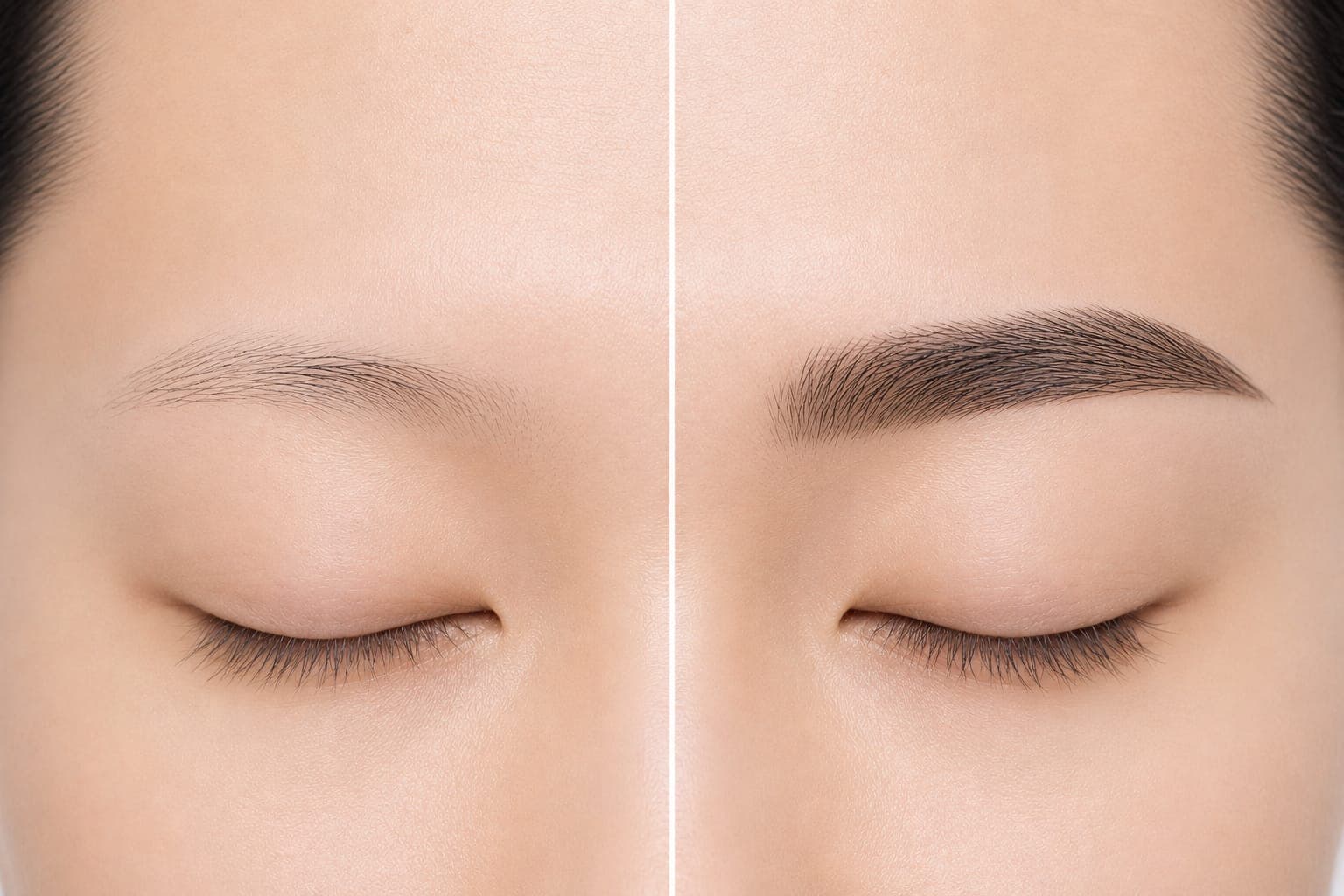
EYEBROW TRANSPLANT
What an Eyebrow Transplant Is
An eyebrow transplant moves your own hair follicles to the eyebrow area one strand at a time to create eyebrows of the shape and density you want. When the tail is short, the front lacks density, or only pigment remains from semi-permanent makeup, it fills the area with actual hair for natural eyebrows.
In fact, hair transplantation began with the eyebrows. Reconstructing the eyebrows of a patient who had lost them to Hansen's disease by separating follicular units from tissue at the back of the head was nearly the first hair transplant. It later expanded for hair loss and cosmetic purposes, but there is a reason the oldest procedure of all—the eyebrow transplant—did not become widespread.
We Don't Split Follicles — We Harvest Naturally Single Ones
Most follicles at the back of the head are multi-hair follicles, with several strands growing from a single opening. To use them for eyebrows, they must be separated one strand at a time with a blade under a microscope, and that process damaged the follicle's anatomical structure, leaving the grain misaligned and reducing survival. This is why eyebrow transplants were not widely performed.
To overcome this limitation, Modi Hair Plant does not separate follicles with a blade but harvests single-hair follicles that naturally grow one strand at a time. Because they are not cut with a blade, follicle damage is minimal, which favors survival, and because their thickness and growth rate are similar to the eyebrows, the grain looks natural after transplant and requires less trimming.
Matching Thickness with Nape Hair
When a multi-hair follicle from the back of the head is separated into a single strand and implanted, it is thicker and grows faster than the original single-hair follicle, creating a difference in texture from the eyebrows. So instead of the back of the head, Modi Hair Plant harvests from areas where hair is naturally fine and grows one strand at a time, such as the nape or above the ears.
Single-Follicle Harvest from the Nape
Fine and slow-growing, matching the existing eyebrows in thickness and grain
0.7 mm Punch
Harvested with a small punch, recovering to about a red mark by the next day
Direction and Angle Design
Transplanted one strand at a time, following the direction and grain of eyebrow growth
The front of the eyebrow grows upward, so it can curl back with even a little length; the finest vellus follicles are selected for implantation and must be trimmed periodically.
Matching the Curl with Long FUE
With standard non-incision harvesting, the hair on the harvested follicle remains short, making the curl (curvature) hard to confirm. Modi Hair Plant performs Long FUE (long-hair non-incision), harvesting without cutting the hair so it remains long, in order to match the bending grain and curvature of the eyebrows so the result looks natural from immediately after surgery.
Long FUE
Long hair remains intact, so the Curl of the hair is checked during transplant
Standard Non-Incision
Hair is short, making the Curl hard to confirm
Eyebrow Design
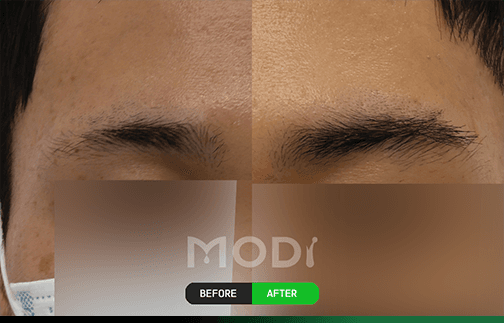
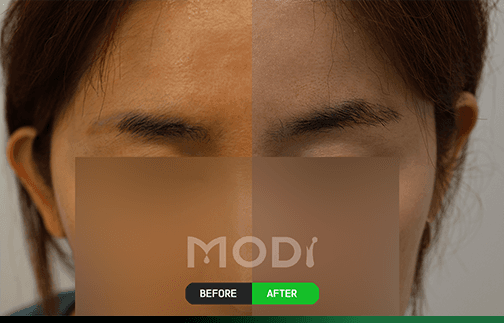
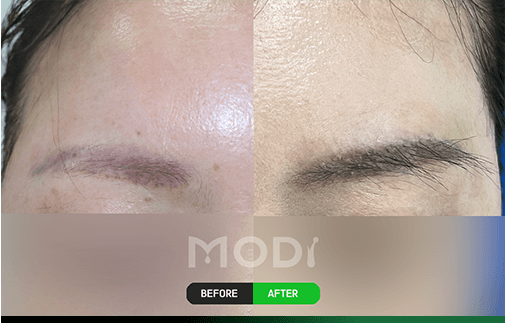
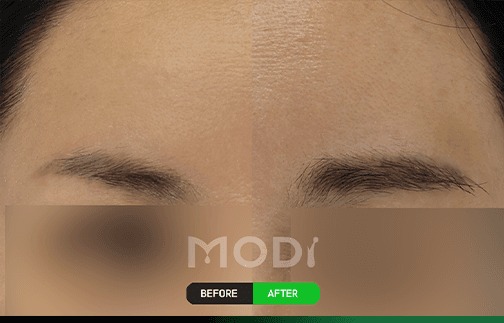
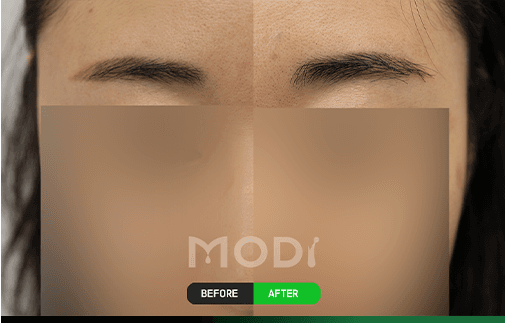
The transplanted hair must be placed with its thickness in mind and implanted one strand at a time to match the angle and direction of the hair, which requires meticulous surgery. The shape that suits each person differs by face shape.
Round Face
Design the eyebrows with an angular bend and transplant to follow the contour
Angular Face
Soften a strong impression with arched eyebrows
Long Face
Extend the eyebrow tail thinly to balance a long face
Inverted-Triangle Face
Extend the eyebrow peak outward for a design that makes the face look smaller
How It Differs from Tattoos and Semi-Permanent Makeup
Semi-permanent makeup places pigment in the epidermis and upper dermis, so it fades over time and is not permanent. Microblading scratches the skin by hand to insert pigment, making it hard to place precisely in the intended layer; if the pigment reaches the deeper lower dermis (the tattoo layer), it spreads along the lymphatic system and discolors blue or red due to light scattering.
Every tattoo spreads and changes color. When it discolors, pigment is layered over it again, and as the pigment overlaps into a solid patch, the skin's natural color and grain disappear. Laser removal takes more time and cost than the original procedure, and the long-term effects of residual pigment are not clearly known. By contrast, an eyebrow transplant uses your own hair, which actually grows, creating natural eyebrows with living grain.
CONSULT
Decide Carefully
Eyebrow shapes follow trends closely. Because an eyebrow transplant is a long-lasting procedure, it is better to set conservatively—rather than by the trend of the moment—the area where having eyebrows is preferable no matter which trend comes. No hair transplant is entirely without scarring, but harvesting with a small punch does not disrupt daily life. Start with a diagnosis and consultation.