Modi Hair Plant
Sideburns
We perform the transplant according to the angle and direction of the hair.
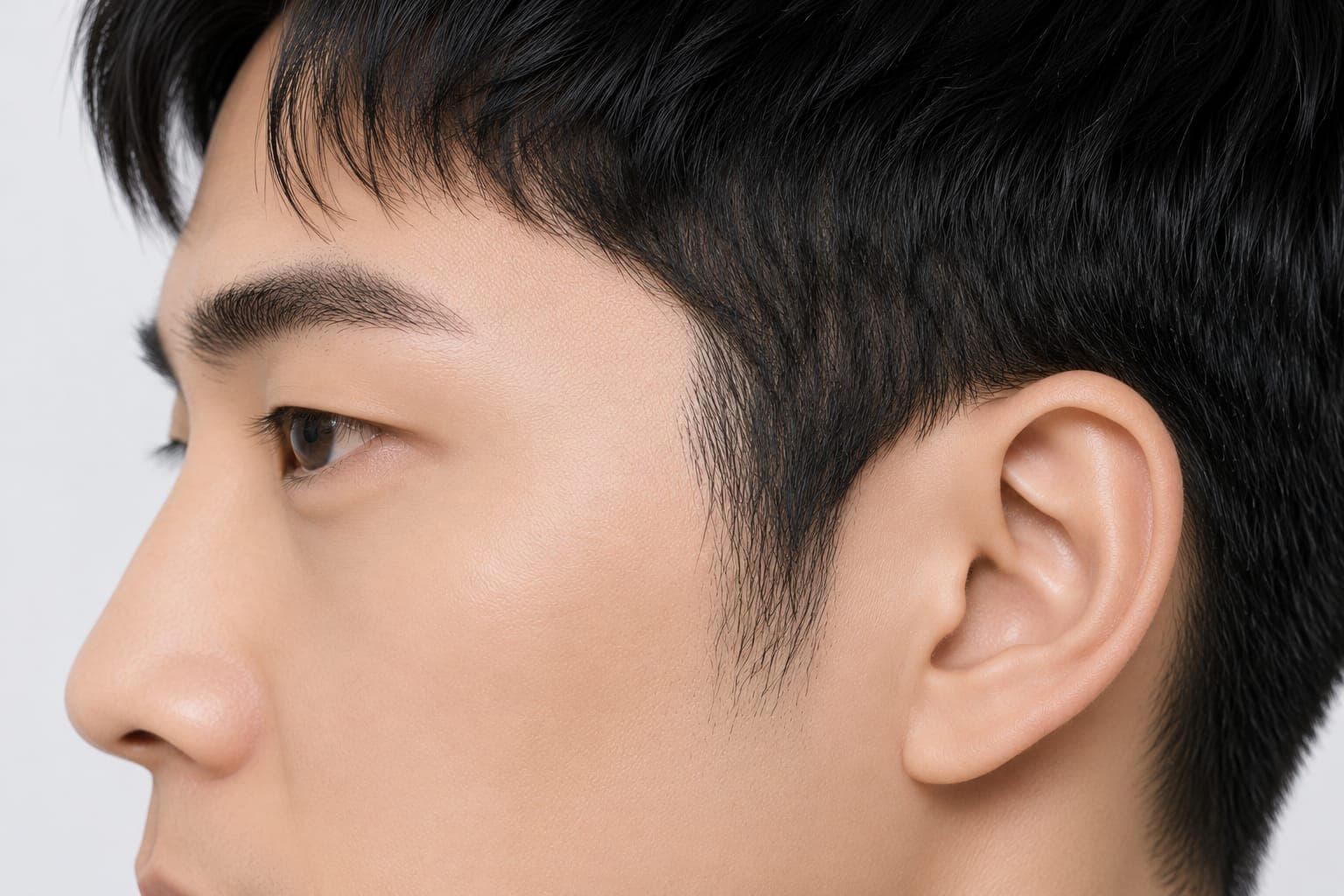
MALE SIDEBURNS
Sideburns are small, but they shape the entire impression
The face is perceived not as a surface but as a set of 'lines.' When the hairline, jawline, and sideburns connect naturally, the facial line looks organized; when the sideburns look short or broken, the whitespace on the side of the face widens, making the face look larger and the hair look thinner. Even without hair loss, more people have recently been seeking to transplant only the sideburns for cosmetic purposes.
When the space between the eyebrows and the temple peak is narrow and the sides are full, the face looks slim from the front and looks full-haired and youthful from the side. If your forehead looks wide or awkward when you push your hair back, the side line is often the cause.
Check 01
When the sideburns are sparse and the side-face whitespace looks wide
Check 02
When the side line looks short or broken
Check 03
When the face looks wide or the contour looks blurry
Check 04
When you want the sides to look fuller
Check 05
When you want to refine your face shape naturally
DESIGN FIRST
For sideburns, the design determines the result
Sideburns should be expressed not as a straight line but as a 'flow.' For some faces, a pointed finish suits best; for others, a long, blunt finish that reduces the side-face whitespace is better. The following four elements determine how natural the result looks.
- 01
Angle
- 02
Direction
- 03
Density
- 04
Length
Sideburns design for men
A line that connects naturally with the jawline A defined shape with crisp angles A fuller impression by reducing the side whitespace
Sideburns design for women
A design centered on soft curves A line that makes the face look smaller Emphasis on the connection with the surrounding hair
NATURAL RESULT
Naturalness comes from the details
The sideburn area is highly visible, so it must look not as if it was 'implanted' but as if it 'had always been there.' When transplanting into the side hair, no matter how flat the angle of implantation, it must match the direction of the original hair so that the flow does not become misaligned. A clear direction, a density that is not excessive, and a line composition without visible borders create the result.
- Transplant aligned with the original hair direction
- Connecting the flow with the surrounding hair
- A density design that is not excessive
- A line composition with no visible borders
When scalp tattooing (SMP) is applied to an area with no hair, the 2D drawn with dots and lines cannot fully replace 3D hair, so it can become noticeable under lighting, in wind, or when wet. It is not uncommon for people to come in for a transplant to cover up a tattoo.
MINIMAL & DISCREET
Shave-free and non-incision, even with a small hair count
Because the sideburns are a visible area, a method with minimal change to the appearance is important. Applying shave-free non-incision surgery can reduce the burden of returning to daily life. In actual cases, even with about 600 hairs—300 on each side—the side-face whitespace can be noticeably reduced and the hair can look fuller.
- Shave-free non-incision available
- Minimal burden returning to daily life
- An inconspicuous procedure
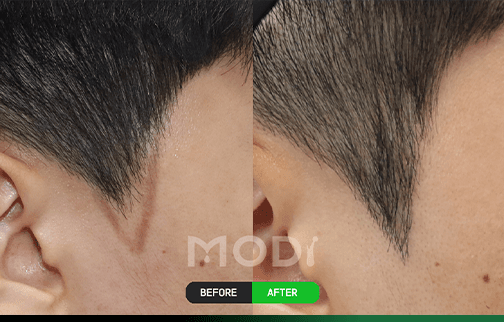
BEARD GRAFT
Beard hair can also refine the impression and face shape
If a long jawline is a concern or beard density is lacking, a beard transplant can refine the face shape and cover scars. However, because beard follicles differ from scalp hair in thickness and texture, they must be designed to match the existing density so that they look natural after the transplant.
CONSIDER BEFORE
Only when truly needed — decide with full understanding
Because side-line correction has a large cosmetic effect, there are also long-term points to consider. Hair at the back of the head grows faster and thicker than hair at the sides, so the side hair can stick out more, which may shorten the down-perm cycle. Also, the sides tend to gray earlier and the hairline recedes with age, so a difference between the implanted hair and the original hair may appear long afterward. We recommend it when the cosmetic effect is clear, but if it is not truly necessary, there is no need to force it.