Modi Hair Plant
Dutasteride Injection Treatment
Dutasteride delivered directly to the scalp, instead of taken orally
WHY DUTASTERIDE
The foundation of male pattern hair loss treatment: 5-alpha reductase inhibitors
Male pattern hair loss is a common condition that more than half of all men experience at some point in their lives. Among the various treatments, the most central are 5-alpha reductase inhibitors such as finasteride and dutasteride. Inhibiting this enzyme prevents the male hormone testosterone from converting into DHT, which causes hair loss, thereby improving male pattern hair loss and preventing its progression.
Standard treatment is taking finasteride once a day and applying minoxidil twice a day. However, when finasteride does not produce a clear effect or hair loss continues to progress, dutasteride is considered. Dutasteride works by the same mechanism but has a higher rate of enzyme inhibition — in simple terms, it is a stronger drug that works on the same principle.
ORAL VS INJECTION
Why oral medication can feel burdensome, and the injection as an option
Dutasteride has a long blood half-life, reported in the literature as roughly 3 to 5 weeks. In other words, a single dose stays in the body for a long time. As a result, even those who want to switch to dutasteride because finasteride is not effective enough often hesitate, owing to the long half-life and concerns about systemic side effects.
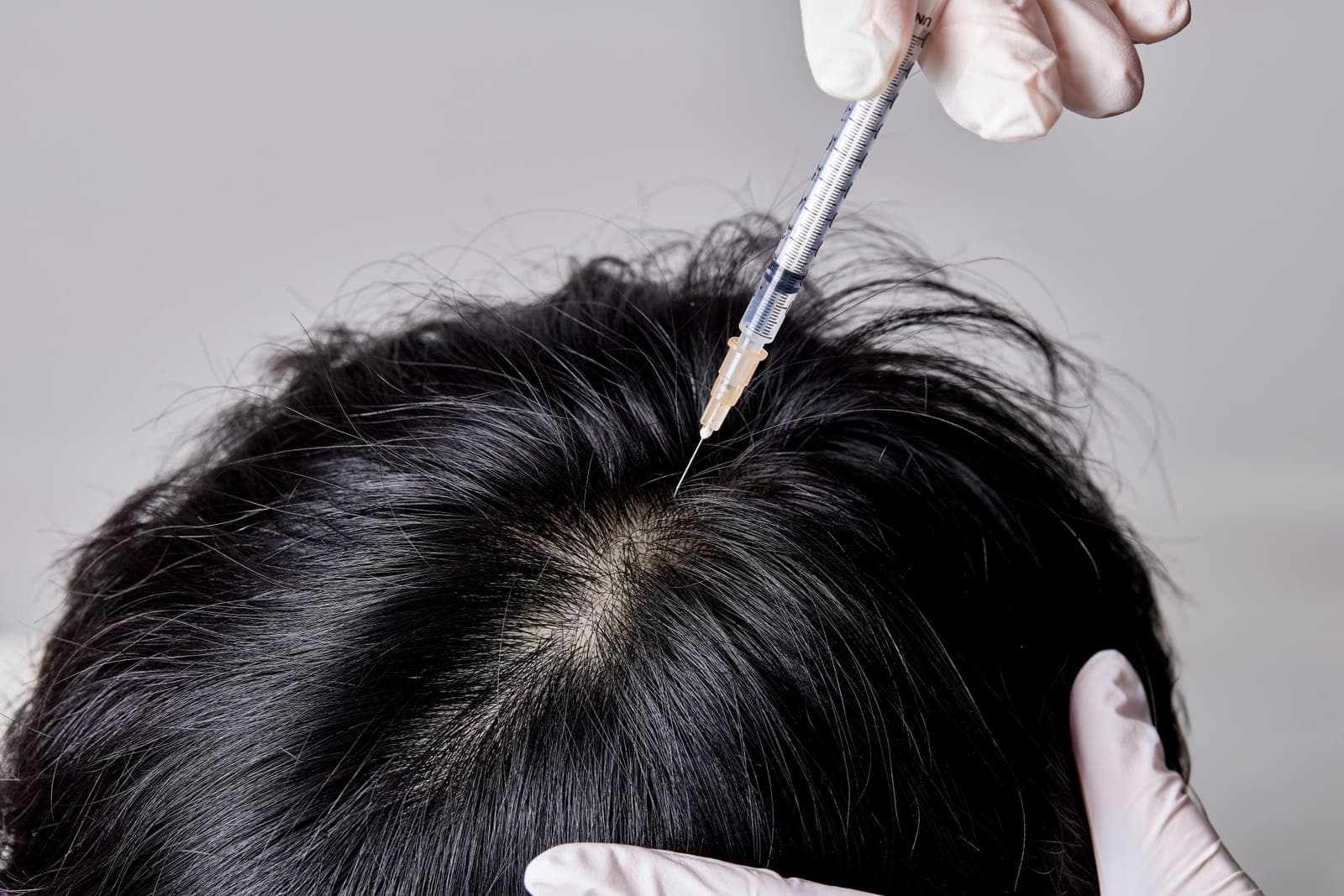
Modi Hair Plant performs dutasteride follicular injections for these patients. The method involves diluting the dutasteride drug to a low concentration of 0.05% and then injecting it directly into the dermal layer of the scalp with a fine needle. Because the capillaries that supply nutrients to the hair follicles are located in the dermal layer, an effect can be expected even at a low concentration while reducing the amount absorbed into the rest of the body.
WHY DUTA, NOT FINA
Why dutasteride is the choice for the injection
An injection cannot be given every day and requires a clinic visit, so a drug that stays in the body longer is more advantageous. Finasteride has a short half-life of 7 hours, so using it as an injection would require frequent treatments, whereas dutasteride has a long half-life and can be planned at roughly once a month.
- Its inhibition of type 2 5-alpha reductase is about three times stronger than finasteride, making it more effective.
- It is strongly lipophilic, so it stays in scalp tissue longer and is absorbed less into the bloodstream.
- Thanks to the long half-life, the interval between visits can be extended during the maintenance phase.
Treatment proceeds by giving injections at two-week intervals for about the first three months, then extending the interval to once a month. A 1 cc syringe is used each time, containing about the amount of one dutasteride tablet. Because this amount is divided across as much as several weeks, the total dosage is lower than taking it daily, and absorption into the blood is also less.
WHO IS IT FOR
Dutasteride injection: recommended for these patients
Those who cannot continue oral medication due to side effects
When it is difficult to keep taking oral medication because of sexual or mood-related side effects of finasteride or dutasteride
Those who can visit regularly
When you can come to the clinic at four-week intervals early on and, even as the interval lengthens, at least once every three months
Those who can accept injections
When there is pain during the injection but it feels preferable to taking medication every day
SIDE EFFECTS
Why oral medication causes side effects, and how to manage them
Rather than vaguely avoiding oral medication, it is better to understand how it works. When 5-alpha reductase is inhibited, testosterone cannot convert into DHT, so in the first 1 to 2 weeks of taking it, testosterone actually rises temporarily by 10 to 20%. The reason sexual side effects still appear is thought to be that DHT, a potent male hormone, decreases while the metabolism of other hormones, such as neurosteroids, is also affected. The psychological effect of taking medication for the first time also plays a part.
These side effects are usually most noticeable early in treatment and tend to diminish the longer the medication is taken. The temporarily elevated testosterone also returns to pre-treatment levels after a few weeks. So if the side effects are not severe, we observe for a while; if they are severe, we reduce or stop the dose, or consider other treatments such as switching to finasteride or injections. Because the degree of side effects and personal preference vary from person to person, the decision is made through consultation.
WHEN MEDS DON'T WORK
If you truly cannot take the medication
Oral medication is the most convenient first-line treatment with the least cost burden. However, although it varies from study to study, about 3 to 4% of people find it difficult to continue taking it because of side effects. Being unable to take the medication is no reason to give up on treatment. If you have stopped the medication because of side effects, we recommend not leaving it at that, but consulting us about alternatives, including injections.
For patients with advanced, severe hair loss (Norwood stage 7) who have refused all oral medication, we sometimes carry out dutasteride injections together with hair follicle stem cell treatment. We have been able to confirm improvement in the crown and front areas with injections alone, without medication. However, because stem cell treatment involves greater cost and more visits, the principle is to consider it in stages, when drug treatment is not sufficient.
CONSULT
The right drug treatment for you, starting with diagnosis
Whether oral medication suits you, whether to switch to a dutasteride injection, or whether to combine stem cell treatment depends on your type of hair loss and how the side effects present. Start with an accurate diagnosis.