Modi Hair Plant
Scar Transplant
The goal is not to erase the scar, but to make it naturally less visible.
SCAR HAIR TRANSPLANT
Making scars that cannot be hidden less visible
The goal of a scar transplant is not to remove the scar entirely, but to cover the white, smooth-looking area with hair so that it is not noticeable from the outside. Hair transplantation covers scars that show when the hair is cut short or blown by the wind — such as surgical scars, burn and trauma scars, and the scar at the back of the head after a strip-method hair transplant.
When a surgical or trauma scar is exposed and bothers you
When a scalp scar is visible after a forehead lift or forehead reduction
When the scar at the back of the head bothers you after a strip-method hair transplant
When a scar prevents you from wearing short hair or a two-block cut
WHY IT IS HARD
Hair struggles to survive in scar tissue
Scars differ from normal skin. They have reduced sensation, are unevenly fibrotic, and have fewer blood vessels. For a follicle to settle and survive, it must receive oxygen and nutrients through blood flow, but the scar area lacks that environment, making graft survival less favorable than in normal skin.
However, because why, when, and how each scar formed varies widely, it cannot be stated uniformly that “a scar loses a certain percentage.” Scars from trauma or surgery generally tend to have a good prognosis. On the other hand, there are reports that cicatricial alopecia caused by autoimmune or inflammatory skin disease is unfavorable for transplant outcomes, so we proceed only after carefully reviewing past biopsy and treatment records.
OUR APPROACH
Four ways to improve graft survival in unfavorable scars
To overcome the disadvantages of scar tissue, Modi Hair Plant uses the following methods in combination. This allows graft survival in the scar area comparable to that in normal skin.
- 01
Nerve anesthesia first, minimal vasoconstriction
Using local anesthesia and vasoconstrictors directly on a scar with few blood vessels reduces blood flow further. Where possible, the scar area is anesthetized indirectly with nerve anesthesia to preserve blood flow.
- 02
Transplanting only healthy follicles
Since the number of follicles a given area can sustain is limited, that number must be filled with thick, healthy follicles to look full.
- 03
Combining hair follicle stem cells
From follicles that are difficult to use for transplantation, stem cells are separated and administered together into the scar area, with the addition of components that aid skin recovery such as PDRN.
- 04
Hyperbaric oxygen therapy
Because oxygen supply is important to the area in the early stage after transplantation, hyperbaric oxygen therapy after surgery helps oxygen reach the follicles and speeds recovery.
DESIGN
Making scars less visible through design
A forehead lift or forehead reduction damages the blood vessels supplying the scalp once, which can later lead to frontal hair loss or scarring. In such cases, we cover the scar while also refining the hairline, and if there is asymmetry in the head shape, we adjust the transplant volume differently on the left and right sides to restore balance as well.
For lift and forehead-reduction scars, it is best to visit at least six months after surgery so the tissue can stabilize. We assess the scar and give you an accurate guide to the transplant volume needed.
PROCESS
The scar transplant process
- 01
Reviewing the scar condition and past treatment history
- 02
Assessing transplant eligibility and prognosis
- 03
Planning density and extent, and designing
- 04
Harvesting and selecting healthy follicles
- 05
Transplanting into the scar area, combined with stem cells
- 06
Hyperbaric oxygen therapy and follow-up care
CASES
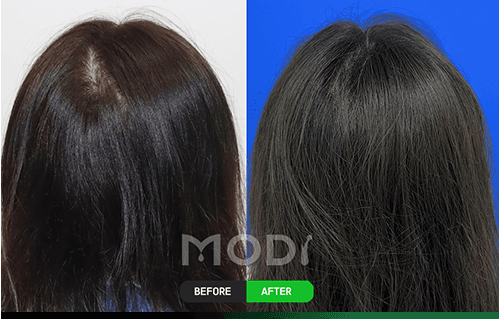
Before and after scar transplant cases
A patient with a large scar at the back of the head received about 1,000 hairs so that the scar was not very noticeable even with short hair, and a patient whose scalp was depressed and scarred after brain surgery had about 3,000 hairs restored by combining stem cells with hyperbaric oxygen. Since the scalp is the area where hair transplantation is most effective for scars, when carried out according to the condition, it is a procedure with high satisfaction.
CONSULT
Start by checking what is possible for your scar
Because each scar differs in its cause and course, the range of what is possible also differs. If you have been troubled for years by a stubborn bald patch or a scalp scar, have your current condition assessed accurately and find out what is possible.