Modi Hair Plant
Female Hairline Design Transplant
We design a female hairline matched to your facial proportions.
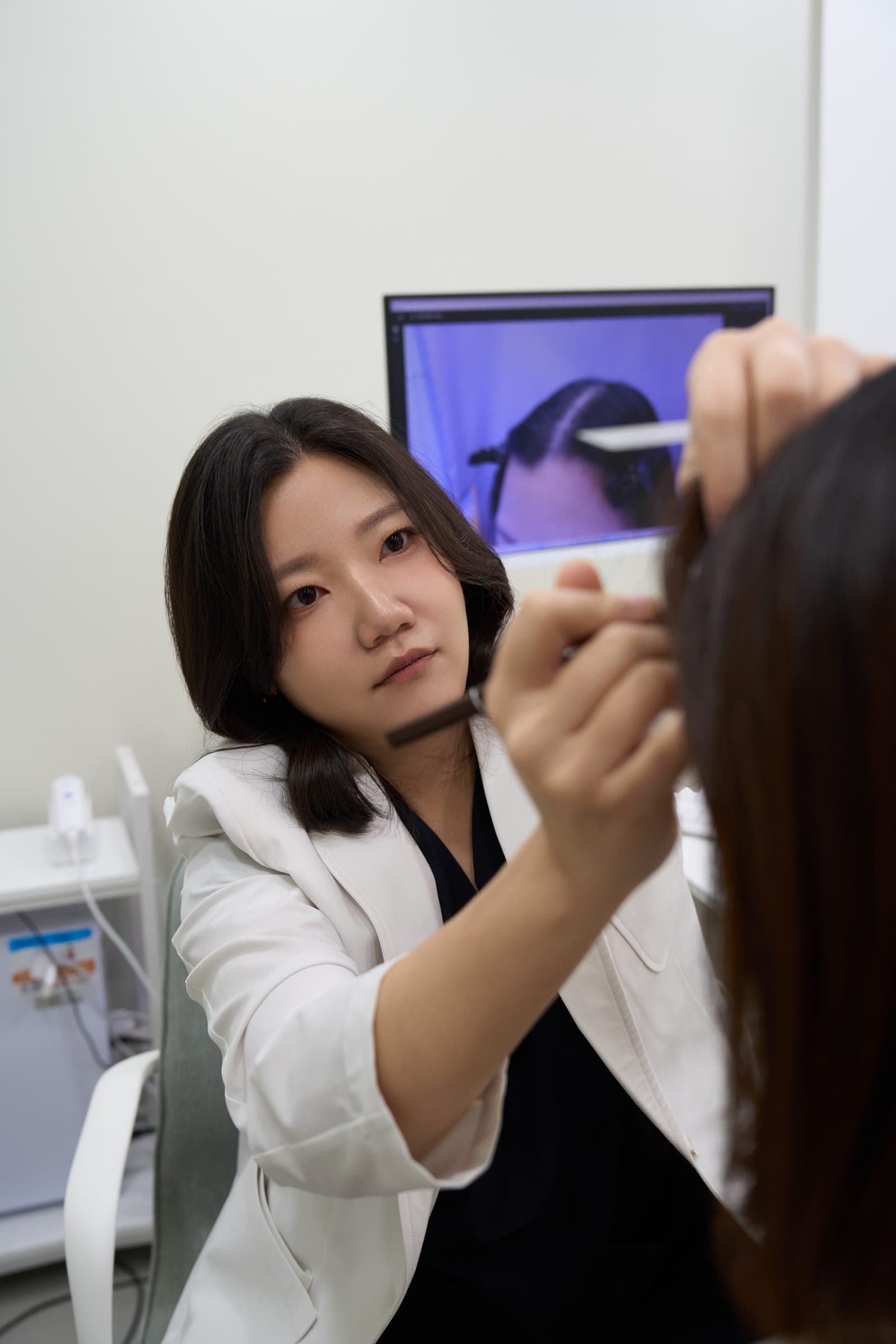
FEMALE DESIGN
For a female hairline, the front design is what matters most
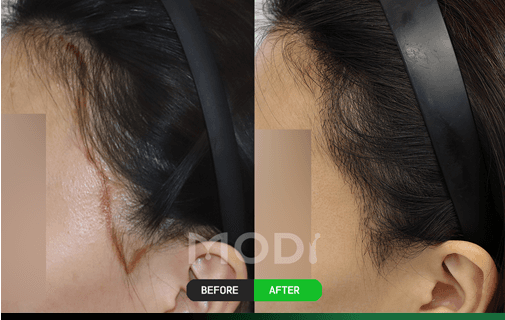
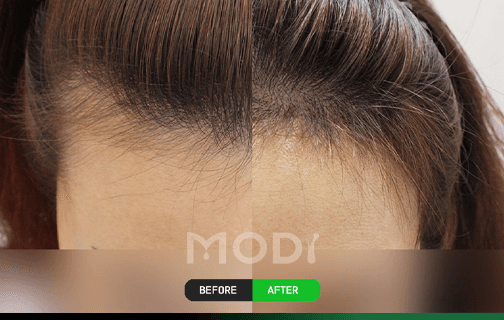
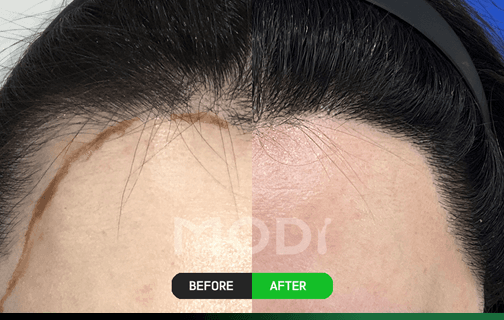
Female design transplant comes down to two things. First, placing finer hair at the very front of the hairline so that the scalp boundary is not obvious and looks natural. Second, designing not only the front line but the side line as well, for a slim, small-looking face.
The causes, hormones, and treatment of female pattern hair loss (the part and crown) are covered separately under “Hair Loss by Type.” This page focuses on the design transplant that creates a new hairline.
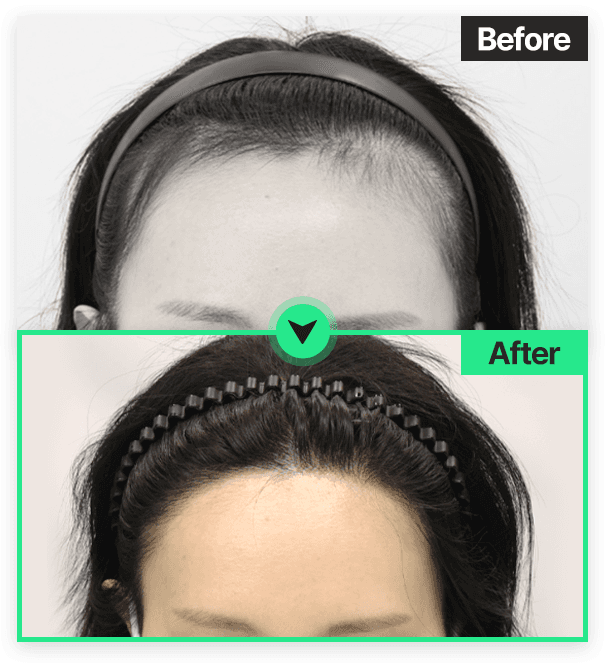
DESIGN BY RATIO
The hairline is designed by proportion
A female hairline is designed based on the forehead-to-nose ratio and the forehead-nose-chin ratio. Whether to set it at 1:1 or to narrow the forehead further to 0.8–0.9 differs from case to case depending on the shape of the patient's head, so in the end it must be drawn out in person. When a narrowly drawn area is covered by hand and checked, it looks too narrow, so it is usually agreed at between 0.9 and 1. How far the temples are lowered also changes the impression.
- 01
Draw several lines together
All options — round or wave shapes, lowering or raising the temples, and so on — are drawn out together with the patient, and both the doctor and the patient confirm them.
- 02
Set the forehead height
Starting from a typical forehead height (about 6.7 cm), the line is lowered to 6.3–6.4 cm according to the head shape and the patient's satisfaction to find a natural line.
- 03
Add sufficient density
If the density is low, it looks artificial, as if only a few strands were filled in. We transplant densely, paying attention to density relative to the line (for example, about 3,500 hairs for a woman in her 40s).
- 04
Confirm again just before transplanting
Just before transplanting after harvesting is complete, the design is matched with the patient once more. Usually each side confirms it two or three times before proceeding.
DIRECTION
We match direction and thickness as well
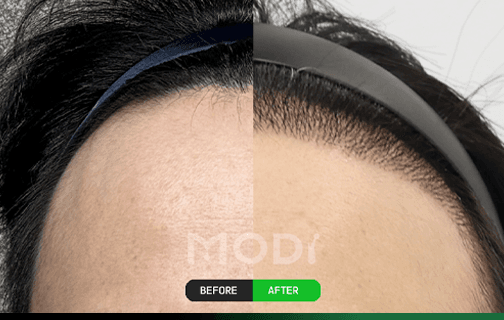
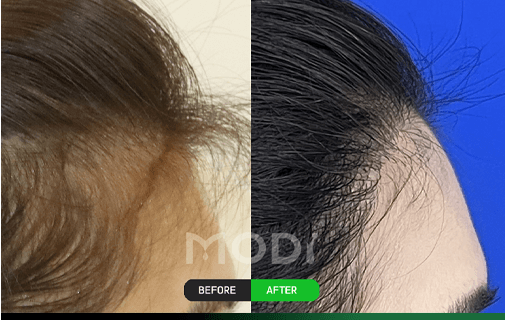
Hair must be implanted in a pattern similar to the direction, angle, and depth of the existing hair so that it cannot be distinguished from normal hair areas. In particular, because East Asian hair is thick and dark, simply relocating it can look unnatural, so finer hair is selected for the hairline details. At the skin boundary, we begin with single hairs and gradually increase the diameter and number in a gradation transplant, making the scalp boundary natural.
VS FOREHEAD SURGERY
How it differs from forehead reduction surgery
Forehead reduction surgery is an operation that incises the forehead skin and dissects the scalp to reduce the area. Although the surgery time is short and the cost is low, a linear scar remains at the incision, and it is difficult to round off the line. The blood vessels supplying the scalp are injured, which can accelerate hairline recession and crown hair loss over the long term, and even if the scar area is later transplanted, the hair growth rate may be lower.
| Category | Forehead reduction surgery | Hairline design transplant |
|---|---|---|
| Method | Forehead skin incision and scalp dissection | Relocating occipital follicles to the hairline |
| Scar | A linear scar remains | Almost no scar with non-incision |
| Line shape | Vertical reduction, hard to curve | Natural with curves and gradation |
| Long-term effect | Risk of accelerated recession and crown hair loss | Natural result matched in direction and density |
Forehead reduction surgery requires shortening the vertical length by 2 cm or more and is limited to certain indications where harvestable follicles are insufficient. Because hair transplantation may need to be performed several times afterward to correct scars and the line, it is best not to decide lightly.
FUE WITHOUT SHAVING
Female non-incision: shaving is not required
Some say that “female hairline non-incision always means shaving,” but that is not true. Non-incision also includes line-strip shaving, partial shaving, and no shaving, and shaving is not recommended for women with long hair. This is because hair grows about 1 cm per month, so at a length of 50–60 cm it takes years to grow back. There is no case that absolutely requires shaving even with a lot of curly or gray hair or with thin hair; the surgery simply takes a little longer, and equally good follicles are obtained without shaving.
| Incision FUSS | Non-incision FUE |
|---|---|
| Separating and harvesting follicles after a scalp incision | Harvesting follicles unit by unit with a punch |
| Advantageous for large-scale transplants | Can be harvested without shaving |
| Has an incision scar | Almost no incision scar |
| Short surgery time | Surgery time is longer without shaving |
SIDE LINE
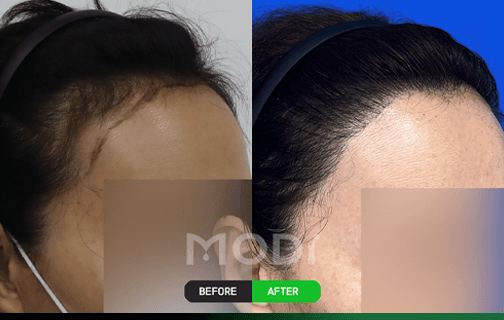
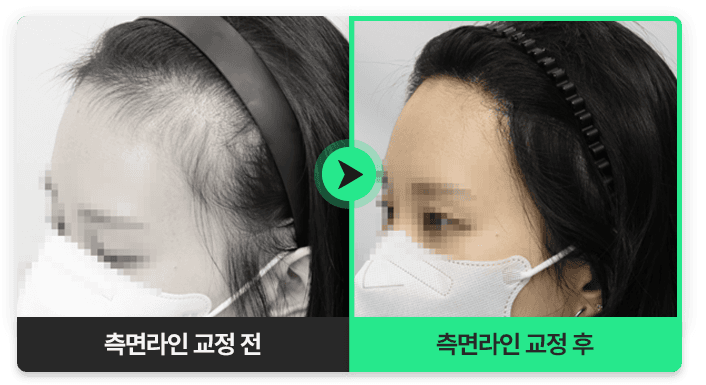
Designing the side line too is what makes the face look slim
Just as important as the front hairline is the side line. Filling in the side lines pulls the facial contour together so it looks slim and small, making it an indispensable design element in female design transplant. The side, however, is high in difficulty: hair relocated from the back of the head grows faster and thicker than temporal hair, and the temporal area also turns gray sooner, so unless the direction, density, and thickness are set precisely, the side hair can stick out or differ in color and look unnatural. That is why the side line must be designed from the start with a natural flow and thickness.
What sets natural apart is not how densely you plant but the order of thickness. Over-planting the side tends to look unnatural, so the very front at the skin border starts with the finest single hairs and the hair is placed progressively thicker toward the inside — a thickness gradation. Hair relocated from the back of the head keeps growing, so the very short vellus hairs cannot be fully reproduced and the fine hairs need periodic trimming; but when this thickness gradation is set precisely, the side margin can be narrowed naturally.
It is best to design the side from the start with the thickness flow in mind. That said, even a line that has already settled can be corrected to look natural by realigning the order of single-hair thickness if it became uneven.
CONSULT
The right method for you starts with a diagnosis
Whether treatment or transplantation should come first, and whether incision or non-incision is right for you, depends on the condition of your scalp and hair loss. It is fine if you are not sure whether the design you want is right. Just visit us, and we can draw it out together and agree on it.