Modi Hair Plant
Revision Surgery
Not simply transplanting again, but designing a better result.
WHY REVISION
Why people seek revision surgery
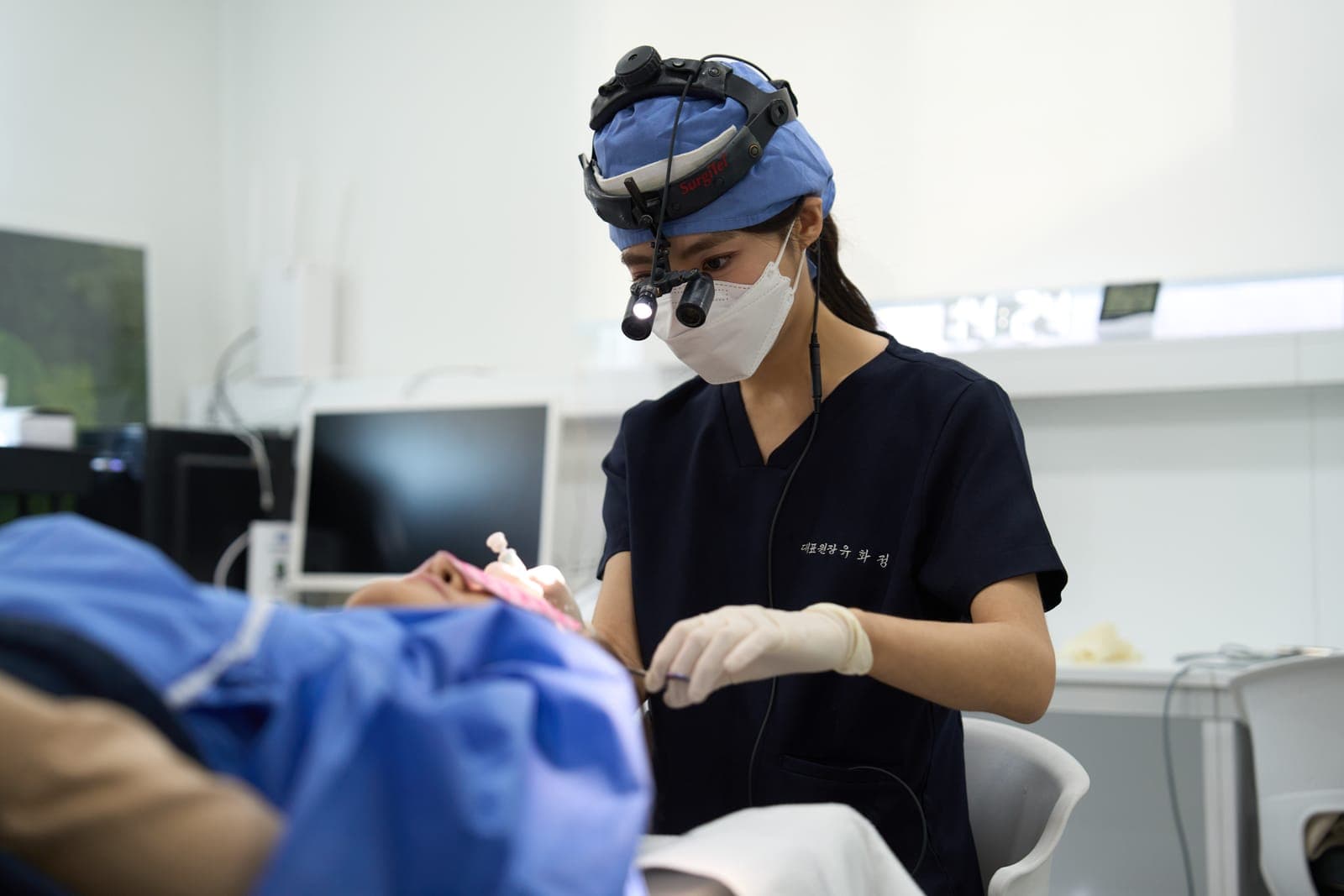
If you had a hair transplant at another clinic but the density is lacking, the hairline looks unnatural, or it was set too low and looks unnatural, revision surgery can correct it. Revision surgery is not repeating the same procedure; it is a process of accurately analyzing what went wrong and designing it anew.
Patients who return after a transplant at another clinic generally come with similar problems: the hairline density is insufficient, the design does not suit the face, or thick hair was placed at the very front of the line and looks unnatural. In the past, female hairline correction in particular often lacked agreement on the design, so many cases were performed with the forehead lowered too far or with insufficient density.
Insufficient density
Areas that look sparse because the amount transplanted and the density were underestimated
Inappropriate design
An unnatural line that does not consider facial proportions
Over-correction
The forehead set too low, or thick hair placed at the front
Reduced graft survival
A lower survival rate caused by problems in the harvesting or transplanting process
WHY HARDER
Why revision surgery is more difficult
The biggest constraint in revision surgery is that there are not enough follicles to harvest. A person is born with an average of 80,000 to 90,000 hairs, and the amount that can be transplanted over a lifetime is limited to about 10,000 hairs. If a large number of follicles have already been harvested from the donor area once, few usable follicles remain. East Asian women in particular often do not have enough body hair (legs, chest, and so on) to correct a hairline, so precious donor-area follicles must ultimately be used.
- The available follicles in the donor area are limited
- Harmony with existing transplanted hair and scars is required
- Over-corrected areas may need to be cleaned up (hair removal) first
- A donor area harvested with a large punch may be difficult to harvest from again
When another clinic uses a large punch to harvest a large amount quickly, neighboring follicles can also be damaged, and in some cases almost no normal follicles remain in the donor area years later. This is why we first check the donor area's available follicles before revision surgery.
Some patients come to us for revision after a large session abroad sold as a low-cost tourism package. One patient who had about 3,500 hairs placed via non-incision overseas (such as in Turkey) ten years earlier had a severely damaged donor area, because the harvest was done quickly with a punch far larger than the follicles; almost only single-hair follicles survived. In such cases further harvesting is difficult, so we proceed cautiously, focusing on the essential density reinforcement and correcting the existing line rather than over-reaching. Donor hair is a limited resource that cannot be bought back, so how much of the donor area was preserved in the first surgery determines how much revision is possible. This does not mean surgery abroad is itself a problem — only that choices led by 'cheap and plentiful' deserve careful thought.
HOW WE PLAN
Modi's revision surgery planning
Revision surgery is not a matter of how much to transplant, but of where and how to transplant. Doing it the same way again produces the same result, so we first assess the existing surgical condition and the donor-area follicles, then reset the design. Hair that was placed thickly at the front through over-correction is trimmed or cleaned up with laser hair removal, and areas lacking density are filled in with a natural direction and density.
- 01
Analyze the existing surgery and donor area
We check the previous surgical method and graft survival and assess the usable follicles remaining in the donor area.
- 02
Customized redesign
We revise the design considering the face shape and the existing line and plan around the areas that need density reinforcement.
- 03
Cleanup of over-corrected areas
Hair set too low or placed too thickly is cleaned up by hair removal, then a natural line is rebuilt.
- 04
Efficient use of limited follicles
With a shave-free, non-incision approach, only as many as needed are harvested one by one to aim for the maximum effect with minimal harvesting.
HAIRLINE CHANGES AFTER COSMETIC PROCEDURES
An unnatural hairline after forehead procedures
A growing number of patients visit because their hairline appears to have receded after forehead fillers, fat grafting, or implant insertion, or after forehead reduction surgery. When a procedure moves the forehead's highlight position downward, the forehead looks longer even at the same length. Because the hairline must be redesigned to match the three-dimensional reference points of the forehead, please tell us exactly which procedures you had and when during your consultation.
REGENERATIVE MEDICINE WITH FOLLICULAR STEM CELL
Combined hair follicle stem cell therapy
In revision surgery, the scalp environment is often already damaged, or hair loss is still progressing. A hair transplant relocates and plants follicles, while hair loss treatment protects the remaining hair; the two cannot replace each other and must go together. Modi Hair Plant combines revision surgery with hair-loss medication management and hair follicle stem cell therapy, managing recovery, scalp condition, and ongoing hair loss together.
- 01
Recovery management
- 02
Improving scalp condition
- 03
Managing ongoing hair loss
CASES
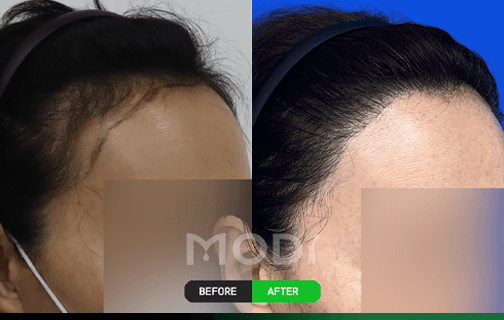
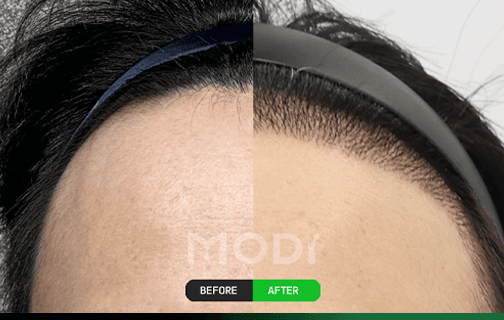
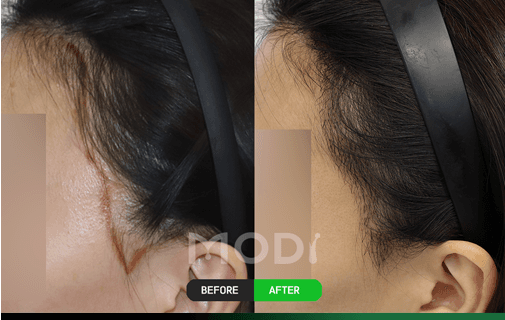
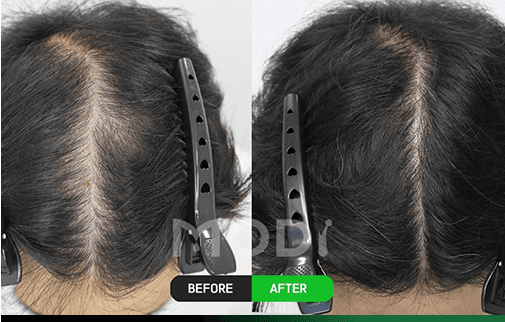
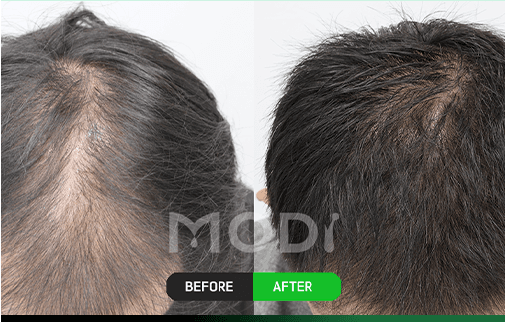
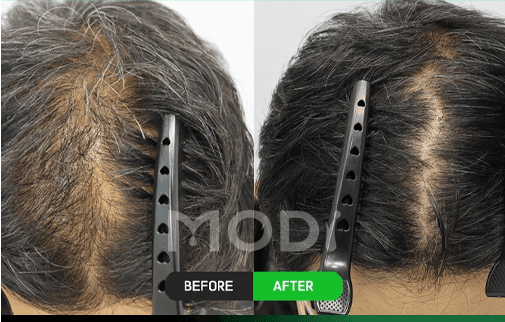
Before-and-after photos / cases
With revision surgery, it is more important to look at the process of improvement than the result.
CONSULT
Start by accurately confirming your current condition
Many people hesitate for years to visit a clinic because of results that differed from their expectations, but surgical correction is now quite possible. Once we check the donor area's available follicles and the condition of your scalp, we can guide you toward the most suitable direction.