Modi Hair Plant
Hair Transplant Surgical Process
We disclose every step of the process so patients can feel at ease.
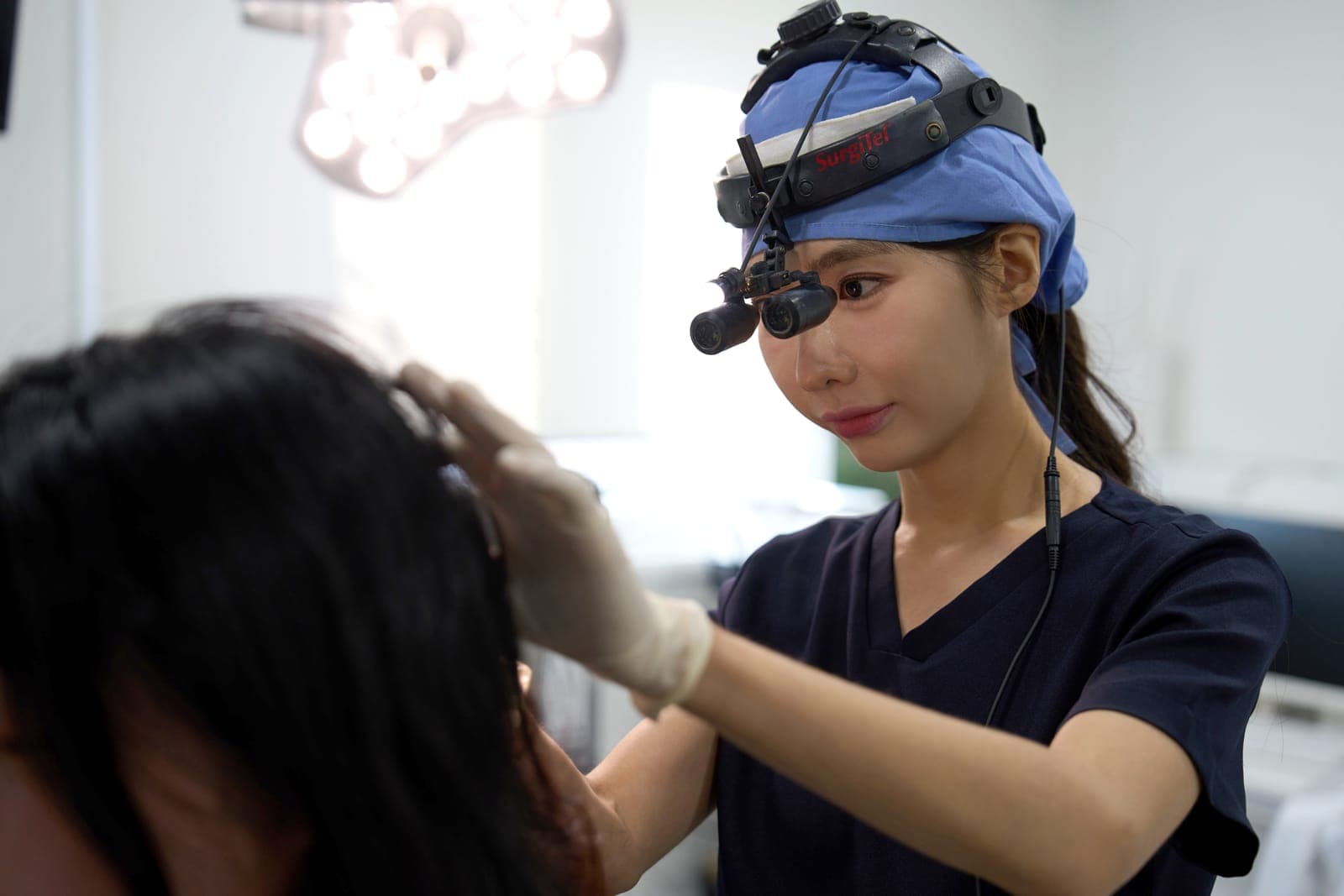
MODI'S SURGICAL PROCEDURE
In a hair transplant, the outcome is decided at each step
A hair transplant is a cosmetic surgery that harvests healthy follicles from the back of the head and relocates them to the areas that need them. Even with the same follicles, the outcome depends on how they are designed, how they are harvested, sorted, and stored, and where they are implanted. At Modi Hair Plant, our medical team carries out the entire process, from consultation to recovery.
- 01
Pre-op screening and consultation
We take a history of past conditions and current medications, run basic same-day tests, and build a plan tailored to each individual.
- 02
Hairline design
Considering facial proportions and head shape, we draw the line out in person and agree on it with the patient.
- 03
Follicle harvesting
Using a dedicated punch, we harvest follicles from the back of the head one by one, with a shaving method suited to the patient.
- 04
Follicle sorting
After harvesting them all, we sort them by thickness and number of strands under a high-magnification microscope.
- 05
Follicle preservation
We cool the follicles in a dedicated cooler and keep them in preservation solution to maintain their condition until just before implantation.
- 06
Implantation and recovery
We implant along the designed line, matching direction, angle, and density, and manage the course of recovery.
PRE-OP SCREENING
Pre-op screening — the starting line for graft survival
A hair transplant is not an emergency procedure, and it is more favorable for graft survival when the body is in its best condition. For this reason we ask about past medical history before surgery and check fasting blood glucose, blood pressure, and other values on the day; if fasting glucose is high, we check HbA1c (the average blood glucose over roughly the past three months) on the spot.
Uncontrolled diabetes reduces the capacity for skin healing and blood vessel formation, lowering the graft survival rate and raising the risk of complications. In such cases we advise treating it first and postponing surgery to at least one month later. Gout, hyperlipidemia, fatty liver, blood pressure, and similar conditions allow surgery if they are managed in advance.
DESIGN
Design — we draw it out and decide together
Much of how natural the result looks is decided in the design. We use the proportions of the forehead, nose, and chin as a baseline, but we draw the line out in person according to the head shape and existing density, and then the patient and doctor confirm it together. Even when someone wants to narrow the forehead, drawing it out and covering it with a hand often leads to agreement on an appropriate area. The height and density at the temples also greatly affect the impression, and the design is checked again just before implantation before the transplant begins.
EXTRACTION
Harvesting — shave-free, minimal-shave, line-shave, and full-shave
Whether by incision or non-incision, there is no hair transplant that leaves no scar at all; with the non-incision method, follicles are harvested one by one with a small punch, so it is simply less noticeable. At Modi Hair Plant, we divide the shaving method according to the patient's situation.
| Method | Donor-area handling | Characteristics |
|---|---|---|
| Shave-free | Nothing cut except the harvested follicles | Volume barely decreases, so it is the least noticeable |
| Minimal-shave | Every other hair cut short with a patented dedicated clipper | Volume decreases slightly, but the cost is lower |
| Line-shave | Several line-shaped sections thinly shaved | Hard to see with long hair · used in combination |
| Full-shave | The whole donor area shaved short | Fast to harvest, but the marks show the most |
Full-shave
Line-shave
Minimal-shave
Shave-free
With line-shave, dividing the lines too finely can leave staff-line-shaped scars on the back of the head, so we do not recommend it.
We use a dedicated punch for harvesting. The tough surface of the skin is handled in a high-cutting rotation mode, while the sensitive roots and fat layer are handled in a gentle vibration mode, and the negative pressure of the suction at the top holds the follicle in place so it is extracted uniformly without damage. Because the non-incision method is a time-consuming procedure, we use a dedicated chair so patients can receive it comfortably while lying down and watching video.
SORTING
Follicle sorting — an eight-stage gradation
Harvested follicles vary in both thickness and number of strands. A natural hairline requires creating a gradation by implanting thin follicles with few strands at the front, and thicker follicles with more strands toward the back. At Modi Hair Plant, we sort follicles into roughly eight stages, from thick to thin.
Sorting is done under a high-magnification microscope, holding a clear acrylic plate marked with 50, 80, and 100 ㎛ lines next to the hair to keep the thickness reference consistent. We unify judgments that could vary from person to person with a clear standard, sorting follicles without waste. Commercial sorting containers did not fit either, so we make our own with a 3D printer to match the cell size and add a metal core for good cooling.
PRESERVATION & PLACEMENT
Preservation and implantation — solution over time, aesthetics over speed
Follicles come under stress the moment they leave the body. International expert consensus recommends that when out-of-body storage exceeds 6–8 hours, follicles should be cooled and kept in an organ-transplant preservation solution (Custodiol / HTK). When Modi Hair Plant stored follicles in saline and HTK for 4, 8, and 12 hours at its research institute and compared them by immunofluorescence, cells were better preserved with 8-hour HTK storage than with 4-hour saline storage. Storing them well in the right solution matters more for graft survival than fast implantation.
For this reason, we do not implant while harvesting; instead, we harvest them all, sort them, and then transplant. Implanting while extracting makes it hard to properly sort which follicles should go to the front and which to the back. During implantation, we match direction, angle, and density one by one along the designed line, and for areas with heavy bleeding, areas that had scars, or scalp with complex direction, we prioritize care over speed.
AFTERCARE
Post-op recovery management
Care after surgery is also part of the result. To help the implanted area recover, Modi Hair Plant uses treatments such as PDRN injections, and we check the course of recovery while providing the necessary care and guidance.