
Some people find that their front hair always parts in the same spot, or bends strongly to one side, making it difficult to style in the direction they want.
It is easy to dismiss this as a simple hair habit, but in some cases the cause is actually a cowlick, in which hair grows in different directions around a particular point.
Many people assume a hair whorl exists only at the crown, but whorl-like hair flow can also appear in the front hair and the frontal hairline.
In such cases, a hairline hair transplant is difficult to approach simply as filling in empty areas.
It is also necessary to examine which direction the existing hair is growing in, at what angle it emerges from the scalp, and what overall flow it forms.
In this article, based on an actual hairline correction case involving a frontal whorl and cowlick, we will explain what a cowlick is and why hair direction and angle are important in hairline hair transplants where a cowlick is present.
Key Summary
- A cowlick is a hair growth pattern in which hair grows in different directions around a particular point, creating a distinctive flow.
- Cowlicks can appear not only at the crown but also in the front hair and hairline.
- In hairline hair transplants where a cowlick is present, it is important to consider not only the height and shape of the hairline but also the Direction, Angle, Curl, and overall Flow of the existing hair.
- If the direction of the existing hair and the direction of the transplanted hair are not in harmony, an unnatural flow may result even if a sufficient number of hairs is transplanted.
- The no-shave non-incision hair transplant (Long Hair FUE) performed at Modi Hair Plant is a method of harvesting and transplanting hair follicles while the hair is kept long.
- A cowlick itself is not a medical condition, so the goal is not necessarily to eliminate it; what matters is analyzing the flow of the existing hair and planning so that the entire hairline connects naturally.
Can a Whorl Appear at the Front of the Hair?
Yes, it can.
When we hear the word "whorl," we usually think of the swirl-shaped hair at the crown.
However, the pattern of hair growing in multiple directions around a particular point does not appear only at the crown.
In the front hair or frontal hairline as well, hair direction may split or bend strongly to one side.
The term cowlick is used to describe this kind of hair growth pattern.
When a cowlick is present, a particular area may repeatedly part or stick out to one side even after combing or blow-drying.
Therefore, when planning a hairline hair transplant, rather than simply checking the width of the forehead or the degree of M-shaped recession, it is also necessary to examine which direction the remaining hair is currently growing in.
What Is a Cowlick?
A cowlick refers to a hair growth pattern in which hair grows in a direction different from the surrounding hair, creating a characteristic flow.
Put simply, the hair does not all go in the same direction but parts or bends around a particular area.
What is important is that a cowlick itself does not indicate a medical condition or hair loss.
Just as the shape of the hairline differs from person to person, the direction and angle of hair growth also vary between individuals.
The issue arises when new hair needs to be transplanted into an area with a cowlick.
What would happen if the existing hair is growing in the ↗ direction, but the newly transplanted hair is uniformly placed in the ↑ direction?
Even if each hair grows normally, when viewed as a whole, the existing hair and the transplanted hair may appear to move in different directions.
Therefore, in a hairline with a cowlick, the process of first identifying the growth direction of the existing hair is important.
CASE. Hairline Correction Case with a Frontal Whorl and Cowlick (12 Months After Hair Transplant)
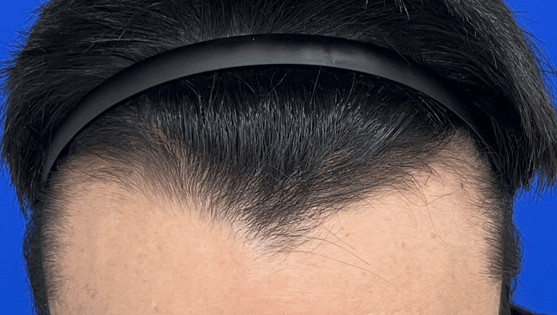
In this case, a whorl-like hair flow and a cowlick were observed in the frontal hairline.
Rather than looking only at the shape of the hairline, we also checked which direction the existing front hair was growing in and at which point the hair flow divided.
In a hairline with a cowlick, the existing hair does not grow in only one consistent direction.
Therefore, rather than applying a standard hairline shape as is, the design needs to take into account how the direction of the currently existing hair will connect with the new hairline.
Why Is 'Direction' Important in Cowlick Hair Transplants?
In hairline hair transplants, the number of hairs is not the only factor that determines a natural look.
Even when the same number of hairs is transplanted in the same location, the overall impression may differ depending on the direction and angle at which the hairs are placed to emerge.
This difference can become even more important in cases like a cowlick, where changes in the direction of existing hair are pronounced.
In the field of hair transplantation, considering the growth direction and angle of the existing hair has also been treated as an important principle for achieving natural results.
In the hairline, the following four elements can broadly be examined.
1. Direction — The Direction of the Hair
This refers to the direction in which the hair grows.
The natural hair direction may differ between the central hairline, the lateral hairline, and the temple area.
If there is a cowlick, these directions may change in an even more complex way around a particular point.
2. Angle — The Angle at Which the Hair Emerges
Even when pointing in the same direction, hair that grows lying close to the scalp and hair that grows relatively upright create a different visual appearance.
Therefore, the angle at which the hair emerges from the scalp is as important as the direction.
3. Curl — The Curl of the Hair
The natural bend of the hair itself also affects the actual hairstyle.
Depending on whether the hair is straight, gently wavy, or strongly curled, the flow that is actually visible may differ even when transplanted in the same direction.
4. Flow — The Overall Flow of the Hair
The overall Flow is what is ultimately created when elements such as Direction, Angle, and Curl come together.
What ultimately matters in cowlick hairline correction is not the direction of any single hair, but the overall flow that the existing hair and transplanted hair will create together.
Cowlick Correction Differs from a Hair Transplant That Simply Fills Empty Areas
In hair transplant consultations, people often ask, "How many hairs do I need to have transplanted?"
Of course, it is important to calculate the extent of hair loss and the required density to plan an appropriate transplant amount.
However, in a hairline with a cowlick, it is difficult to explain the surgical plan by the number of hairs alone.
This is because if the existing front hair flows to one side but the newly transplanted hair is placed in a completely different direction, an unnatural boundary may form between the existing hair and the transplanted hair.
Therefore, in a hairline with a cowlick, one must consider not only
where to transplant
but also
in which direction and at which angle to connect with the existing hair
together.
No-Shave Non-Incision Hair Transplant (Long Hair FUE) and Hair Direction
Modi Hair Plant performs the no-shave non-incision hair transplant (Long Hair FUE), in which hair follicles are harvested and transplanted while the hair is kept long.
Long Hair FUE is an FUE method in which follicular units are harvested while the donor area hair is kept long rather than being shaved short.
What matters here is not merely the fact that 'the hair is not cut.'
When long hair is maintained, it can be used to observe the external characteristics of that hair, such as direction, curl, and thickness.
Especially in cases like a cowlick, where the direction and flow of hair must be considered, checking these hair characteristics can serve as a reference in making a transplant plan.
However, Long Hair FUE is not equally necessary for every patient.
The appropriate surgical method for each individual should be determined after a comprehensive evaluation of the number of hairs to be transplanted, the condition of the donor area, the density and thickness of the existing hair, the extent of hair loss, and other factors.
CASE. What Is Checked After Correction?
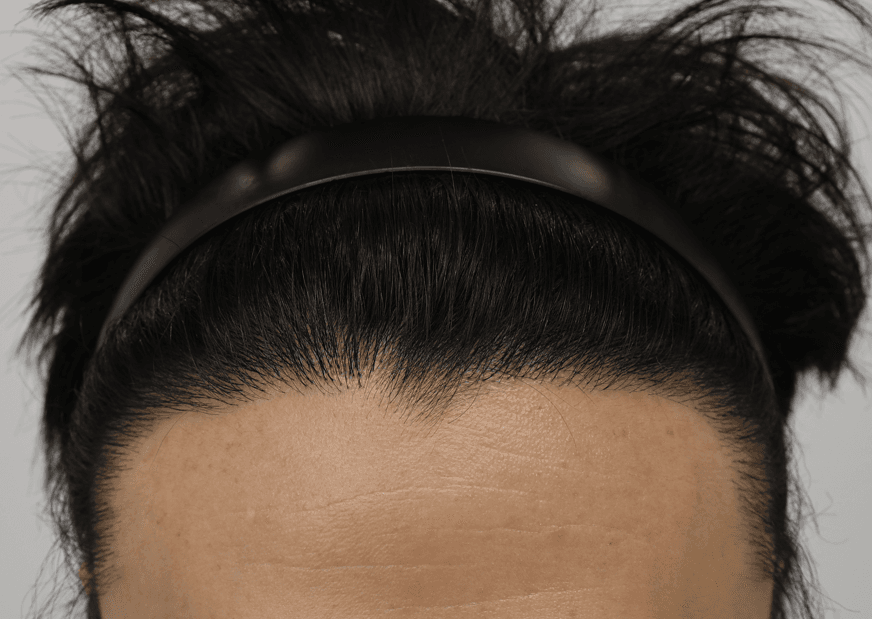
After correction, we do not simply check how far the hairline has been lowered.
We also check in which direction the hair around the existing cowlick connects with the newly transplanted hair, and how the hair flow continues across the entire hairline.
Because the location and direction of the cowlick, the angle and thickness of the existing hair, and the shape of the hairline differ from person to person, the same design or transplant direction cannot be applied to every patient with a cowlick.
Ultimately, what matters is first understanding the characteristics of the hair the patient originally has.
A Cowlick Does Not Necessarily Need to Be Eliminated
A cowlick is not a medical condition but one of the natural hair growth patterns an individual may have.
Therefore, having a hair transplant does not mean the cowlick itself must necessarily be eliminated.
In some cases, it may actually look more natural to keep the existing cowlick while supplementing the surrounding sparse areas.
Conversely, if the cowlick makes the flow of the hairline or front hair appear strongly divided, methods of supplementing the overall flow can be considered, taking into account both the current hair condition and the desired hairstyle.
Therefore, the important question is closer to
"How should the flow of the existing cowlick be interpreted and naturally connected with the newly transplanted hair?"
rather than
"Can the cowlick be eliminated?"
A Hair Transplant Is Not Determined by 'How Many Hairs' Alone
In hair transplantation, calculating the required number of hairs is important, but transplanting the same number of hairs does not produce the same appearance for everyone.
This is because each individual differs in
- Density of existing hair
- Hair thickness
- Number of hairs per follicle
- Extent of hair loss
- Donor area condition
- Hair direction
- Angle at which hair emerges
- Curl and overall flow
and more.
In particular, when correcting a hairline where existing hair remains, one must also consider how the newly transplanted hair will connect among the existing hair.
This cowlick case can be said to illustrate why the direction and flow of hair must be examined in hair transplantation, not just the simple 'number of hairs.'
Cowlick Hairline Hair Transplant FAQ
Q1. Can a whorl appear at the front of the hair?
Yes. A pattern in which hair grows in multiple directions around a particular point can appear not only at the crown but also in the front hair or hairline. This characteristic hair growth pattern is referred to as a cowlick.
Q2. If I have a cowlick, can I not have a hair transplant?
A cowlick itself is not a reason a hair transplant cannot be performed. However, it is important to check the growth direction and angle of the existing hair, the location of the cowlick, the extent of hair loss, and other factors in order to plan the transplant direction and hairline.
Q3. Can a hair transplant completely eliminate a frontal whorl?
It is difficult to completely change the growth direction of the existing hair itself through a hair transplant. Therefore, after analyzing the flow of the existing hair, it must be determined on an individual basis whether to maintain and supplement it, or to adjust the overall flow through the newly transplanted hair.
Q4. Are the no-shave non-incision hair transplant and Long Hair FUE different procedures?
At Modi Hair Plant, the Long Hair FUE method, in which hair follicles are harvested while the hair is kept long, is described as the no-shave non-incision hair transplant. The donor area hair is not shaved short, and follicular unit harvesting is performed using the FUE method.
Q5. If my front hair keeps parting to one side, is it always a cowlick?
Not necessarily. Parting of the front hair can be influenced by various factors, including not only the growth direction of the hair but also hair length and thickness, hairstyle, and the density of the existing hair. Whether a cowlick is present and whether a hair transplant is needed should be determined after examining the actual hairline and hair growth direction.
References
- Unger WP. Recipient Area Hair Direction and Angle in Hair Transplanting. Dermatologic Surgery. 2004;30(6):829-836.
- Park JH. A novel concept for determining the direction of implanted hair in hairline correction surgery in East Asian women. Archives of Plastic Surgery. 2018;45(3):292-294.
- Rodríguez Tamez G, Jiménez F. Long-hair FUE: advantages and disadvantages of the most recent technique in hair transplantation. Actas Dermo-Sifiliográficas. 2026.
Summary — A Natural Hairline Takes the Flow of Hair into Account
When there is a cowlick or whorl in the front hair, a hairline hair transplant is difficult to explain simply as filling in empty space.
It is necessary to examine where the existing hair starts and in which direction it flows, as well as how the newly transplanted hair will connect with that flow.
Therefore, in cowlick hairline correction, what matters is not only the height and shape of the hairline but a plan that comprehensively considers the direction, angle, curl, and overall flow of the hair.
Since the form of the cowlick and hair characteristics differ for each individual, the actual surgical method, transplant direction, and required number of hairs should be determined through diagnosis by the medical team.
How Many Hairs Do I Need for a Hair Transplant?
The required number of hairs may vary depending on the extent of hair loss and the condition of the existing hair.
[Check your estimated number of hairs with the AI Hair Count Calculator]
This article was reviewed by the medical team before publication.