
Female Hairline · Video Commentary by Director Lee Yujin
Not How Much to Lower the Forehead, but Which Line Suits You
When considering a female hairline hair transplant, the first question that usually comes to mind is, “How much can my forehead be reduced?” However, the design is not determined by forehead height alone. Facial and head proportions, the connection to the temples, and density harmony with existing hair must all be considered together.
Based on the consultation process and the case of a woman in her 40s explained in Modi Hair Plant Director Lee Yujin’s video, we have summarized what to check when deciding on a hairline design.
Key Summary
- How the line actually looks when drawn matters more than a fixed ratio. The same height can look different depending on the face and head shape.
- The central forehead and temples are assessed together. The connection of the side lines and a density that suits existing hair are also considered.
- The patient and medical team decide after checking multiple times. The 2-week post-op photos in the video are material for reviewing the design and early progress, not the final result.
1. Is There a Correct Ratio for Female Hairline Design?
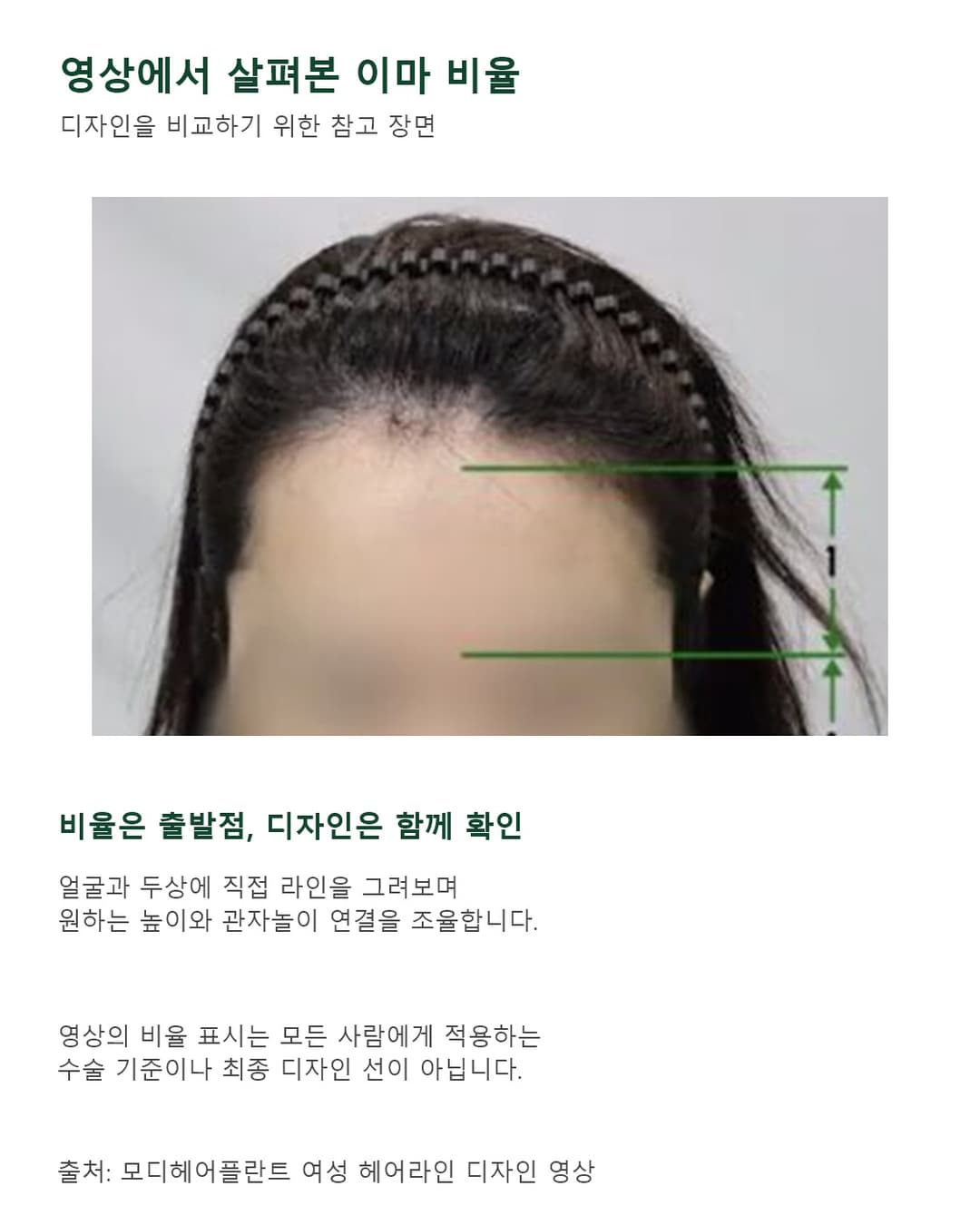
In the video, Director Lee Yujin explains the proportions of the forehead, nose, and chin as the starting point of the design. However, a specific number is not applied identically to everyone.
This is because even when a hairline is drawn with the same ratio, it can look different depending on the curvature of the head, the face shape, and the existing hairline. After deciding on the desired forehead height, it is necessary to actually draw the line and check whether it harmonizes with the face as a whole.
Ratios such as 1:1 and 0.9:1 shown in the video are references for comparing designs. They do not represent an ideal ratio or surgical standard that applies to everyone.
“As Low as Possible” and “Suited to My Face” Can Be Different
Even if you wanted to reduce your forehead significantly before the consultation, your thoughts may change when you see the line actually drawn. The video also describes cases where, when the drawn area is covered by hand to check, it appears narrower than expected.
Therefore, rather than deciding immediately on a single desired height, it is advisable to compare options with slightly different heights. This process reflects both the medical team’s suggestions and your own preferences.
2. Is the Design Complete Just by Lowering the Central Forehead?
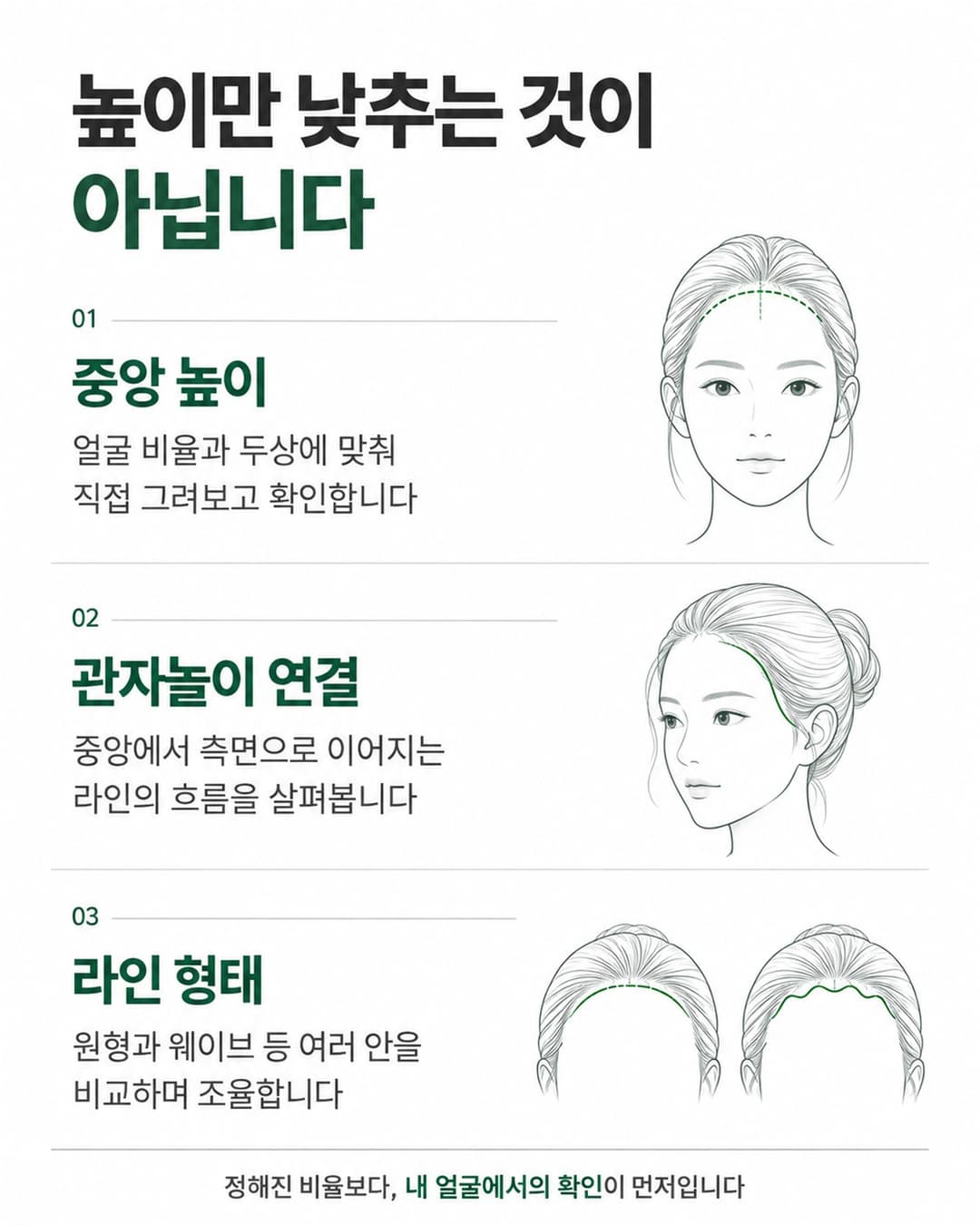
For a female hairline, not only the front center but also the shape extending to the temples on both sides is important. The video explains that the overall style can differ depending on how far down the temples are brought and connected.
Forehead Height and Overall Proportion
We check at what height to place the central hairline and whether that position suits the face and head shape. Rather than only setting a number, we also review how the drawn line looks.
Temple and Side Line Connection
We compare the shapes extending from the center to both sides. The desired look is adjusted while also considering the sides that are exposed when the hair is tied back.
The Density of Existing Hair and the Transplant Area Is Also Reviewed
Even if you like the hairline position, a large density difference between existing hair and the newly filled area can make the boundary noticeable. In the case in the video, the density of the existing hairline and the occipital area was relatively good, so the transplant plan was made considering harmony with the surrounding hair.
However, simply increasing density or the number of transplanted hairs is not the answer. The plan should be made after checking individual conditions such as the required area and the condition of the donor area.
3. Case in the Video: A Woman in Her 40s Who Wanted to Tie Her Hair Back
The patient introduced in the video is a woman in her 40s who had a relatively wide forehead since birth. She wanted to sweep her hair back and tie it, but found it difficult to try the style she wanted due to concerns about her forehead.
In this case, instead of simply lowering the forehead as much as possible, several heights were drawn and the temple connection was adjusted together.
| Item Checked | Explanation in the Video |
|---|---|
| Patient’s Concern | Congenitally wide forehead; hesitation about styles with hair swept back and tied |
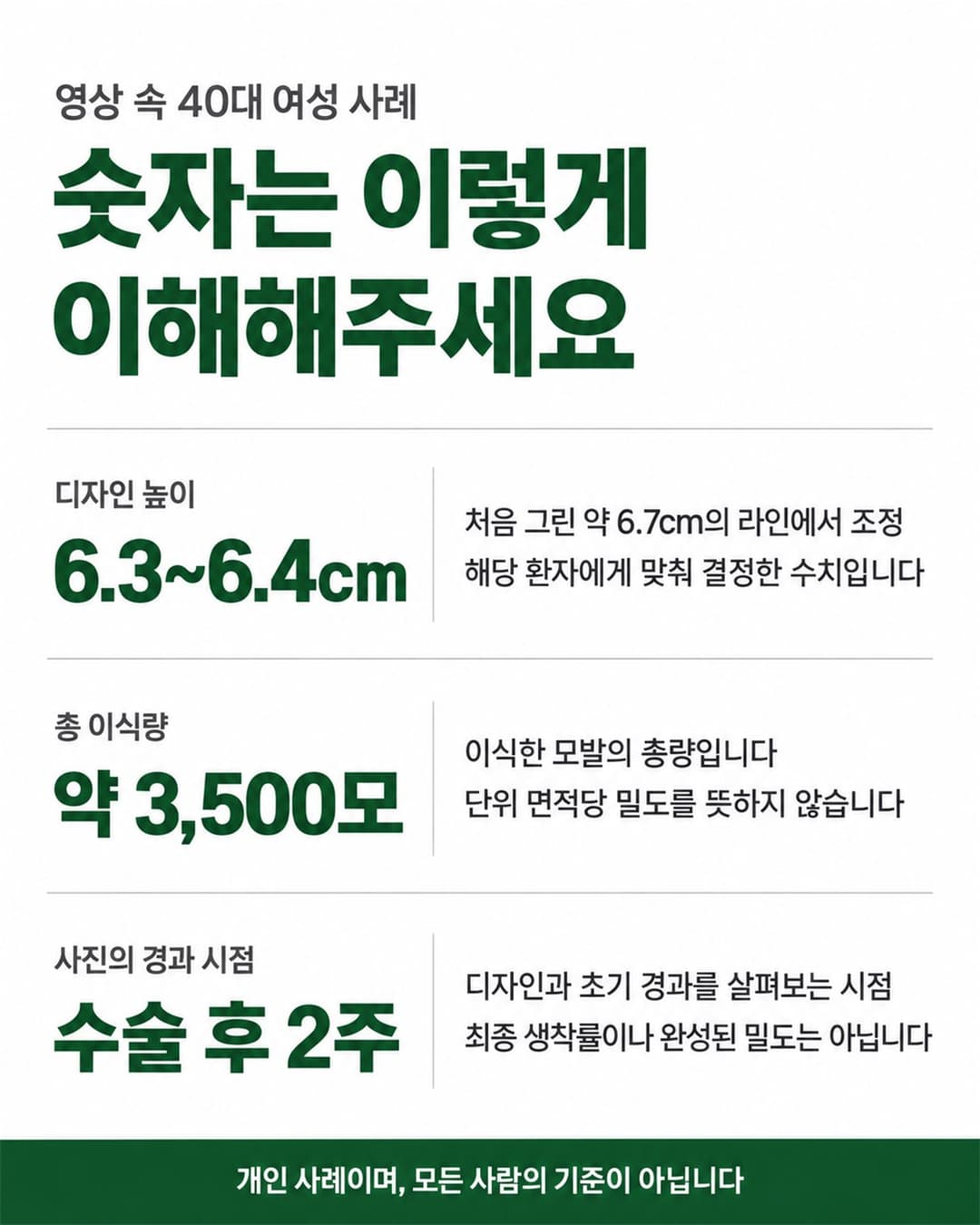
| First Drawn Design | Line drawn and checked based on a forehead height of approx. 6.7cm |
| Adjusted Design | Line adjusted to approx. 6.3–6.4cm, with the temple connection also checked |
| Number of Transplanted Hairs | Approx. 3,500 hairs |
| Progress Shown in the Video | Early progress at 2 weeks after surgery |
6.7cm is not the actual pre-surgery forehead height but the height of the first drawn design. Therefore, the actual amount by which the forehead was lowered cannot be calculated from the difference between this number and 6.3–6.4cm. In addition, 3,500 hairs is the total number of transplanted hairs in this case and does not mean the same as transplant density or the number of follicles.
4. What Can Be Seen in the Actual Pre-Surgery and 2-Week Photos?
The images below are captures of an actual case shown in the video. By comparing the pre-surgery hairline with the transplant area at 2 weeks after surgery, you can see which area was filled and the shape of the early line.
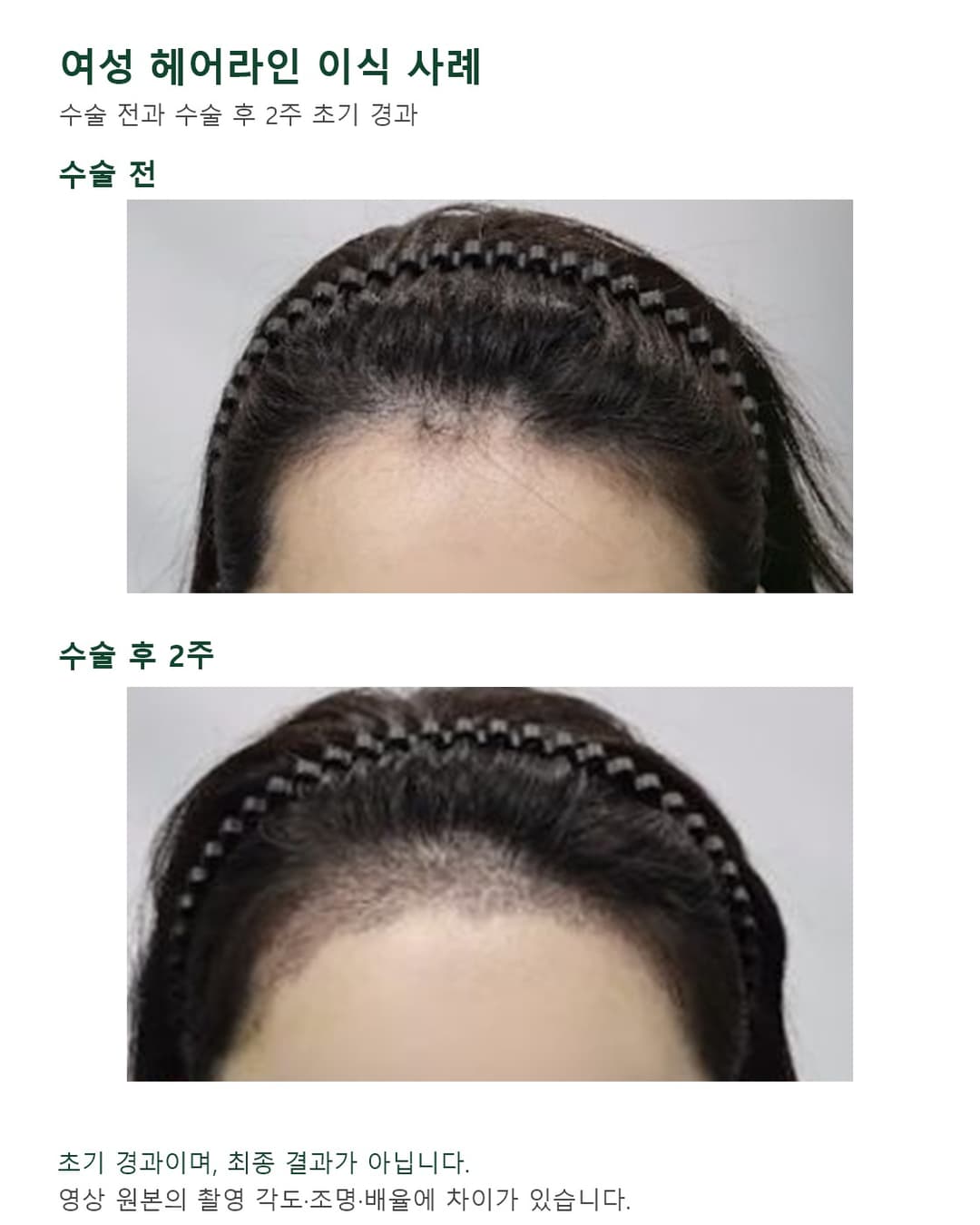
Looking at the 2-week photos in the video, Director Lee Yujin explains that shading appears in the transplant area and that one can anticipate the shape once the hair grows in.
However, the final density or graft survival rate should not be judged from photos at this stage alone. They should be viewed as material for checking the initial design and recovery status, and the subsequent growth progress should also be observed.
5. Is the Design Checked Only Once Before Surgery?
In the case in the video, after the line was drawn, the medical team and patient first checked it, and after the harvesting was completed, the design was checked again just before transplantation. Director Lee Yujin explains that during this process, they reviewed the design together two or three times.
- Describe the look you want. Share not only the forehead height but also how you tie your hair and what has bothered you day to day.
- Draw several lines directly. Compare different heights, curves, and temple connections.
- Check the overall appearance in a mirror. Don’t look only from the front; also check the side lines and the impression when the hair is swept back.
- Reach a final agreement before transplantation. Proceed after understanding both what you want and the limitations explained by the medical team.
You do not need to come with your desired design set in exact numbers from the start. The video also explains that the patient’s thoughts are heard first, and several options are drawn to find a direction the patient is satisfied with and the medical team can also agree to as a surgical plan.
6. Before a Female Hairline Consultation, Try Preparing Like This

- Identify what bothers you most. Try distinguishing whether it is the central forehead height, the empty spaces on both sides, or the line exposed when your hair is tied.
- Tell us your usual hairstyle. Letting us know whether you wear bangs, part your hair, or want to tie it all back helps in discussing the design.
- Prepare reference photos as material to explain the look you want. Rather than applying someone else’s line as is, it needs to be adjusted to fit your face.
- Ask the reason for the proposed number of hairs. Check which area will be filled and how the plan aims to match density with existing hair.
- Check when progress photos were taken. Distinguish between photos taken immediately after surgery or at 2 weeks and long-term progress photos.
Frequently Asked Questions
If the line drawn during consultation looks too low, can it be changed?
If you are at the stage of adjusting the design before transplantation, you can discuss what you want again and compare different heights. In the video as well, the first drawn option was not finalized as is; the height and temple connection were adjusted. If something feels uncomfortable, please explain it specifically before the final check.
My central forehead is fine and only the sides look wide. Does the center need to be lowered too?
The center does not necessarily have to be lowered as well. It is possible to consider how to change the side connections while maintaining the central height. However, the decision should be made after drawing directly how the overall line connects when only some areas are filled.
If I have 3,500 hairs transplanted as in the video, will I get a similar hairline?
The same number of transplanted hairs does not produce the same result. This is because the area to be filled, the density and thickness of existing hair, the condition of the donor area, and the desired line all differ. The 3,500 hairs in the video is that patient’s plan, and in a consultation it is important to check the basis for the number of hairs proposed to you.
If the 2-week post-op photos look dense, will that appearance be maintained?
The 2-week photos should not be interpreted as meaning the final density will be maintained as is. The video also presents them as early progress for anticipating the shape once the hair grows in. The final shape and density should be evaluated by observing the subsequent growth process.
If my desired design differs from the medical team’s recommendation, what should the decision be based on?
It is advisable to identify specifically where the opinions differ. Draw the central height, curve, and temple connection differently for each, and discuss the desired impression together with surgical considerations. The approach explained in the video is also a process of directly comparing several options to find common ground.
Female Hairline Design Is About ‘How It Suits You’ More Than ‘How Many cm’
Before asking how much your forehead can be lowered, check whether the line suits your face and head shape. The key point of this video is to review the central height, temple connection, and density harmony with existing hair together, and to thoroughly check the design drawn directly.
If You Wonder Whether the Hairline You Have in Mind Would Suit You
Tell us your desired style and what concerns you most. At Modi Hair Plant, after checking your face and head shape, existing hair, and donor area condition, we consult with you on applicable designs and a transplant plan.
Source
Modi Hair Plant YouTube, Director Lee Yujin. “This Is How We Proceed Considering Hairline Design Proportions I Female Hairline Hair Transplant I”. This article was reconstructed based on the explanations and publicly shown case in the video.
This article is provided for general medical information and does not replace individual diagnosis or treatment planning. The case introduced is the progress of one patient and does not guarantee the same result for all patients. After a hair transplant, pain, swelling, inflammation, scarring, changes in sensation, and other effects may occur, and treatment suitability and method are determined after consultation.
See It in Director Lee Yujin’s Video
In the original video, you can see why the design is adjusted by actually drawing lines, as well as the explanation of the female hairline case.