
“How much area can a 3,000-hair transplant cover?”
One of the most common questions when looking into a hair transplant is “how many hairs do I need?” In particular, a 3,000-hair transplant is a figure frequently encountered by those considering M-shaped hair loss or hairline correction.
However, the same 3,000 hairs does not mean the same transplant area or a similar change for everyone.
This is because how 3,000 hairs are distributed and where they are placed can differ depending on factors such as the extent of hair loss, the density and thickness of existing hair, the desired hairline design, the presence of scars, and the condition of the occipital donor area.
Today, through 5 actual cases of 3,000-hair transplants performed at Modi Hair Plant Clinic, we will look at how 3,000 hairs can be used — from M-shaped hair loss to male and female hairline correction, and cases with scars.
Key Summary|A 3,000-hair transplant: how much does it cover?
- 3,000 hairs does not mean the same transplant area for everyone.
- Depending on the purpose and area of the transplant — such as the M-shaped area, hairline, or scars — the way hairs are distributed can differ.
- Even with the same 3,000 hairs, the visual change may appear different depending on the density and thickness of existing hair, the transplant area, and the hairline design.
- The number of hairs needed should be determined by evaluating not only the recipient area but also the condition of the occipital donor area.
Can 3,000 hairs fill in the entire M-shaped area?
To answer first: it varies from person to person.
Even with the same M-shaped hair loss, the area requiring transplantation differs between a case where both M-shaped corners have receded slightly and a case where hair loss has progressed widely into the frontal area.
In addition, the number of hairs needed may vary depending on how much existing hair remains, whether the hair is thick or fine, and how far forward you wish to correct the hairline.
Therefore, rather than uniformly calculating that “3,000 hairs can cover a certain area,” the assessment should be based on each individual’s hair loss condition and desired design.
CASE 01. A 3,000-hair transplant filling in the M-shaped line
First is the 3,000-hair case for M-shaped hair loss, which is the most commonly asked about.
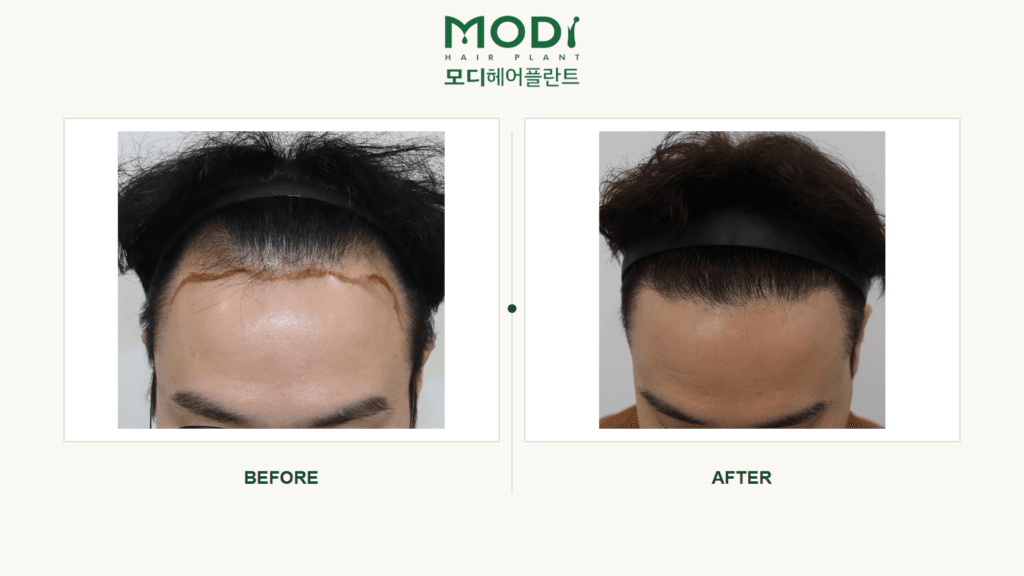
▲ Before and after a 3,000-hair transplant on the M-shaped line
In this case, 3,000 hairs were distributed mainly across both M-shaped areas to supplement the hairline.
Even with the same M-shaped hair loss, the required transplant area and number of hairs can vary depending on the position of the existing hairline, the depth of the M-shape, and the condition of existing hair in the central area.
CASE 02. A 3,000-hair transplant for male hairline correction
A hair transplant is performed not only to fill areas where hair loss has progressed, but also for the purpose of hairline correction, which supplements the shape of the existing hairline.
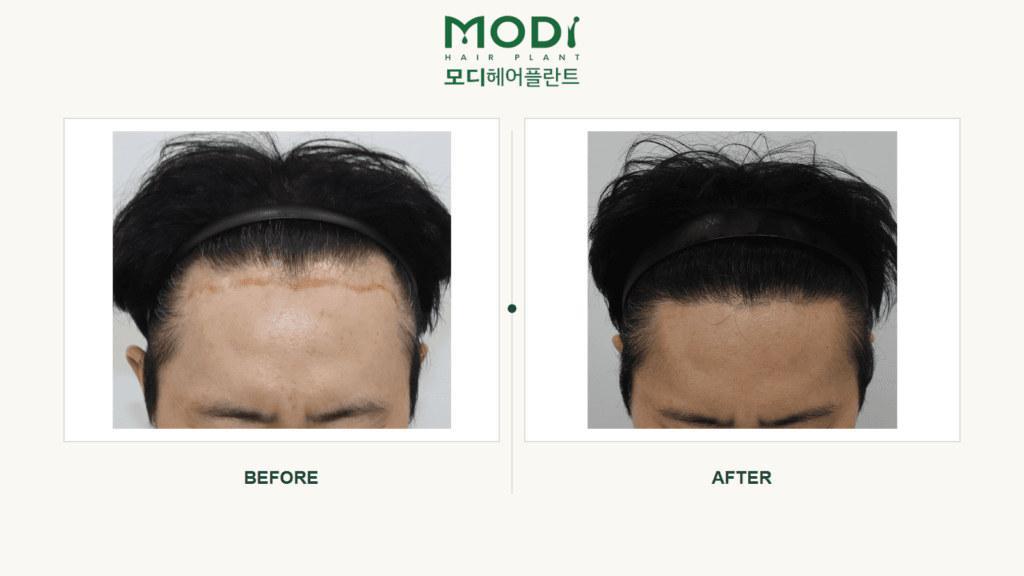
▲ Before and after a 3,000-hair transplant for hairline correction
In hairline correction, rather than simply transplanting a large number of hairs, it is necessary to also consider a design that takes the face shape and existing hairline into account, the direction and angle of the hairs, and a natural connection along the front line.
Therefore, even with the same 3,000 hairs, the way hairs are distributed can differ between a case that intensively supplements a deep M-shaped area and a case that corrects a wide hairline.
CASE 03. 3,000 hairs addressing both an old scalp scar and M-shaped hair loss
The third is a case that differs somewhat from typical M-shaped hair loss.
About 20 years ago, the frontal scalp was lacerated and sutured, leaving a scar. As hair loss subsequently progressed, a 3,000-hair transplant was planned taking both the frontal scar area and the M-shaped area into account.
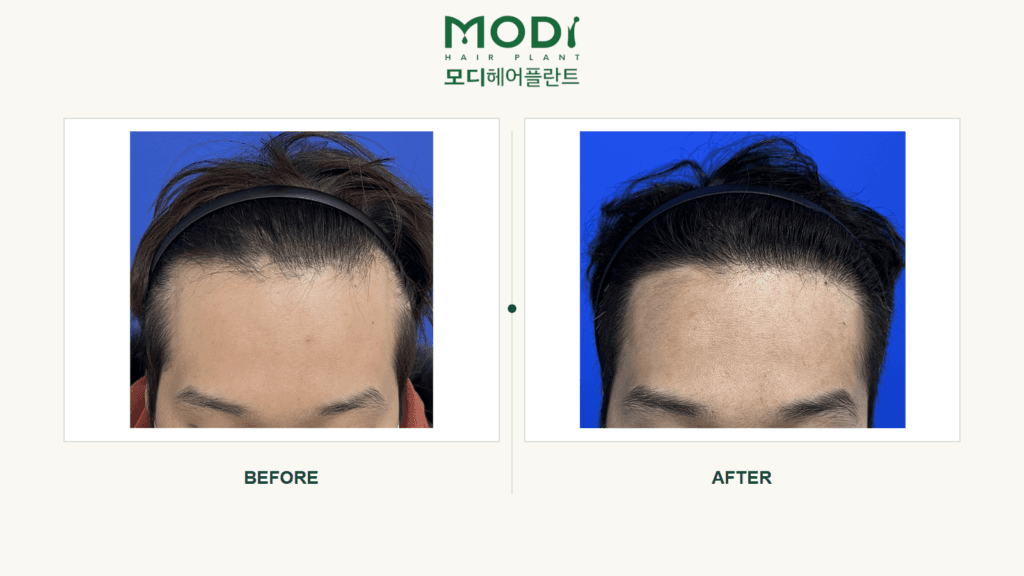
▲ Before and after a 3,000-hair M-shaped transplant including the frontal scar area
Rather than approaching a scarred area the same way as normal scalp, a hair transplant in such an area requires a process of checking the location and width of the scar and the condition of the tissue before determining whether transplantation is possible and to what extent.
In other words, the scope of surgery is not determined by the figure of 3,000 hairs alone; the condition of the recipient scalp can also be an important factor in the surgical plan.
CASE 04. A case combining a 3,000-hair M-shaped transplant with crown treatment
Hair loss does not necessarily progress in only one area. In some cases, hair becomes thinner or density decreases in both the M-shaped area and the crown at the same time.
In this case, a 3,000-hair transplant was performed on the M-shaped area, while a separate stem cell treatment was planned for the crown area.
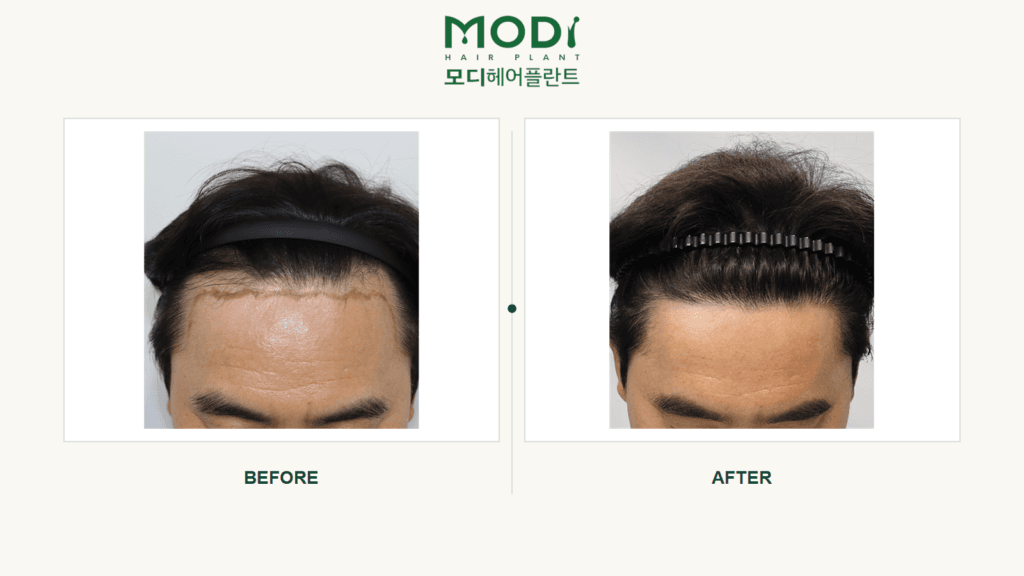
▲ Case of a 3,000-hair M-shaped transplant and crown treatment
When the area of hair loss is wide, rather than approaching every area in the same way, it is possible to distinguish the areas requiring a hair transplant from those for which a separate treatment will be planned, taking into account the condition of existing hair.
However, since the applicable treatment methods and plans may vary depending on the type and extent of hair loss and the condition of the scalp and hair, a diagnosis by medical staff is required.
CASE 05. A 3,000-hair transplant correcting a female hairline
A 3,000-hair transplant may be planned not only for male M-shaped hair loss but also for female hairline correction, according to each individual’s transplant area and design.
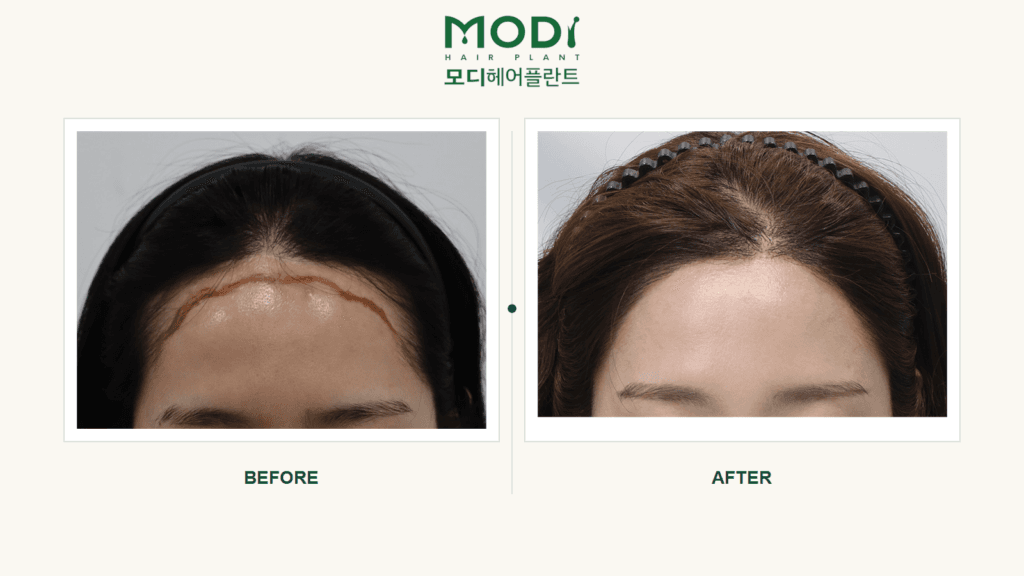
▲ Before and after a 3,000-hair transplant for a female hairline
In female hairline transplants, rather than simply narrowing the forehead, it is important to design a line that connects naturally, taking the face shape and the form of the existing hairline into account.
In particular, the frontmost part of the hairline requires consideration of the direction and angle of the hairs, as well as their thickness and placement, so that it connects naturally with the existing hair.
Even with the same 3,000 hairs, the transplant area and the method of distributing hairs can differ between a case focused on a man’s deep M-shaped area and a case correcting the overall shape of a woman’s hairline.
Why do results look different with the same 3,000 hairs?
The five cases reviewed above were all based on 3,000 hairs, but the purpose and area of transplantation differed from one another.
- 3,000 hairs mainly supplementing the M-shaped hair loss area
- 3,000 hairs correcting the shape of a male hairline
- 3,000 hairs taking both an old scalp scar and the M-shaped area into account
- A case planning a hair transplant for the M-shaped area and a separate treatment for the crown
- 3,000 hairs supplementing the shape and design of a female hairline
Ultimately, the key point about 3,000 hairs lies not in the number itself, but in “where and how they are distributed.”
1. The area to be transplanted
Even with the same 3,000 hairs, the visually perceived density can differ between concentrating the transplant in a narrow area and distributing it across a wide area.
2. The density of existing hair
The amount of transplantation needed and the method of placing the hairs can also vary depending on how much existing hair remains in the recipient area.
3. Hair thickness and characteristics
Hair thickness and curl, as well as the color contrast between the scalp and hair, can also affect the visual density after a hair transplant.
4. The desired hairline design
The area to be transplanted and the number of hairs may also vary depending on how far the hairline is to be corrected and to what extent the M-shaped area is to be supplemented.
5. The condition of the occipital donor area
In a hair transplant, not only the recipient area but also the condition of the occipital donor area from which hair follicles are harvested is important.
It is necessary to use the donor area in a planned manner, considering not only the number of hairs currently needed but also the possibility of future hair loss progression and additional surgery.
So, do I also need 3,000 hairs?
Even if your extent of hair loss looks similar to a case seen in before-and-after photos, that does not necessarily mean the same 3,000 hairs are required.
Even when M-shapes look similar, the expected number of hairs can vary depending on the depth and width of the M-shape, the density and thickness of existing hair, and the desired hairline position.
Therefore, if you are considering a hair transplant, one approach is to first check the approximate number of hairs expected for your current extent of hair loss.
※ Results from the hair count calculator are estimates, and the actual number of hairs needed and whether surgery is possible may differ after examination by medical staff and assessment of the scalp and donor area.
3,000-Hair Transplant FAQ
Q. Can a 3,000-hair transplant fill in the entire M-shaped area?
It depends on the depth and width of the M-shape, the density of existing hair, and the desired hairline design. Even with the same 3,000 hairs, the transplant area and density can differ between concentrating the distribution on a relatively narrow M-shaped area and supplementing widely into the frontal area.
Q. Is a 3,000-hair transplant different for men and women?
Rather than gender itself, the extent of hair loss or correction, the existing hairline, face shape, and desired design influence the surgical plan. Even with the same number of hairs, the placement method can differ between concentrating 3,000 hairs on a male M-shaped area and designing an entire female hairline.
Q. Can 3,000 hairs cover both the M-shaped area and the crown?
It depends on the extent of hair loss and the condition of existing hair. If both areas are extensive, rather than dispersing a limited number of hairs across multiple areas, priorities for transplantation may be set or different treatment plans may be considered for each area.
Q. Is a hair transplant possible on a scalp scar?
A hair transplant may be considered depending on the cause, location, and extent of the scar as well as the condition of the tissue. However, since the conditions may differ from normal scalp, medical staff should check the state of the scar before determining whether transplantation is possible and how it will be planned.
Q. Can the required number of hairs be determined from photos alone?
Photos can serve as a reference for the approximate transplant area, but since an actual surgical plan also requires checking hair thickness and density, scalp condition, and the occipital donor area, the final number of hairs may differ after examination.
For a 3,000-hair transplant, distribution matters more than the number
The five cases reviewed here were all based on 3,000 hairs, but the purpose of surgery and the conditions differed — M-shaped hair loss, male hairline correction, an old scalp scar, cases accompanied by crown hair loss, and female hairline correction.
Therefore, when planning a hair transplant, rather than only thinking “how many hairs should I have transplanted?”, it is important to also consider “given my condition, which areas should receive how much?”
It is necessary to establish an individualized surgical plan that comprehensively considers not only the current extent of hair loss but also the condition of existing hair, the occipital donor area, and the possibility of future hair loss progression.
Hair transplant consultation and estimated hair count
- Estimate the number of hairs for a transplant: Go to the hair count calculator
- Modi Hair Plant website: Go to the website
- KakaoTalk consultation: Go to KakaoTalk consultation
References
- Orentreich N. Autografts in alopecias and other selected dermatological conditions. Ann N Y Acad Sci. 1959;83:463-479. https://doi.org/10.1111/j.1749-6632.1960.tb40920.x (Concept of donor dominance and retention of transplanted follicle characteristics)
- Romera de Blas C, Vega Díez D, Ricart Vayá JM, Gómez Zubiaur A. Complications in follicular unit excision hair transplantation: current evidence and practical approaches. Front Med (Lausanne). 2026;13:1750989. https://doi.org/10.3389/fmed.2026.1750989 (Latest evidence on side effects and complications of hair transplantation)
※ The cases introduced in this article are individual treatment cases and do not mean that the same results will occur for all patients. The hair transplant method, number of transplanted hairs, treatment plan, and progress may vary depending on each individual’s hair loss condition, hair characteristics, and the condition of the scalp and donor area.
※ As with all surgical procedures, side effects or individually varying reactions such as swelling, bleeding, infection, pain, and temporary shedding (shock loss period) may occur after a hair transplant. Please confirm the details with medical staff during your consultation.
This article was uploaded after review by medical staff.