“How many hairs should I have transplanted?”
This is one of the questions most frequently asked in the consultation room by people considering a hair transplant. Some patients tell us they were confused after being advised 2,000 hairs at one clinic and told at another that they would need 3,000 hairs or more.
Hello. I am Dr. Yoo Hwa-jung, Director of Modi Hair Plant Clinic.
To start with the conclusion, the number of hairs for a hair transplant is not determined by the area alone. The extent of hair loss, the condition of the remaining hair, and the desired hairline and density all need to be considered together. Today, I will explain the criteria that determine the hair count for a hair transplant, why estimates differ from clinic to clinic, and introduce the AI Hair Count Calculator that I created so you can check your estimated hair count before visiting a clinic.
Key Summary
- The required number of hairs varies not only with the extent of hair loss but also with the density and thickness of existing hair, the design, and other factors.
- If clinics differ in design, target density, and counting units, hair transplant estimates may also differ.
- The AI Hair Count Calculator is a reference tool for understanding an estimated range before visiting a clinic.
- The final transplant plan should be decided after directly examining the condition of the scalp and donor area.
What Is the Hair Count in a Hair Transplant?
In general, the hair count refers to the number of hairs transplanted. However, during consultations, hair counts and follicle (graft) units are sometimes used interchangeably, so it is important to confirm which is meant. This is because a single hair follicle may contain not just one hair but two, three, or more hairs.
Therefore, when comparing information from different clinics, it is advisable not to look at the numbers alone, but to check whether the figures were calculated on the same basis—number of hairs or number of follicles.
How Is the Number of Hairs Needed for a Hair Transplant Determined?
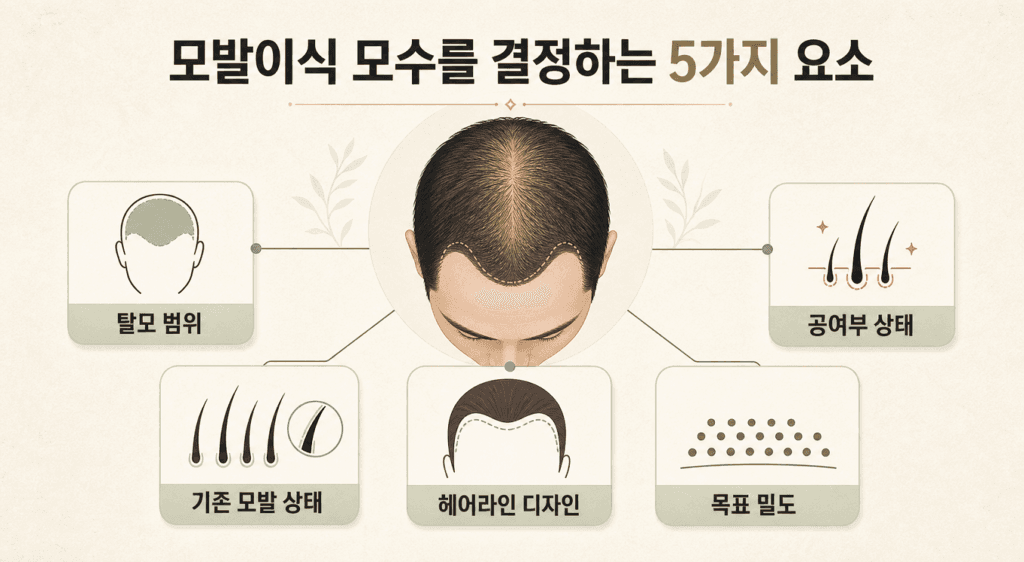
Put simply, the hair count for a hair transplant is calculated based on the area to be transplanted and the density to be supplemented. In actual planning, however, the following conditions are also taken into account.
- Extent of hair loss: The area to be addressed, such as an M-shaped hairline, the hairline, or the crown
- Existing hair condition: Current density and the thickness and direction of the hair
- Desired design: Hairline height and shape, and harmony with the face
- Target density: The desired change and the degree of natural blending
- Possibility of hair loss progression: A plan that considers not only the present but also future changes
- Donor area condition: The amount of hair that can be safely harvested from the back of the head
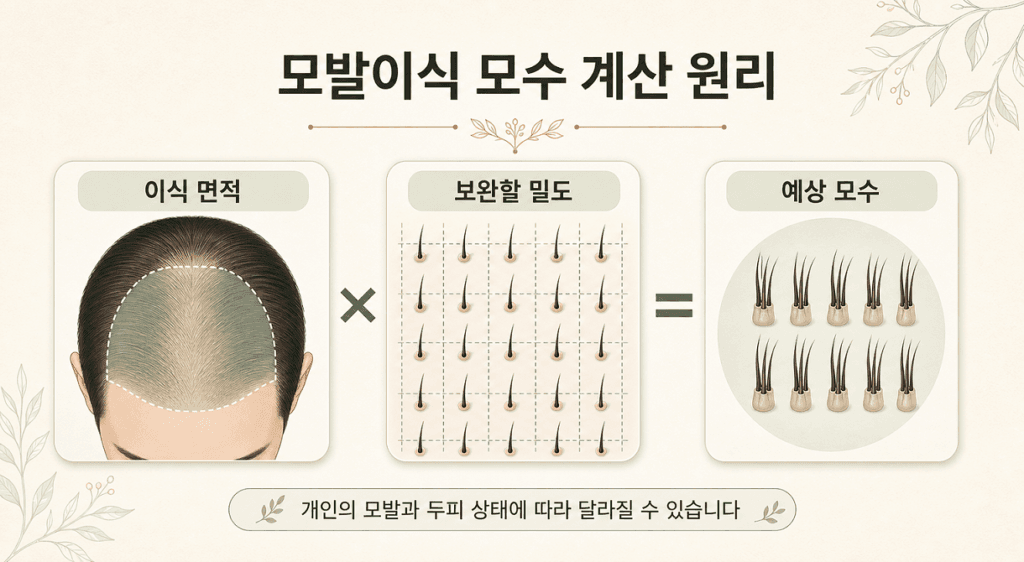
Estimated hair count = Area requiring transplant × Density to be supplemented
Actual planning additionally reflects hair thickness, donor area condition, design, the possibility of hair loss progression, and other factors.
Even when cases look like the same M-shaped hair loss, the required number of hairs varies depending on the width and depth of the forehead, the thickness of existing hair, and the desired hairline. For the crown as well, the direction of the hair whorl and the density among the remaining hairs must be considered, so it is difficult to present a single number as the correct answer based only on photos or the name of the area.
Why Hair Transplant Estimates Differ from Clinic to Clinic
Just because the hair counts quoted by different clinics differ, it is difficult to conclude that one of them is necessarily wrong. This is because the hairline design and target density proposed by the medical team, the approach to preserving existing hair, and the extent to which future hair loss is considered may differ.
In addition, hair transplant costs and estimates may vary depending on whether the unit used is the number of hairs or the number of follicles, the harvesting method such as incision or non-incision, and the scope of the procedure. When comparing multiple estimates, we recommend checking the following items together.
- Is the estimate based on the same transplant area and design?
- Is the quoted number a count of hairs or of follicles?
- What are the harvesting and transplant methods, and what scope of care is included?
- Have the current donor area condition and the possibility of future hair loss been taken into account?
Why I Created the AI Hair Count Calculator Myself

I have often heard that visiting several clinics amid a busy daily life to find out the required hair count, and then comparing differing estimates, is not easy. So I decided to create a tool that lets people check an approximate hair transplant hair count based on their own condition before visiting a clinic.
Although I did not study software development, with the help of AI coding tools I designed the necessary items myself from the perspective of a doctor who treats hair loss and performs hair transplants. Rather than simply presenting an average value, the tool is designed to adjust the estimated hair count by analyzing the areas of concern and the submitted scalp photos.

How Do I Use the AI Hair Count Calculator?
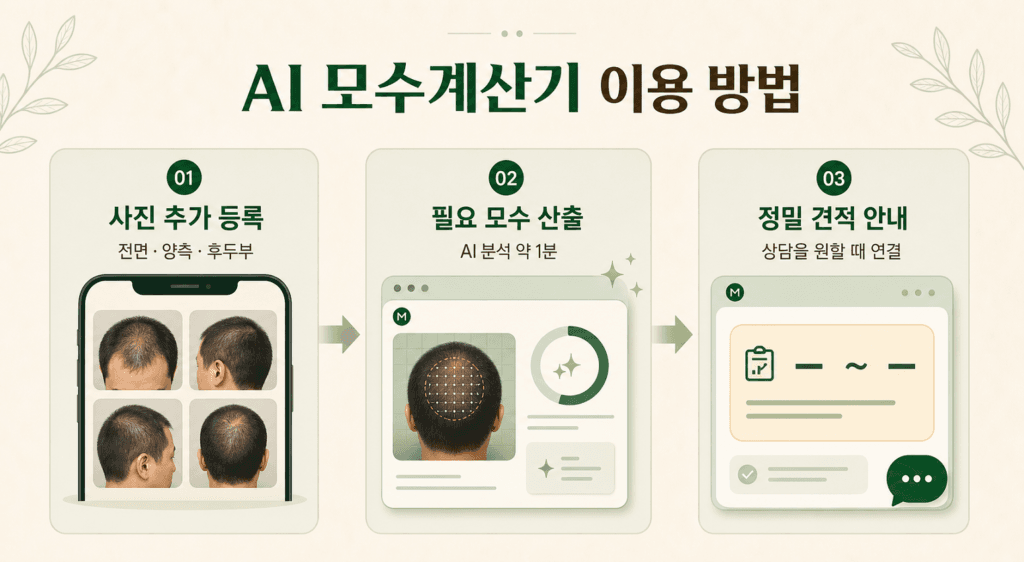
- Select the area you are considering for a hair transplant.
- Submit scalp photos following the instructions.
- The AI analyzes the photos and the conditions you entered.
- Check the estimated hair count and related information.
Submitting photos allows the extent of hair loss and your current condition to be reflected in the analysis. However, results may vary depending on the camera angle, lighting, and whether the hair is wet or flattened, so please use the calculation result as a reference estimate, not a diagnosis or a confirmed quote.
How Are Photos and Personal Information Handled?

No separate personal information is collected at the hair count calculation stage, and the tool is designed so that submitted photos are not stored separately and are used only for analysis. No sign-up or name entry is required to view the results.
If you separately request an estimated cost consultation, you will be asked to enter contact information needed for the consultation, and the clinic may contact you to provide information. Please note the distinction between using only the hair count calculation and requesting a cost consultation.
Calculation Results May Differ from In-Person Consultation Results
It is difficult to fully assess scalp elasticity, hair thickness, donor area density, subtle hair loss progression, and similar factors from photos. Because an in-person consultation examines these conditions together with your desired design, the actual plan may differ from the AI Hair Count Calculator's estimate.
Please use the calculator as a tool to casually answer the question “Roughly how many hairs do I need?” and to prepare for a consultation. Whether to undergo surgery and the final hair count should be decided after examination by the medical team.
Frequently Asked Questions
Q. Can I find out how many hairs I need for a hair transplant from photos alone?
Photos can serve as a reference for the extent of hair loss and your overall condition, but they cannot confirm an exact hair count. A final plan can only be made after directly examining the donor area condition, hair thickness, scalp characteristics, and other factors.
Q. Why do clinics quote different hair counts?
Because hairline design, target density, judgments about hair loss progression, and the units used to calculate the count may differ. When comparing, it is best to first check whether the figure is a count of hairs or of follicles.
Q. Can I decide on surgery based on the AI Hair Count Calculator results?
No. The calculation results are reference material for understanding an estimated range before visiting a clinic. Whether to have surgery and the scope of the transplant should be decided after consulting with the medical team.
Q. Can I also check the cost of a hair transplant?
On the results page, you can view a cost range based on the information entered and the estimated hair count. This is a photo-based reference estimate, and actual costs may vary depending on the required hair count, harvesting method, scope of surgery, and other factors. If you separately request a more detailed cost consultation, the clinic may contact you to provide information.
Q. Are uploaded photos stored?
The tool is designed so that photos submitted for hair count calculation are not stored separately and are used only for analysis.
Check Your Estimated Hair Count First
What matters in a hair transplant is not simply transplanting a large number of hairs, but planning the necessary area and density in consideration of your current condition and donor area.
First, check your estimated range with the Modi Hair Plant AI Hair Count Calculator. If you need a more accurate hair transplant estimate and design, we will directly examine your scalp and donor area and discuss an approach suited to your individual condition.
※ This content is provided for general informational purposes. Eligibility for a hair transplant and specific plans are determined through examination by the medical team.