
Long-Term Hair Transplant Progress · Hair Loss Management After Surgery
Why a Clinic You Can Stay With Long-Term Matters, Even After a Hair Transplant
What does a hair transplant look like 2–3 years later? When reviewing long-term progress, it is important to consider not only the transplanted hairline but also the surrounding existing hair and ongoing hair loss treatment.
A hair transplant is a surgery that relocates hair follicles to areas where hair is lacking. However, the surgery itself does not eliminate the cause of progressive hair loss. In progressive hair loss, treatment for the existing hair and progress check-ups remain important even after surgery.
In this article, we review before photos and photos taken 28, 30, and 34 months after surgery for three different patients, and discuss why, when choosing a clinic for surgery, you should also check whether you can consult with them about future hair loss treatment.
Key Summary
- Hair loss may continue to progress after a hair transplant, so the condition of existing hair should be monitored along with the transplanted hair.
- In progressive hair loss, it is important to continue medication while monitoring response and side effects; treatment methods are determined individually.
- When choosing a clinic, check not only the immediate surgical plan but also subsequent hair loss treatment and progress consultations.
1. Hair Transplant 2–3 Years Later, Seen Through Actual Photos
The photos below compare the before and long-term progress of three different patients. They were taken 28 months, 30 months, and 34 months after surgery, respectively.
These are not photos of one person changing over time, and none of the three cases are photos from exactly 3 years after surgery. Please review each photo based on the time point indicated.
| Case | Time Photographed After Surgery | Area to Review |
|---|---|---|
| Case 1 | 28 months · 2 years 4 months | Outline of the frontal hairline |
| Case 2 | 30 months · 2 years 6 months | Hairline with hair swept back |
| Case 3 | 34 months · 2 years 10 months | Shape extending from the center to both sides |
Before viewing the photos
The comparison images were cropped and arranged around the area above the eyes. No hair was added and density was not retouched, but the original photos differ in shooting angle, lighting, distance, and hairstyle. Photos alone cannot be used to calculate an exact graft survival rate or to assess all intermediate progress.
2. Case 1 | Before Surgery and 28 Months After Surgery
The first case shows frontal photos before surgery and 28 months after surgery. Before surgery, the scalp is visible between the front hairs, and design lines are marked on the forehead. In the post-surgery photo, you can see the outline of the hairline with the hair swept back.
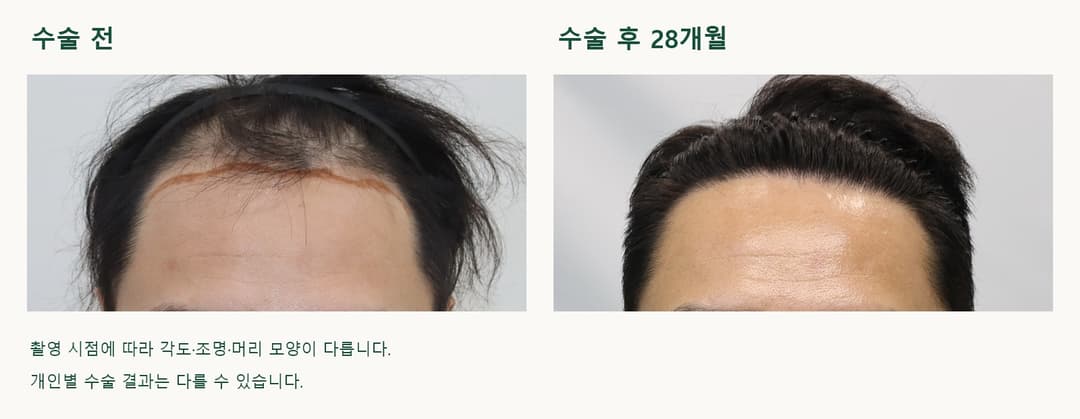
Look at both the appearance of the front hair and the shape extending from the center to both sides. However, the pre-surgery design lines alone cannot be used to accurately calculate the actual transplant area or the change in forehead height.
3. Case 2 | Before Surgery and 30 Months After Surgery
The second case is a record from 30 months after surgery. You can compare the forehead and hairline exposed with the front hair swept back.
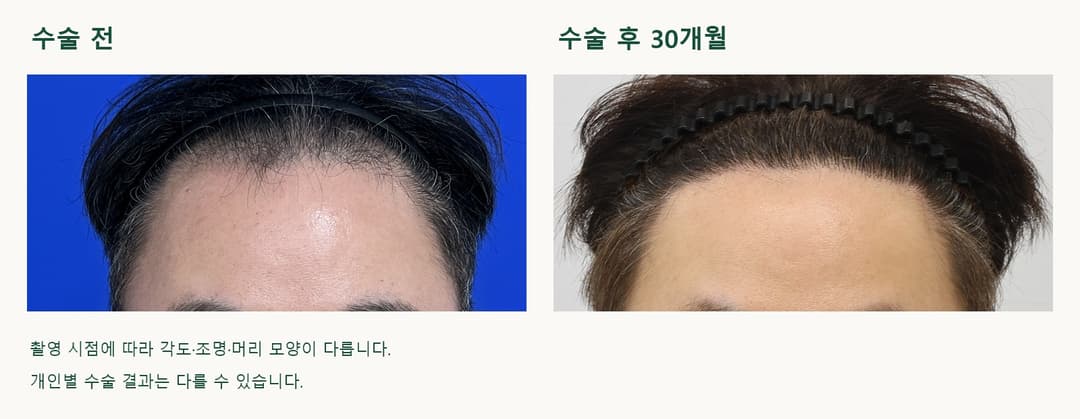
In this case in particular, the shooting environment differs between before and after surgery. Use the overall hairline as a reference, but differences in forehead size or brightness seen in the photos should not be interpreted directly as surgical effects.
4. Case 3 | Before Surgery and 34 Months After Surgery
The third case is a record from 34 months, approximately 2 years 10 months, after surgery. You can review the central hairline along with the outline extending to both sides.
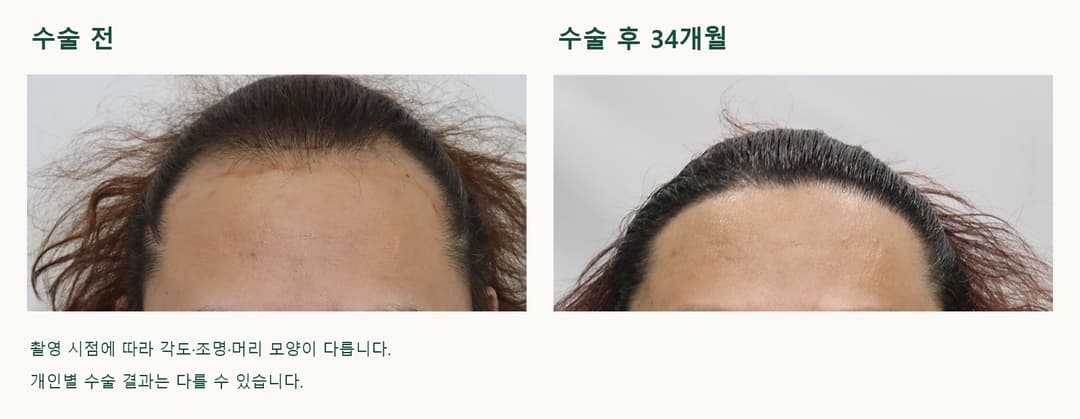
In long-term progress photos, it is helpful to look at the overall continuity as well as the density of specific areas. Specific changes are assessed by reviewing shooting conditions together with records from the time of surgery.
The photos of the three cases are individual records showing the appearance at each time point. The need for medication and long-term management described in this article is general medical information and does not indicate whether these patients took medication or the cause of the results shown in the photos.
5. The End of a Hair Transplant Is Not the End of Hair Loss Treatment
Hair transplants and hair loss treatment serve different roles. While a hair transplant is a surgery to fill in areas where hair is lacking, hair loss treatment is a process to manage progressive hair loss and preserve existing hair.
Especially in progressive cases such as male pattern hair loss, surrounding existing hair may become thinner or decrease even after surgery. This is why changes in the hair behind and around the transplanted frontal hairline should also be monitored.
The American Academy of Dermatology also advises that hair loss and thinning may continue after a hair transplant, and that medical professionals may recommend medication to manage it.[1]
The Role of a Hair Transplant
It aims to improve the hairline and hair distribution in areas where hair is lacking by relocating hair follicles.
The Role of Hair Loss Treatment
To manage progressive hair loss and preserve existing hair, it continues the medication and progress check-ups each individual needs.
Filling in with surgery and preserving existing hair are separate tasks.
When reviewing surgical results over the long term, you should consider not only the transplanted area but also your overall hair loss condition and treatment plan.
6. Post-Surgery Management Does Not End With Receiving a Prescription
If you need medication for progressive hair loss, it is important not to assume treatment is over simply because you have had surgery. Whether to continue or change medication should be discussed with the prescribing medical professional based on your current condition and treatment response.
While continuing medication, you may have questions not only about its effects but also about uncomfortable symptoms or taking the medication. Discussing these matters and reviewing the direction of treatment is also part of long-term management.
After surgery, we review the following together
- Changes in existing hair: Whether any areas appear thinner or sparser compared to previous records
- Treatment response: How current treatment is being continued and what changes you notice
- Uncomfortable symptoms: Whether any issues requiring consultation have arisen while using medication
- Future plans: In what direction current treatment and progress check-ups will continue
Management here does not mean that everyone must continue receiving separate scalp procedures. The focus is on checking your current condition, continuing necessary treatment, and responding appropriately when changes occur.
Whether and how medication is used, as well as the interval between visits, may vary depending on the cause and progression of hair loss and your health condition.

7. That Is Why a Clinic You Can Stay With Long-Term Matters
Even after recovery from surgery is complete, questions about your hair may remain.
- Should I just keep using the hair loss medication I am taking now?
- My front hairline looks about the same, but the area behind it seems to have thinned.
- I have experienced some discomfort while using medication. What should I do?
- Can you check my current condition by comparing it with photos from a few years ago?
When consulting on such questions, it helps to review not only your current appearance but also the transplant area at the time of surgery, the condition of existing hair, and your treatment history.
Therefore, when choosing a hair transplant clinic, it is worth considering not only the immediate surgical method and cost but also whether you can consistently consult about hair loss treatment and hair changes after surgery.
Choosing a hair transplant clinic means deciding where to have surgery, and at the same time, choosing where to consult about future hair loss treatment.
8. Modi Values an Ongoing Care Relationship That Continues After Surgery
At Modi Hair Plant, many patients return for consultations even after surgery. We check their post-surgery appearance, discuss their current hair condition and future concerns, and maintain the relationship.
Concerns at the first consultation may differ from those a few years later. At first, the hairline may be the main concern, but over time, questions about existing hair or medication may arise.
Having a place where you can consult while reviewing your previous condition and treatment history together—that kind of care relationship is what Modi values.
Staying with you long-term does not mean promising lifetime free management or a certain result. It means determining the necessary care and treatment direction together based on your individual condition.
9. Check Post-Surgery Plans During Your Clinic Consultation
Rather than simply hearing “We provide aftercare,” ask specifically what can be discussed, with whom, and in what way.

- Post-surgery progress: When should I visit, and what will be checked?
- Hair loss treatment: Can I also consult about existing hair and medication?
- Long-term consultation: How will I receive care after the scheduled progress check-up period ends?
- Record comparison: Can I receive an explanation comparing previous photos with my current condition?
- Scope of management and costs: What management is included, and what are the separate costs for consultations, tests, and treatments?
Understanding your post-surgery treatment plan in advance makes it clearer what to check and discuss after recovery is complete.
Frequently Asked Questions
Do I need to keep using hair loss medication even if my hair transplant went well?
If you need medication for progressive hair loss, treatment for your existing hair may still be necessary even if you are satisfied with the surgical results. This is because a hair transplant does not eliminate the cause of hair loss progression. However, not every patient needs the same medication, and whether to use it and how long to continue are decided after a consultation.
If I stop medication, will all my transplanted hair fall out?
That cannot be stated definitively. The condition of transplanted hair and changes in existing hair should be assessed separately. Hair loss that was managed with medication may progress again after discontinuation, so if you are considering stopping, first consult your prescribing medical professional about your reasons and current condition.
If my front hairline is unchanged but the area behind it looks sparse, does that mean the surgery went wrong?
That appearance alone cannot be judged as a problem with the surgery. It is necessary to distinguish whether it is a change in existing hair or in the transplanted area. It is best to review the transplant area at the time of surgery, previous photos, and your current scalp and hair condition together.
Do I need to keep receiving scalp procedures for long-term management?
Not everyone needs repeated scalp procedures. The core of long-term management is checking your hair loss condition, continuing necessary treatment, and monitoring response and uncomfortable symptoms. Whether additional treatment is needed should be decided after receiving an explanation of your individual condition, the supporting evidence, what can be expected, and the limitations.
Can I judge whether results have been maintained based only on before photos and photos from 2–3 years later?
You can compare the appearance at those time points, but you cannot know the intermediate progress. Long-term changes can be understood more accurately by also reviewing photos from 1 year after surgery and later, as well as whether medication or additional surgery was involved.
Do I have to get hair loss medication prescribed only at the clinic where I had surgery?
You do not necessarily have to receive treatment only at the same clinic. Even if you receive care at another medical institution, providing information on the timing of surgery, transplant area, medications in use, and previous treatment records will help with consultation. What matters is continuing necessary treatment and progress check-ups without interruption.
Consider Not Only the Changes Made by Surgery, but Also Your Hair Afterward
28 months, 30 months, 34 months. Long-term progress photos capture the time that has passed since surgery.
However, management after a hair transplant does not end with checking the transplanted hairline. In progressive hair loss, treatment and progress check-ups for existing hair should also continue.
A hair transplant is a one-day surgery, but the time that follows is much longer. Consider not only your current surgical plan but also whether the clinic is one where you can consult about future hair loss treatment.
From Surgical Planning to Post-Surgery Hair Loss Treatment, Consult With Us
If you are considering a hair transplant or have questions about existing hair and medication after surgery, we will review your current condition with you. Please let us know when you had previous surgery, any medications you are using, and the areas that concern you most.
References and Sources
[1] American Academy of Dermatology. A hair transplant can give you permanent, natural-looking results. Patient education material stating that hair loss and thinning may progress even after a hair transplant, and that medical professionals may recommend medication.
[Case materials] Clinical photos provided by Modi Hair Plant. Records of three different cases before surgery and 28, 30, and 34 months after surgery were used.
General medical materials and clinic-provided case photos are presented separately. The references are not studies verifying the treatment process or results of the individual patients introduced in this article.
This article is intended to provide general information and does not replace individual diagnosis or prescription. Surgical results and treatment responses vary by individual. Pain, swelling, infection, scarring, changes in sensation, and other effects may occur after a hair transplant, and medication may also have side effects. Decide on surgery, medication use, and treatment methods after consulting a medical professional.