
MODI HAIR MEDICAL GUIDE
Why Is PDRN Used After a Hair Transplant?
For transplanted hair follicles to settle into their new scalp location, early blood-flow connection and tissue recovery are important. We look at why PDRN is used before and after a hair transplant from the perspectives of tissue recovery, angiogenesis, and inflammation control.
3-Line Summary
- PDRN is a substance involved in tissue recovery, angiogenesis, and the regulation of inflammatory responses.
- In hair transplantation, it can be used as a treatment that supports the recovery environment around transplanted hair follicles.
- PDRN alone does not determine the graft survival rate or surgical outcome, and whether it is applied depends on each patient's condition.
Watch the Video First
What Is PDRN?
PDRN stands for Polydeoxyribonucleotide, a substance composed of DNA fragments of a certain size. Medical-grade PDRN is generally manufactured by purifying DNA derived from the germ cells of salmonid fish.
Its main known mechanisms of action are activation of the adenosine A2A receptor and the salvage pathway, which supplies nucleic acid building blocks to damaged cells. These processes are involved in cell growth, angiogenesis, inflammation control, and tissue recovery.1, 2

Why PDRN Is Used in Hair Transplantation
Harvested hair follicles go through a period of temporarily limited blood and oxygen supply before being transplanted to a new location. Immediately after transplantation, the connection with surrounding tissue is not yet sufficient, so creating an environment favorable to recovery is important.
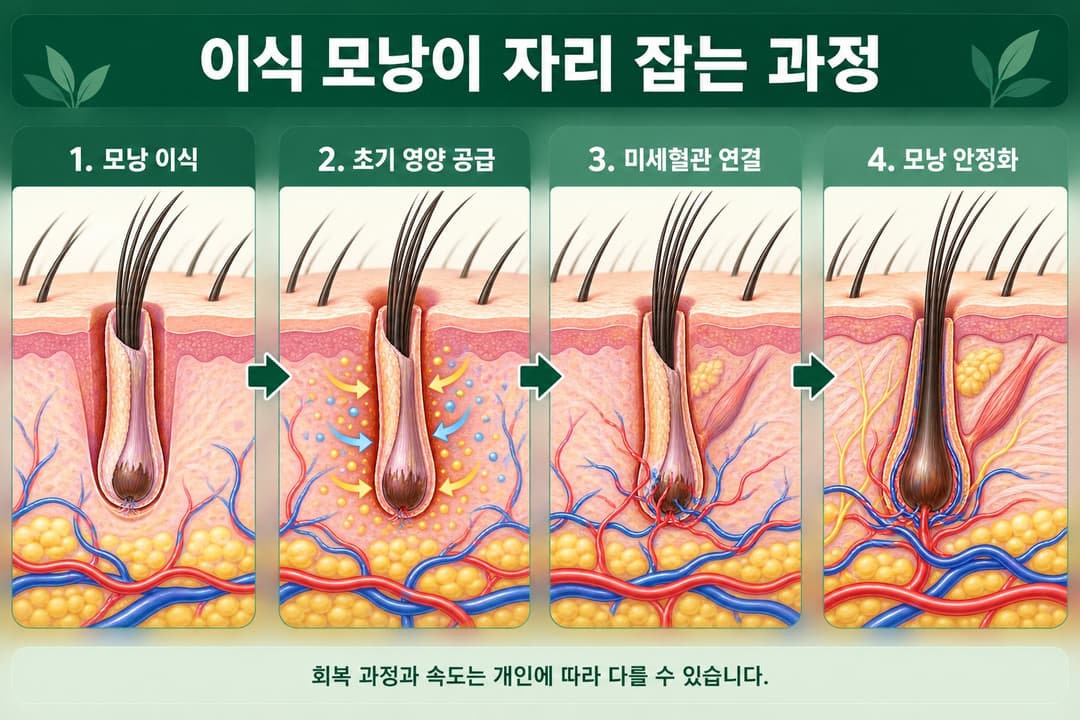
Tissue Recovery and Angiogenesis
- Supports healing of the minor wounds at the donor and recipient areas.
- Is involved in forming an environment in which oxygen and nutrients can be supplied around the hair follicles.
Inflammation Control and Tissue Stability
- May help regulate excessive inflammatory signals and tissue stress after surgery.
- Is used as a way to support normal tissue regeneration and matrix formation.
Research on PDRN's role in wound healing and angiogenesis has accumulated, but large-scale clinical trials directly comparing final graft survival rates in human hair transplants are still insufficient. It is appropriate to understand PDRN as an adjunctive treatment, not a treatment that guarantees success.
4 Roles That May Be Expected After a Hair Transplant

Helps the Scalp's Wound Healing
PDRN has been studied for its role in helping the recovery and re-epithelialization of damaged tissue. In a small clinical study of autologous skin graft donor sites, faster recovery was observed in the PDRN-treated group.3, 4
Its role is to support the surrounding environment so that the sites where hair follicles were placed can stabilize and the scalp can go through normal stages of recovery.
Supports Angiogenesis Around the Hair Follicles
PDRN is known to be involved in the expression of VEGF, which is associated with angiogenesis. In animal studies of wounds and skin flaps, increases in VEGF and microvessels were accompanied by improved tissue recovery or survival.5, 6
Helps Regulate Inflammatory Responses and Tissue Stress
Oxidative stress and inflammatory responses can occur while hair follicles reconnect to the blood supply. PDRN has been reported to regulate inflammatory signals such as TNF-α and IL-6 through A2A receptor-related pathways.7
Supports a Normal Recovery Environment
Collagen and extracellular matrix are formed during wound healing. However, it cannot be definitively stated that “PDRN prevents all scarring.” To reduce scarring, accurate implantation depth and surgical technique that minimizes tissue damage come first.8
Does PDRN Have an Effect on the Hair Itself?
In a small study of patients with female pattern hair loss, improvements in hair count and thickness were observed after PDRN alone or combined with PRP. However, the study had no untreated control group and was small in scale, so it requires cautious interpretation.9
In 2025, a study was also published reporting improvements in hair density and thickness after injecting polynucleotide (PN) in 28 patients with androgenetic alopecia. This too was an early study without a control group, and PN and PDRN may not have identical product characteristics.10

1,500 Vials Used in 2025
At Modi Hair Plant Clinic, approximately 1,500 vials of PDRN were used during surgery and for post-operative recovery care by a point shortly past the first half of 2025. More important than the amount used is applying it appropriately at the timing and areas needed based on each patient's condition.
Is It a Treatment Every Patient Needs?
Not necessarily. The number of hairs to be transplanted, scalp condition, inflammation or skin conditions, recovery factors such as smoking or diabetes, whether it is a revision surgery, medications being taken, and allergy history must all be reviewed together.
If you have ever had a fish allergy or a hypersensitivity reaction to certain medications, you must inform the medical staff.
Frequently Asked Questions
Does receiving PDRN always increase the graft survival rate?
That cannot be stated definitively. It is appropriate to understand it as an adjunctive treatment that helps the recovery environment.
Can PDRN alone treat hair loss?
No. After an accurate diagnosis of the type of hair loss, a method such as medication, injections, or a hair transplant should be chosen.
Is there any pain or side effects?
Temporary pain, redness, bruising, swelling, or itching may occur. If symptoms worsen or persist, they should be checked by the medical staff.
Surgery Takes a Day, but a Hair Transplant Includes the Entire Recovery
Look beyond the transplant volume to harvesting, storage, implantation, and post-operative care.
We provide an individual plan based on your scalp condition.
This article is health information written and medically reviewed by Director Yoo Hwa-jung of Modi Hair Plant Clinic. It does not replace individual diagnosis or prescription, and treatment effects and side effects may vary by individual. Whether and how to proceed with treatment should be decided after a consultation.
References
- Colangelo MT, et al. Regenerative Medicine. 2020. doi:10.2217/rme-2019-0118
- Squadrito F, et al. Pharmaceuticals. 2021;14:1103. doi:10.3390/ph14111103
- Rubegni P, et al. Curr Med Res Opin. 2001;17:128-131. PMID 11759182
- Valdatta L, et al. Curr Med Res Opin. 2004;20:403-408. DOI
- Galeano M, et al. Wound Repair Regen. 2008;16:208-217. PMID 18318806
- Chung KI, et al. Arch Plast Surg. 2013;40:181-186. DOI
- Irrera N, et al. Adv Wound Care. 2020;9:576-589. Full text
- Feoktistov I, et al. Handb Exp Pharmacol. 2009;193:383-397. PMID 19639289
- Lee SH, et al. Wound Repair Regen. 2015;23:30-36. DOI
- Thanasarnaksorn W, et al. Arch Dermatol Res. 2025;317:399. DOI