
Hair Transplant Revision Surgery · Causes and Directions for Improvement
Remaining Concerns After a Hair Transplant: The Approach Depends on the Cause
Have you had a hair transplant but find that the hairline looks unnatural, the hair stands up, or the density appears lower than you expected? A revision surgery consultation should distinguish between design, direction and angle, density, implantation depth, and graft survival. This is because, depending on the cause, options such as additional transplantation, selective removal and repositioning of previously transplanted hair, or scalp treatment are considered differently.
Based on a video by Director Yoo Hwa-jung of Modi Hair Plant, this article outlines five reasons people consider revision surgery, along with the improvement methods and limitations described in the relevant literature.
Summary in 3 Lines
- The five reasons explained in the video are design, direction and angle, density, implantation depth, and graft survival issues. Several factors may be present at the same time.
- Improvement methods differ by cause, and there are cases that cannot be resolved simply by transplanting more hair.
- For a consultation, it is important to prepare your previous surgical records and progress photos from different time points, and to have the current condition of your scalp and remaining donor hair evaluated as well.
An unsatisfactory result is not always the same kind of “failure.” Cases where the desired look has changed should be distinguished from cases involving problems with hair growth, placement, or the skin surface. This article is not a diagnostic chart for determining the cause on your own, but a guide to help you clearly communicate your concerns during a revision surgery consultation.
Key Points of a Revision Consultation, Explained in the Video
In the video, Director Yoo Hwa-jung explains five causes that lead to revision surgery consultations and the importance of previous surgical records. The specific correction approaches described in this article supplement the video with academic literature; this does not mean that Modi performs or recommends every method uniformly.
Reason 1. When the Design Differs from the Desired Impression
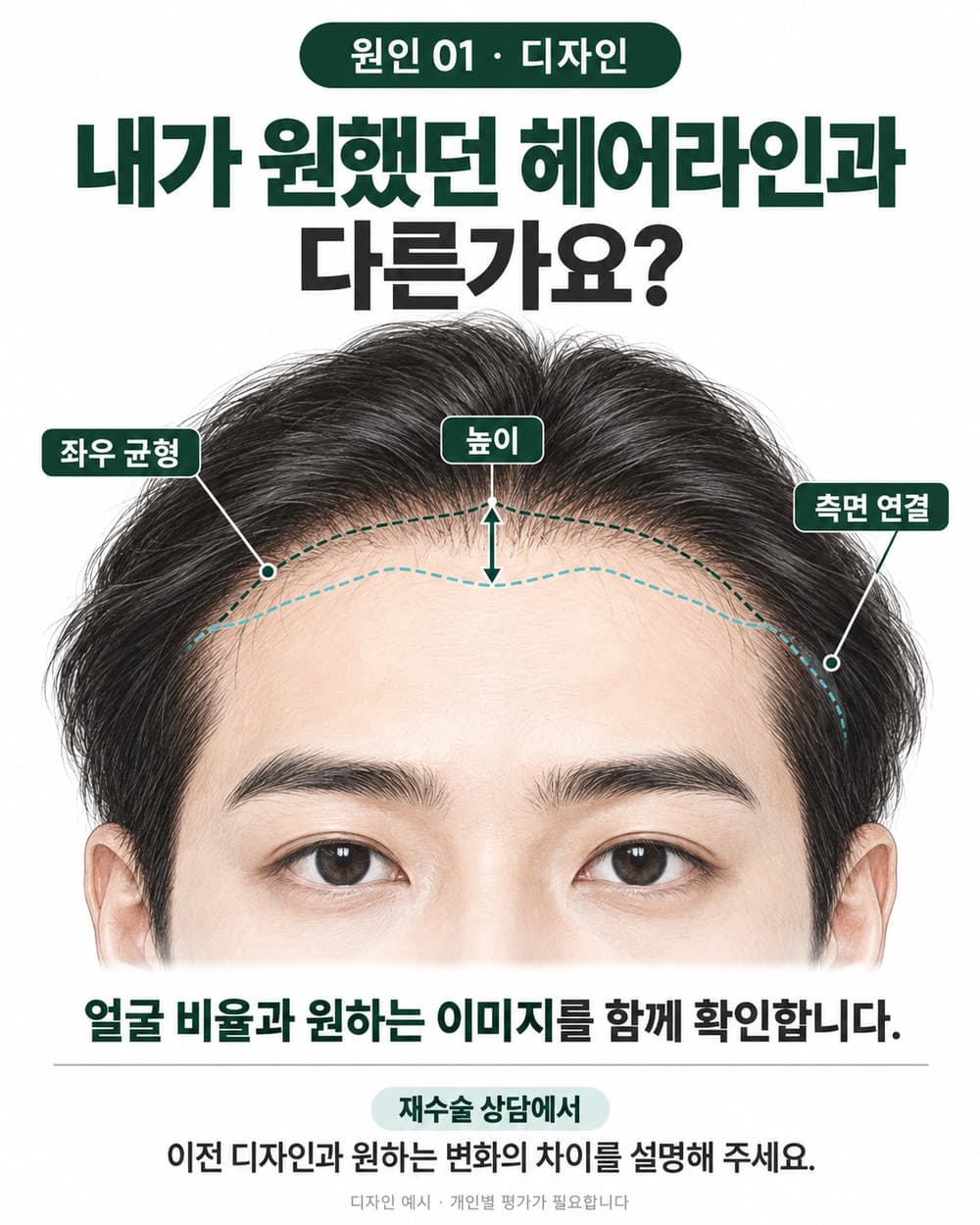
Even if the hair has grown, you may still be dissatisfied if the height and shape of the hairline or the connection to the temples differ from what you wanted. The video explains that not only facial proportions but also the overall facial structure and the desired image should be considered together.
Approach: Start by Defining What You Want to Change
It helps the consultation to break down the feeling that “I don’t like it” into specifics such as too high, too low, overly straight, or an awkward side connection. Supplementing areas that are lacking may be considered, but a line that has already been placed too low is difficult to adjust with additional transplantation alone.
In such cases, selective removal and repositioning of problematic transplanted hair may be evaluated. There are clinical reports of correcting unnatural or low hairlines using the FUE method, but follicle damage during re-extraction, scarring or color changes, and the possibility of further correction must also be considered. [2]
Reason 2. When the Hair Has Grown but the Direction and Angle Look Unnatural
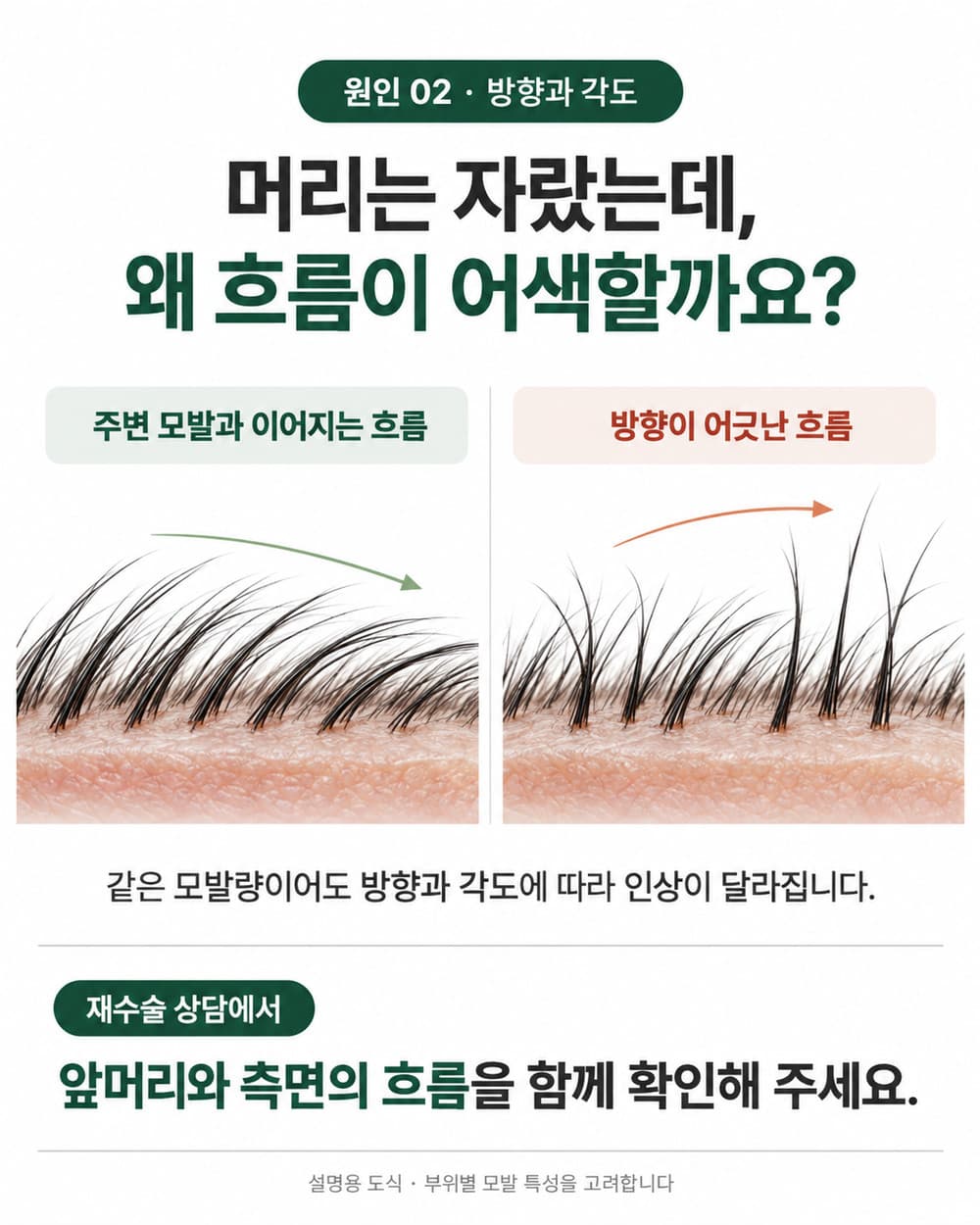
If your front hair stands up noticeably, or does not flow continuously with the hair on the sides and is hard to style, the direction and angle of the hair should also be checked. In the video, Director Yoo Hwa-jung explains that hair angles at the front, sides, and back are not all the same.
Approach: Plan Together How to Handle the Previously Transplanted Hair
Transplanting new hair between hairs growing in a different direction does not change the angle of the existing hair. Depending on the extent and severity of the problem, supplementary transplantation or selective removal and re-transplantation of previously transplanted hair may be considered. Whether re-extracted follicles can be reused depends on the degree of damage and their condition. [2]
During the consultation, please also show how you usually style your hair. Explaining with photos or a short video which direction is uncomfortable to comb and which areas stand up or part makes it easier to convey your areas of concern.
Reason 3. When Density Is Insufficient or the Border Is Overly Dense
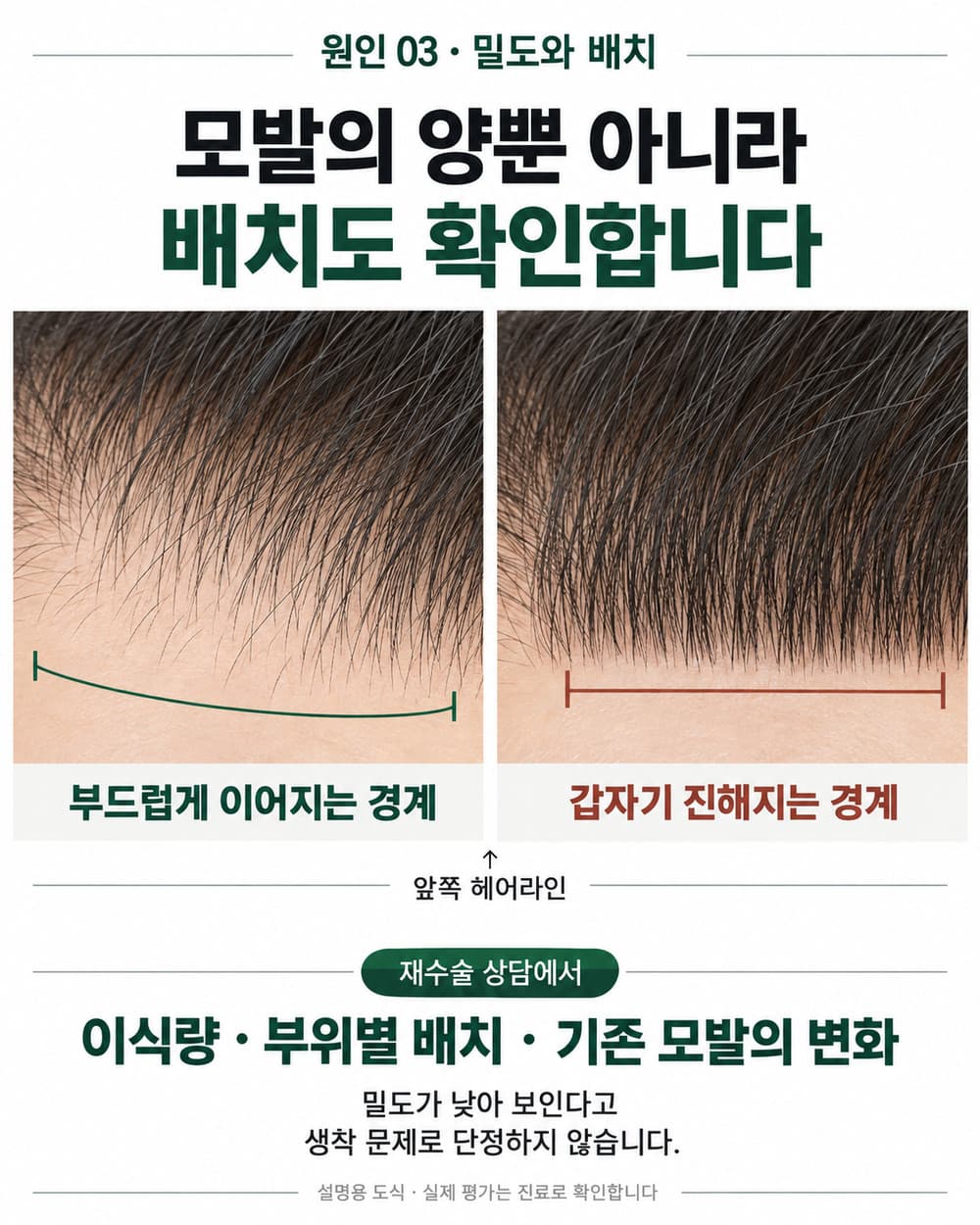
Density issues include not only cases where the area looks sparse overall but also cases where the front border looks abruptly dense. The video emphasizes whether the density distribution between front and back, and between center and sides, connects naturally.
Approach: Supplement Where Needed, but Evaluate Dense Areas Separately
For areas where the amount transplanted was actually insufficient, supplementary transplantation may be considered after checking donor reserves and scalp condition. Conversely, if the border is overly dense or thick hairs are concentrated at the front, a plan to adjust follicle composition and placement may be needed. [1]
Graft survival failure is not concluded simply because the hair looks thin. The originally planned transplant amount, the growth progress, and changes in existing hair should also be assessed separately.
Reason 4. When the Skin in the Transplanted Area Looks Raised or Depressed
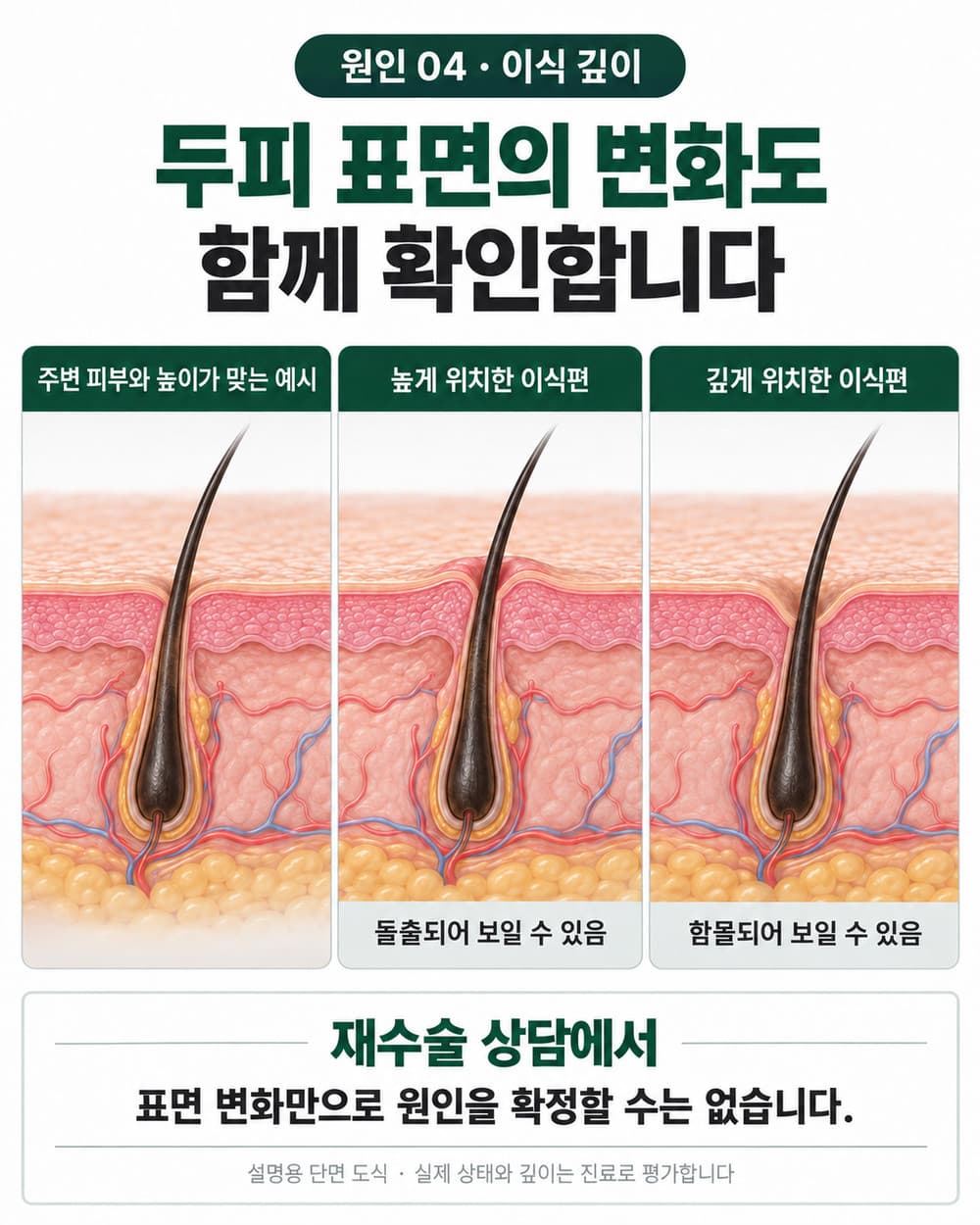
Even if the amount and direction of hair are fine, the scalp surface may look uneven. The video explains surface changes that occur when grafts are positioned too high or too deep. The literature also reports that improper implantation depth and scar tissue may be associated with skin surface irregularities. [1]
Approach: Distinguish Between Hair Supplementation and Skin/Scar Treatment
Surface changes may involve causes other than scarring, such as inflammation or cysts, so an examination is necessary. Observation, scar treatment, or correction of some grafts may be considered depending on the condition; additional transplantation itself does not resolve surface problems. [1]
In a case study of female hairline revision surgery, some patients first underwent scar treatment or hair removal of unnecessary transplanted hair before surgery was planned. This is an example of an approach tailored to the individual situation and does not mean that the same treatment is applied to every elevation or depression. [3]
Reason 5. When Less Transplanted Hair Grew Than Expected
When hair has not grown as much as planned, graft survival and growth progress are evaluated. However, it must first be determined whether the hair is still growing, whether transplanted hair growth is insufficient, or whether the surrounding existing hair has decreased.
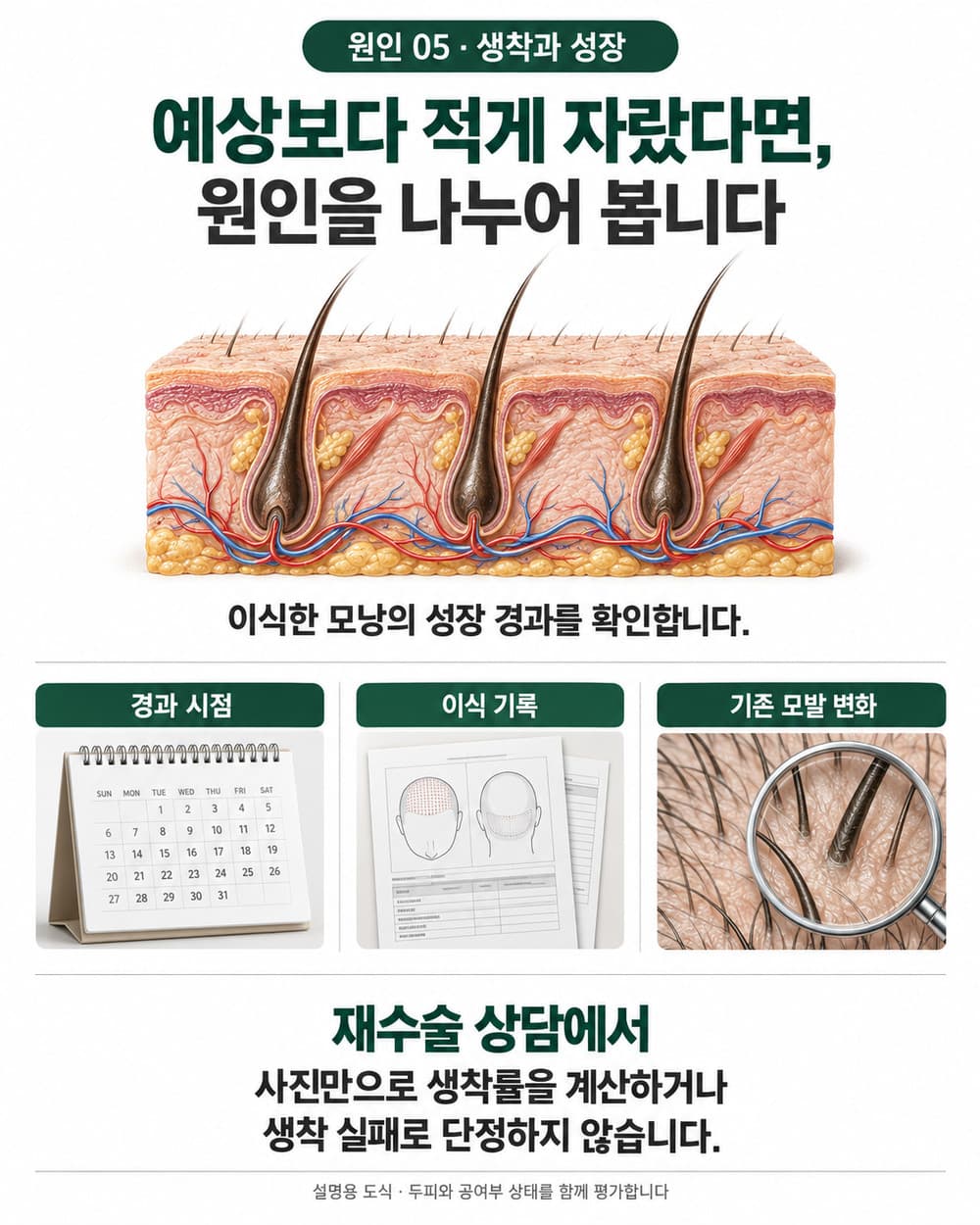
Approach: Identify the Background of Reduced Growth Before Deciding on Supplementation
The literature explains that graft damage or desiccation, the condition of donor hair, and an individual’s health status may be associated with reduced growth. If transplantation is repeated in the same way without examining the cause, the expected change may not occur. [1]
Depending on the examination results, scalp conditions or hair loss of existing hair may be treated first, or supplementary transplantation may be considered after a period of observation. When planning surgery again, the current condition of the scalp and donor area must also be re-evaluated. [4]
In the video, Director Yoo Hwa-jung explains that the follicle preservation environment and post-operative care are also taken into account. However, this does not mean that receiving a particular adjunctive treatment will necessarily resolve graft survival issues, or that every patient needs the same adjunctive treatment.
Approaches by Cause at a Glance
| Concern | What to Check During Consultation | Improvement Approaches to Consider |
|---|---|---|
| Design | Height, shape, side connection, and desired image | Design adjustment; supplementation or selective removal as needed |
| Direction & Angle | Extent of hair standing up or misaligned flow | Plan for handling existing transplanted hair and for supplementation/repositioning |
| Density | Transplant amount, placement, and changes in existing hair | Supplementing insufficient areas or adjusting the border |
| Depth & Surface Changes | Presence of elevation, depression, scarring, and inflammation | Observation, skin/scar treatment, graft correction if needed |
| Survival & Growth | Time since surgery, growth pattern, scalp and donor hair condition | Evaluating the cause and deciding on supplementation after treatment |
The table above summarizes consultation directions. Multiple causes may overlap, and treatment suitability and sequence are determined through individual consultation and examination.
Three Things to Prepare Before a Revision Consultation

1. Previous Surgical Records
Please check the surgery date, extraction method, transplanted areas, and transplant amount. It is helpful to note whether the transplant amount was counted in hairs or in follicles (grafts). Please also let us know about any medications you are taking or using and any post-operative treatments.
2. Progress Photos by Time Point
If you have photos from before surgery, immediately after surgery, and afterward, please bring them. Comparison is easier when lighting, angle, and hair length and styling are similar. Marking the areas that currently bother you the most is also helpful.
3. Evaluation of Current Scalp and Remaining Donor Hair
For revision surgery, the quantity and quality of the remaining donor hair, traces of previous extraction, and the skin condition of the transplanted area are important. Magnified examination can be used to assess donor area density, hair thickness, and miniaturization. [4]
What Modi Emphasizes in the Video: “Records and Communication”
In the video, Director Yoo Hwa-jung describes the process of repeatedly checking the design and communicating thoroughly about the desired look. For those preparing for a revision consultation, she asks that previous surgical records be prepared as much as possible.
The goal of revision surgery becomes more specific when what you are dissatisfied with, what you want to change, and what is possible under current conditions are clarified together. Be sure to check not only what is possible but also donor hair limitations, scarring, and the possibility that correction may require multiple stages.
How We Interpreted the References
The evidence for correction methods includes a review article on complications, a case report on revision surgery in 246 women, and a retrospective multicenter observational study of 20 men. These are not data from randomized controlled trials establishing the superiority of any method. Research results from other medical institutions are not presented as Modi’s success rates and are not used as grounds to guarantee individual results. [3] [2]
Frequently Asked Questions
My hair looks thin. How can I tell whether it is a graft survival issue or a transplant amount issue?
The original transplant amount and placement records, the time elapsed since surgery, and the current condition of transplanted and existing hair need to be compared. It is difficult to calculate the survival rate based only on how photos look. During the consultation, we assess whether the amount was insufficient from the start, whether the hair is still in the growth process, or whether changes have occurred in the existing hair.
Can hair transplanted in the wrong direction be removed and reused?
It is possible in some cases, but not every follicle can be reused. Re-extraction can be difficult due to fibrosis from the previous transplant and the direction of the follicles, and damaged follicles may not be suitable for re-transplantation. You should also receive an explanation of scarring, hair regrowth, and the possibility of further correction. [2]
If the back of my head already looks quite sparse, is revision surgery impossible?
Whether it is possible cannot be concluded from appearance alone. We check the density and thickness of the remaining donor hair, the extent of previous extraction, and the current hair loss pattern. If usable donor hair is limited, the scope or priorities of correction may be adjusted, or non-surgical methods may be considered. [4]
Can I still have a consultation if I cannot obtain surgical records from my previous clinic?
Even without records, a consultation to evaluate your current condition is possible. Please bring what you remember about the timing and method of surgery, the approximate transplant amount, and any photos you have. However, without sufficient records, there may be limits to accurately determining the previous extraction amount and the plan at that time.
It has only been a few months since my surgery. Can I have a revision consultation?
You can have a consultation to review your current concerns, but the timing of a consultation and the timing of deciding on revision surgery are different. If growth or skin/scar changes are still in progress, further observation may be needed. If pus develops or pain or redness worsens, do not postpone medical care while waiting to evaluate the results.
Before Deciding on Revision Surgery, Start by Checking Your Current Condition
Please organize whether you want to change the design, whether the hair direction bothers you, or whether density or the scalp surface is your concern. Preparing previous surgical records and progress photos helps in discussing your current condition and possible directions for improvement.
Phone inquiries: 02-544-8659
References and Video Source
- Kerure AS, Patwardhan N. Complications in Hair Transplantation. Journal of Cutaneous and Aesthetic Surgery. 2018;11(4):182–189. DOI: 10.4103/JCAS.JCAS_125_18. PMID: 30886471.
- Gómez-Zubiaur A, Mir-Bonafé JM, Muñoz Moreno-Arrones O, et al. FUE for the repair of unnaturally designed or low hairlines in men with androgenetic alopecia: a retrospective, multicenter observational study. Frontiers in Medicine. 2026;13:1735251. DOI: 10.3389/fmed.2026.1735251. PMID: 41907238.
- Park JH, Kim NR, You SH. Secondary Revision of Female Hairline Correction Surgery: Personal Experience. Aesthetic Plastic Surgery. 2019;43(3):644–651. DOI: 10.1007/s00266-019-01372-y. PMID: 30989275.
- Issa NT, Tosti A. Trichoscopy for the Hair Transplant Surgeon—Assessing for Mimickers of Androgenetic Alopecia and Preoperative Evaluation of Donor Site Area. Indian Journal of Plastic Surgery. 2021;54(4):393–398. DOI: 10.1055/s-0041-1739245. PMID: 34984075.
Video source: Modi Hair Plant, Director Yoo Hwa-jung. 5 Reasons People Consider Hair Transplant Revision Surgery! A Doctor Candidly Explains the Causes of Hair Transplant Failure and How to Prevent Them.
This article provides general medical information and does not replace individual diagnosis or treatment. The comparison and cross-sectional images in this article are explanatory materials to aid understanding and do not represent actual patient before-and-after results or any specific graft survival rate. The possible scope of correction and results may vary by individual, and revision surgery carries risks such as bleeding, infection, scarring, sensory changes, and damage to existing hair. Whether and how to proceed with treatment is decided after a medical consultation.