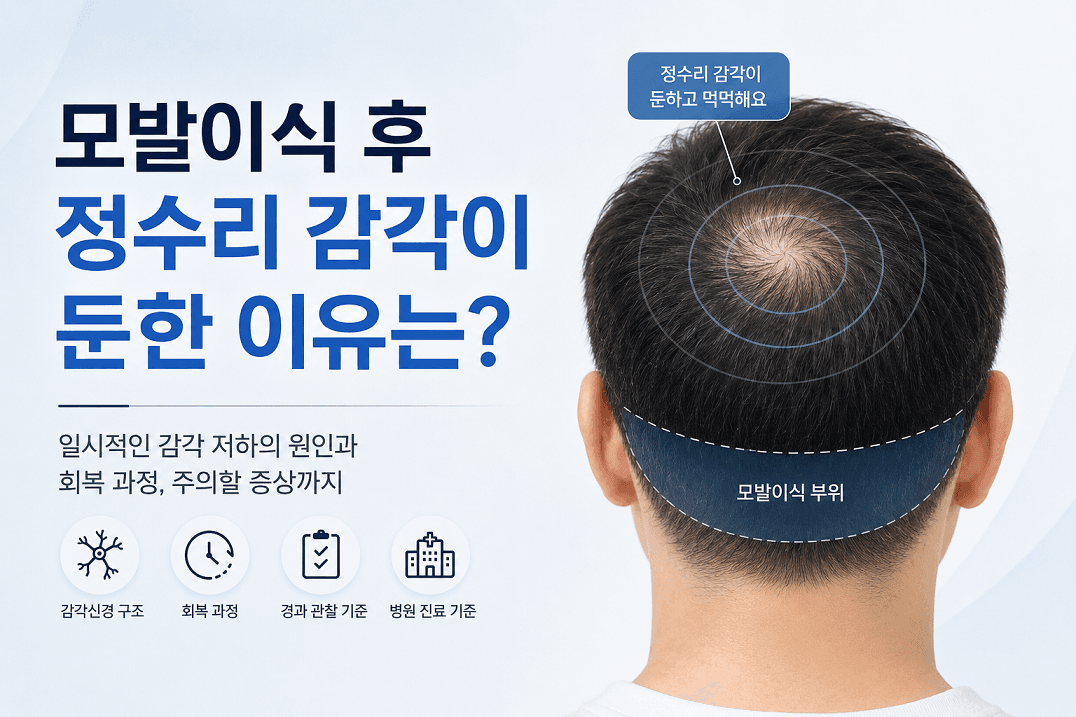
After a hair transplant, the hairline may appear to have no particular issues, yet the crown may feel dull or numb when touched.
Some patients worry, asking, “I only had my front hairline transplanted—why does my crown feel strange?” or “My scalp doesn’t feel like my own skin. Is this okay?”
To start with the conclusion: reduced sensation in the scalp or crown can occur temporarily after a hair transplant. This is because minor tissue irritation during the transplant process and post-operative swelling can affect the surrounding sensory nerves.
In most cases, it tends to gradually improve over time. However, if sensation continues to worsen or is accompanied by other symptoms such as skin lesions or severe pain, it should be checked by a medical professional.
Reduced Sensation After a Hair Transplant: Key Points
- After a hair transplant, the scalp or crown may feel dull and numb.
- The scalp, including the crown, has relatively lower tactile discrimination than the fingertips or lips.
- Even if the transplant was done at the hairline, sensation in the upper scalp may change due to the course of the nerves and post-operative tissue changes.
- Temporary sensory changes often improve gradually over several weeks to several months.
- If sensation continues to worsen or other abnormal symptoms occur, a medical consultation is needed.
Why Does Scalp Sensation Become Dull After a Hair Transplant?
Hello. I am Yoo Hwa-jung, Director of Modi Hair Plant.
A hair transplant is a procedure that moves healthy hair follicles to the areas where they are needed. During this process, tiny incisions are made at the recipient site to insert the hair follicles, and temporary swelling may occur in the surrounding tissue after surgery.
Because the scalp contains numerous sensory nerves and small nerve branches, these tissue changes can temporarily affect the surrounding sensory nerves.
As a result, sensory changes may occur—the scalp may feel numb, duller than usual when touched, or as if it were not your own skin. These symptoms in themselves do not mean permanent nerve damage.
Is the Crown Naturally Less Sensitive?
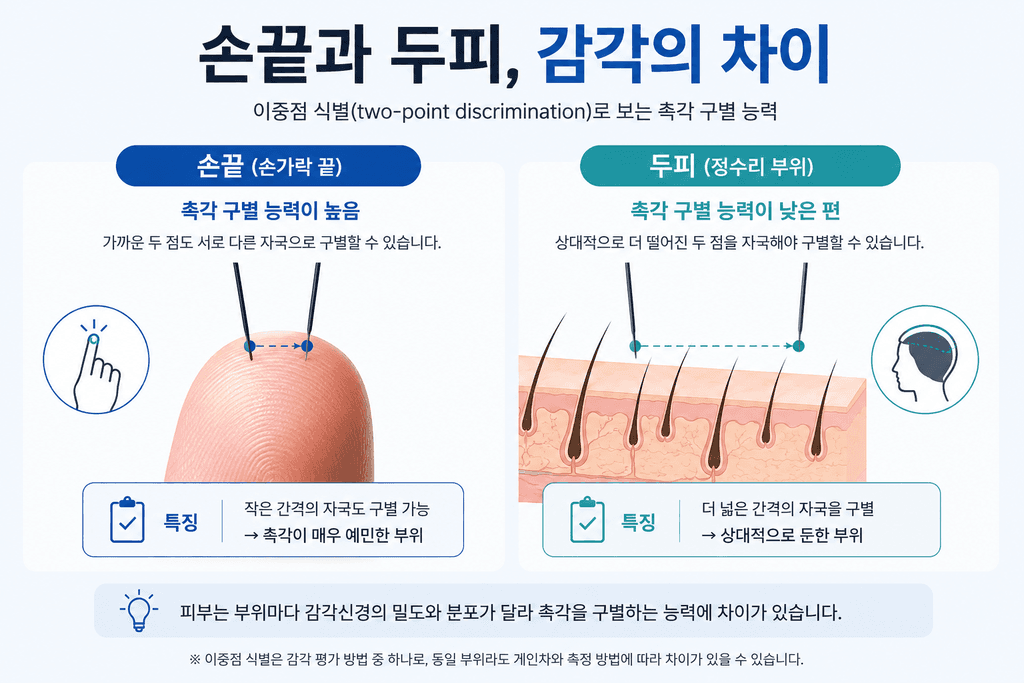
Yes. The scalp, including the crown, is not as tactilely sensitive as areas such as the fingertips or lips.
Each part of the body has a different ability to discriminate touch. One method of assessing this is two-point discrimination, which checks whether two nearby points stimulated simultaneously can be distinguished as two separate stimuli rather than one.
Tactilely sensitive areas such as the fingertips can distinguish two points that are close together, whereas the scalp requires a relatively wider gap. Therefore, the scalp can be understood as an area that naturally has lower tactile discrimination than the fingertips.
I Had a Hairline Transplant—Why Does My Crown Feel Numb?
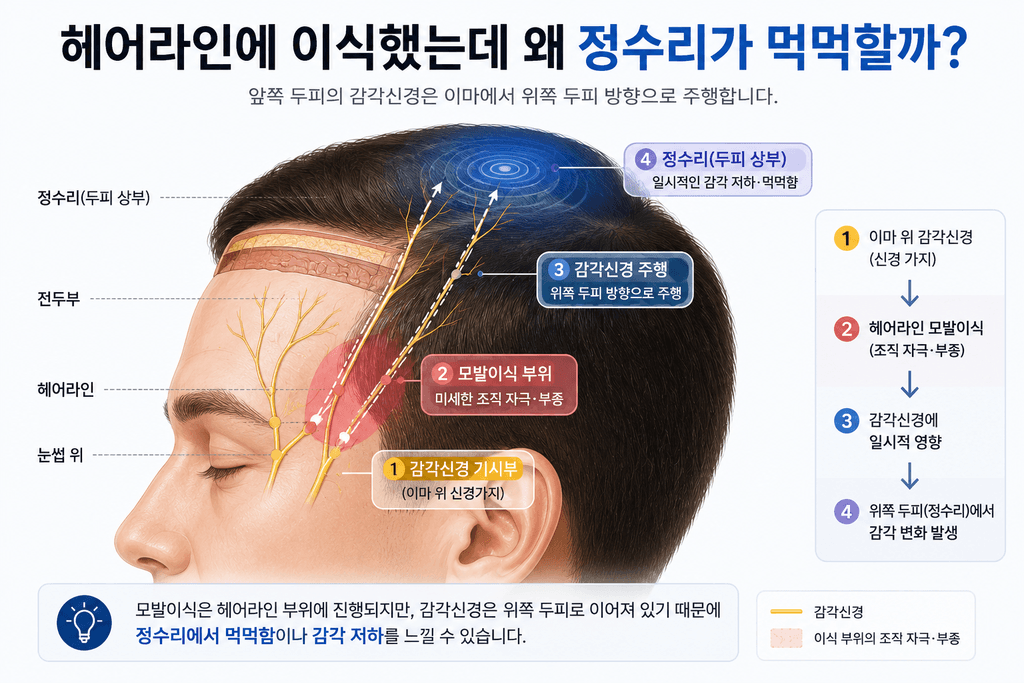
The area where hair was transplanted and the area that feels dull do not necessarily coincide.
Several sensory nerves branching from the trigeminal nerve are involved in sensation of the front of the scalp. Some nerve branches run from the forehead and frontal region toward the upper scalp and are responsible for sensation in that area.
Therefore, when a hair transplant is performed on the hairline or frontal region, minor damage to surrounding tissue and swelling can temporarily affect the areas through which the nerves pass.
Simply put, temporary irritation around the path the nerves travel can make sensation in the scalp above it feel different from usual. That is why you may feel numbness in the crown even if only the hairline was transplanted.
How Common Is Reduced Sensation After a Hair Transplant?
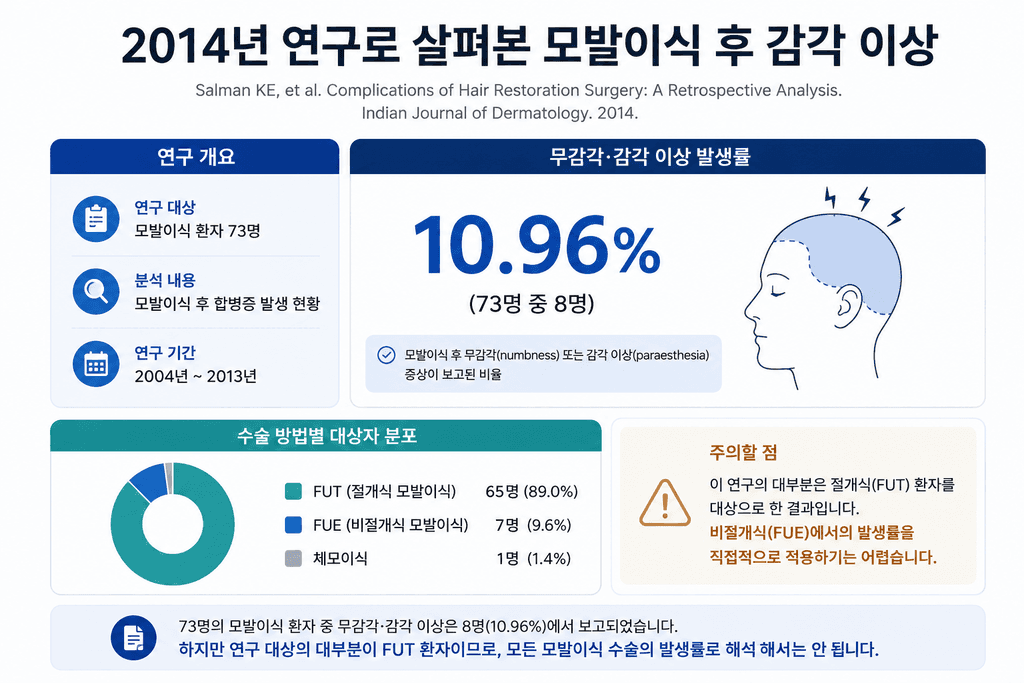
Numbness or abnormal sensation after a hair transplant has been reported in previous studies. In a study on hair transplant complications published in 2014, numbness or paresthesia was reported in 10.96% of 73 patients.
However, this figure should not be interpreted as the current incidence rate for all non-incision (FUE) hair transplants. Of the 73 patients in the study, 65 underwent strip (incisional) hair transplant (FUT), 7 underwent FUE, and 1 underwent body hair transplant.
Therefore, rather than concluding that “about 10% of hair transplant patients experience reduced sensation,” it is more appropriate to understand this as research evidence that temporary sensory changes can occur after a hair transplant.
When Does Crown Sensation Return After a Hair Transplant?
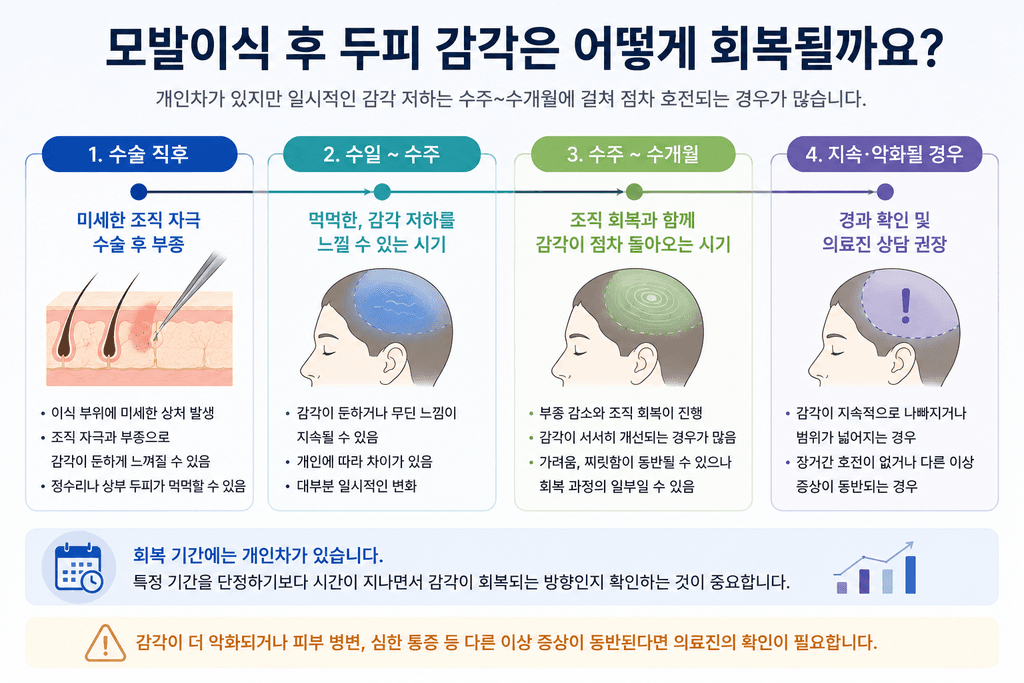
Temporary reduced scalp sensation often recovers gradually over several weeks to several months.
In the early post-operative period, you may feel unusual sensations due to minor tissue damage and swelling. As the swelling subsides and the surrounding tissue recovers, sensation may gradually return.
In clinical practice as well, some patients report that their crown feels numb or duller than usual in the early post-operative period, but in many cases it improves naturally over time.
However, recovery speed varies between individuals, so rather than assuming a specific timeline such as “it will definitely recover in 3 months,” it is important to check whether sensation is improving over time.
Is It Okay If My Crown Still Feels Numb 2 Weeks After a Hair Transplant?
About 2 weeks after surgery, slightly dull sensation in the crown alone does not necessarily require treatment, because tissue recovery is still in progress in the early post-operative period.
What matters at this point is not whether numbness is present, but how it is changing.
- Whether the numbness is decreasing compared to the beginning
- Whether sensation is gradually returning
- Whether the area of reduced sensation is expanding
- Whether skin lesions or severe pain are present
If sensation is gradually recovering, the progress can be monitored. However, if it becomes duller over time, it is advisable to have it checked by a medical professional.
Reduced Sensation After a Hair Transplant: When Should You See a Doctor?
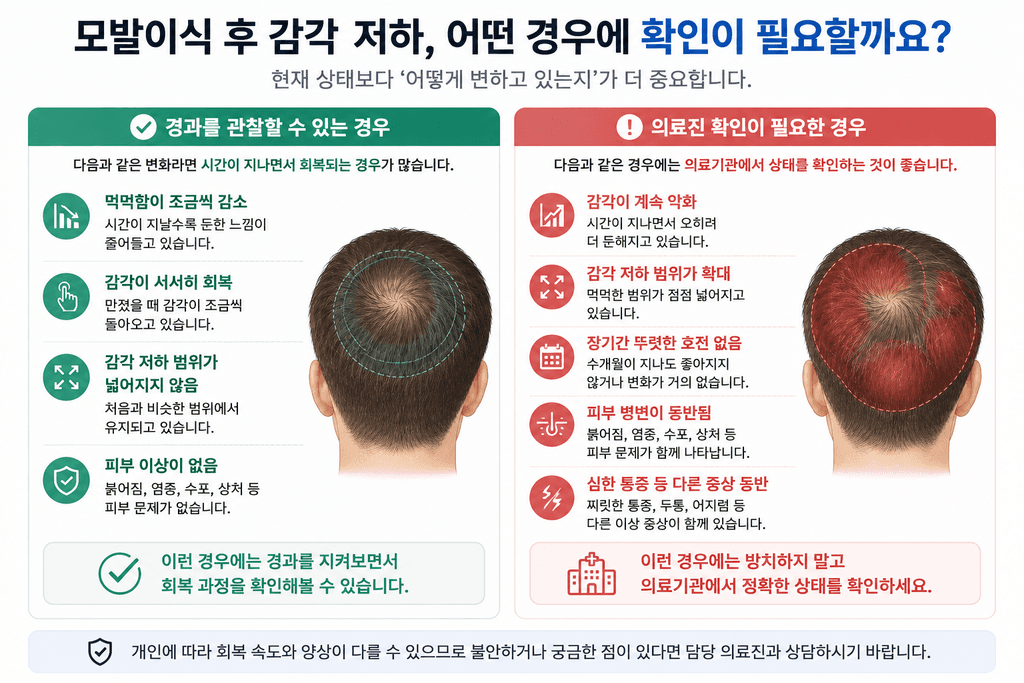
Rather than simple numbness in the crown, it is important to check whether symptoms are continuously worsening or accompanied by other abnormal symptoms.
- Sensation decreases further over time
- The area of reduced sensation keeps expanding
- There is no clear improvement over a long period
- Skin lesions such as redness, inflammation, blisters, or wounds are present
- Severe pain or other abnormal symptoms are present
In particular, if skin lesions appear, it is necessary to check whether the abnormal sensation is caused not only by the hair transplant itself but also by other causes such as inflammation or skin disease.
Is There a Way to Recover Scalp Sensation Faster?
Vitamin B complex and alpha-lipoic acid are sometimes mentioned in relation to nerve health, but there is insufficient evidence to say they must be taken to speed recovery from temporary reduced scalp sensation after a typical hair transplant.
Therefore, rather than adding supplements on your own, basic recovery care comes first—quitting smoking, getting enough rest and sleep, and managing underlying conditions. In particular, if you have diabetes, proper blood sugar control is important, and it is also necessary to avoid excessively irritating the surgical site.
FAQ: Reduced Sensation After a Hair Transplant
Q1. After my hair transplant, my crown feels numb and not like my own skin. Is this okay?
After a hair transplant, the scalp or crown may temporarily feel dull or numb. What matters is checking whether sensation gradually recovers over time.
Q2. I only had my hairline transplanted—can sensation in my crown also decrease?
Yes, it can. Because some nerve branches responsible for sensation in the front of the scalp run from the forehead toward the upper scalp, tissue changes around the hairline can temporarily affect sensation in the upper scalp.
Q3. When does crown sensation return after a hair transplant?
It varies by individual, but temporary sensory changes often improve gradually over several weeks to several months. Rather than a specific period, it is important to check whether sensation is moving toward recovery.
Q4. Should I see a doctor if reduced sensation persists for a long time?
If sensation continues to worsen or the affected area expands, if there is no clear improvement over a long period, or if other symptoms such as skin lesions or severe pain are present, we recommend having it checked by a medical professional.
Director Yoo Hwa-jung’s Summary
Numbness or dull sensation in the crown after a hair transplant can occur temporarily. Rather than focusing only on how dull it feels now, it is important to check whether sensation is recovering over time.
If sensation is gradually improving and there are no other abnormal symptoms, progress can be monitored for a certain period. Conversely, if sensation continues to worsen or is accompanied by skin lesions, severe pain, or similar symptoms, please have your condition checked at a medical institution.
Learn More About Hair Transplants
A hair transplant plan may vary depending on the number of hairs needed, the transplant area, and the condition of existing hair. You can find hair transplant information below.
- Check your estimated hair count with the AI Hair Count Calculator
- Modi Hair Plant Website
- KakaoTalk Consultation
Watch the Video
A detailed explanation of why crown sensation becomes dull after a hair transplant and the recovery process is also available in Director Yoo Hwa-jung’s video.
References
- Loganathan E, Sarvajnamurthy S, Gorur D, et al. Complications of Hair Restoration Surgery: A Retrospective Analysis. International Journal of Trichology. 2014;6(4):168-172.
- Tajran J, Gosman AA. Anatomy, Head and Neck, Scalp. StatPearls Publishing.
Medical Review: This content was written following medical review by Director Yoo Hwa-jung of Modi Hair Plant Clinic.
Last Updated: August 2026
※ This content was written to provide general medical information about scalp sensory changes that may occur after a hair transplant. Symptoms and recovery may differ depending on the individual’s surgical method, transplant area, scalp condition, and health status, and this content does not replace individual diagnosis or treatment. If symptoms persist or worsen, please have your condition accurately assessed at a medical institution.