MODI HAIR CASE REVIEW
How Did an M-Shaped Hairline Hair Transplant of 2,600 Hairs Change Over 1 Year?
This is the case of a 29-year-old male patient who felt stressed because both M-shaped areas looked empty when the wind blew or when his forehead was exposed. After 2,600 hairs were transplanted into the hairline and M-shaped areas using the non-incision method, we look at the changes from before surgery through 3 months, 6 months, and 1 year using actual progress photos and an interview.
Key Summary
- The 29-year-old male patient named his M-shaped hairline and the empty areas exposed when his front hair was blown back as his biggest concern.
- A non-incision hair transplant of 2,600 hairs was performed, focusing on the hairline and both M-shaped areas.
- Actual photos compare the changes before surgery and at 3 months, 6 months, and 1 year, and the video also shows progress immediately after surgery and at 2 weeks.
- The transplant volume, recovery speed, sense of density, and final results may vary depending on the extent of hair loss, the donor area, and hair characteristics.
Watch the Video First
In the video below, you can see the progress from before surgery to immediately after surgery, and at 2 weeks, 3 months, 6 months, and 1 year, along with the changes the patient actually felt and his experience of the surgery.
About This M-Shaped Hairline Hair Transplant Case
Patient and Surgery Information
- 29-year-old male
- Main concern: both M-shaped areas and the hairline
- Surgical method: non-incision hair transplant
- Transplant volume: 2,600 hairs
- Observation period: 1 year after surgery
Points to Keep in Mind When Viewing This Case
- The patient interview reflects an individual's subjective experience.
- Even with the same transplant volume, the sense of density may differ depending on the transplanted area and hair characteristics.
- Recovery speed, swelling, pain, and the hair growth process vary from person to person.
- The before-and-after photos show one patient's progress and do not mean that every patient will achieve the same results.
Jump to Key Scenes in the Video
| Time | Main Content |
|---|---|
| 00:15 | Multi-angle comparison: before surgery, day 2, and 1 year later |
| 00:32 | Changes at 2 weeks, 3 months, 6 months, and 1 year |
| 00:52 | The M-shaped hairline concern that caused the most stress before surgery |
| 01:22 | What left an impression during the hairline consultation |
| 01:37 | Discomfort on the day of surgery and after surgery |
| 02:00 | The biggest change he felt after 1 year |
| 02:47 | His message to those considering a hair transplant |
What Was His Biggest Concern Before Surgery?
The area that caused the patient the most stress was his M-shaped hairline, receding on both sides. He said that he could usually cover it to some extent with his front hair, but it bothered him that the empty spaces in both M-shaped areas stood out when the wind blew or when his forehead was exposed after washing his hair.
When planning an M-shaped hairline hair transplant, it is difficult to approach it simply by filling in the empty space. The current hairline height, left-right asymmetry, facial proportions, the direction and thickness of existing hair, and the range that can be safely harvested from the occipital donor area all need to be assessed together.
In particular, when considering a hair transplant at a relatively young age, a long-term design that takes into account not only the currently visible M-shaped area but also the possibility of future hair loss progression in existing hair is important. Hair transplant clinical guidelines also describe evaluating the patient's age, pattern of hair loss progression, donor area condition, and long-term treatment plan together.1, 2
M-Shaped Hairline Hair Transplant: What Matters More Than the Number 2,600 Hairs?
In this case, 2,600 hairs were transplanted, focusing on the hairline and both M-shaped areas. However, the number 2,600 hairs is not a standard that applies equally to all M-shaped hair loss.
Even when the same 2,600 hairs are transplanted, the sense of density seen after surgery may differ depending on the actual area to be filled, the desired hairline height, the thickness of each hair strand, the number of hairs per follicle, and the density of existing hair.
Therefore, it is difficult to estimate your own transplant volume based only on numbers such as "how many hairs were transplanted" that you see from other people online. The actual transplant volume should be determined by considering both the area that needs transplantation and the number of follicles that can be safely harvested from the donor area.
A transplant plan suited to your condition can be made only after assessing the size of the M-shaped area, the desired hairline, existing hair density and thickness, donor area condition, and the possibility of future hair loss progression.
What Is a Non-Incision Hair Transplant?
A non-incision hair transplant is a method in which follicular units are harvested one by one from a donor area such as the back of the head and then transplanted into the areas where they are needed.
Unlike the incision method, it does not create a long linear incision scar on the back of the head. However, small dot-like marks may remain at the harvest sites, and excessive harvesting may reduce density in the donor area.
Therefore, rather than understanding a non-incision hair transplant as "surgery with no scars at all," it is important to plan the harvesting range and distribution according to the donor area density and hair characteristics.1, 3
What Were the Day of Surgery and the Return to Daily Life Like?
In the interview, the patient said that he passed the time watching video content during surgery and that, in his own experience, nothing was particularly difficult or uncomfortable.
However, this is one patient's personal experience. Because a hair transplant is performed under local anesthesia, pain during the anesthesia process, throbbing or itching after surgery, swelling, and changes in scalp sensation may occur.4
This patient explained that it took about 1–2 weeks for the swelling to subside, but that it did not cause major problems in his daily life.
Swelling after a hair transplant is one of the known parts of the recovery process, and its degree and duration may vary depending on the extent of surgery and the patient's condition. If the swelling gradually worsens or is accompanied by symptoms such as severe pain, warmth, or discharge, you should have it checked by the medical institution where you had the surgery.5
How Did the Hairline Change from Before Surgery to 1 Year?
The results of a hair transplant are not complete immediately after surgery. Changes appear over several months as the scalp goes through initial recovery, shedding of the transplanted hair, and a resting phase before new hair begins to grow.
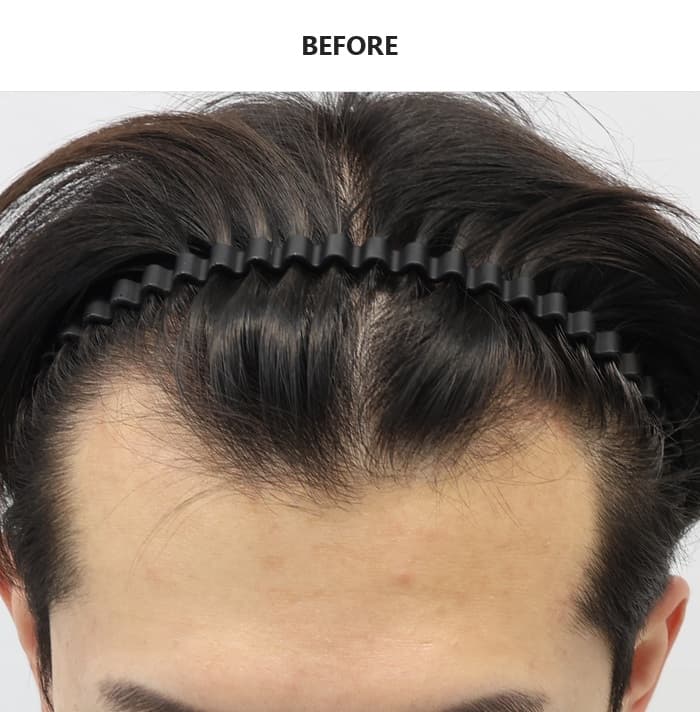
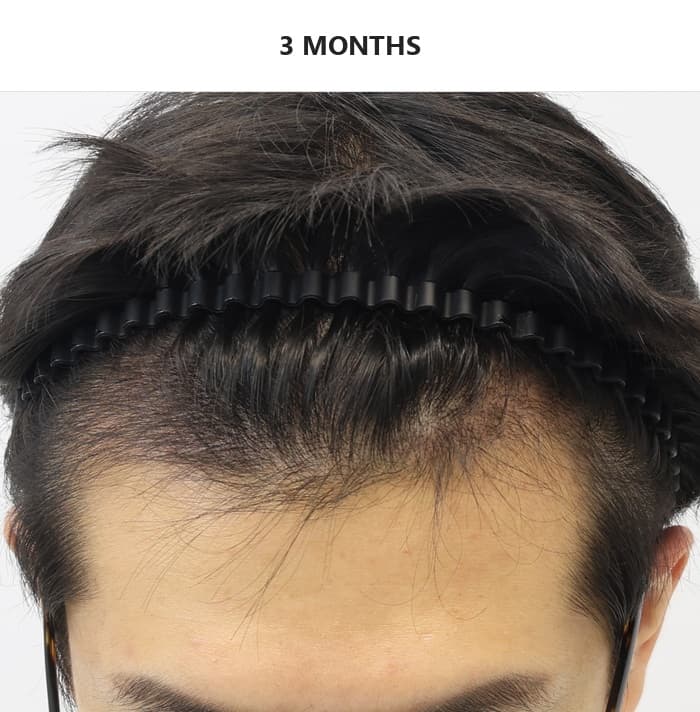
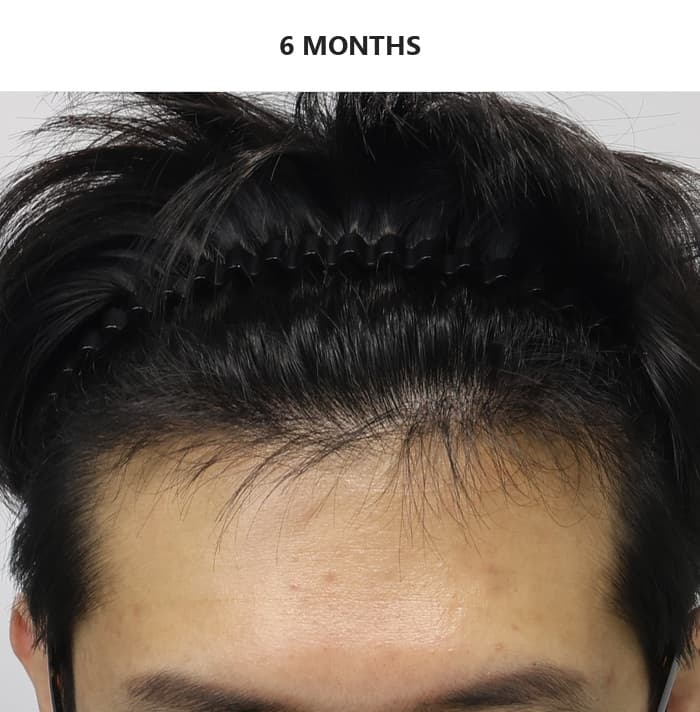
The photos below are actual case photos comparing the same patient's progress before surgery and at 3 months, 6 months, and 1 year. The video also shows the progress immediately after surgery and at 2 weeks.
Before Surgery
3 Months After Surgery
6 Months After Surgery
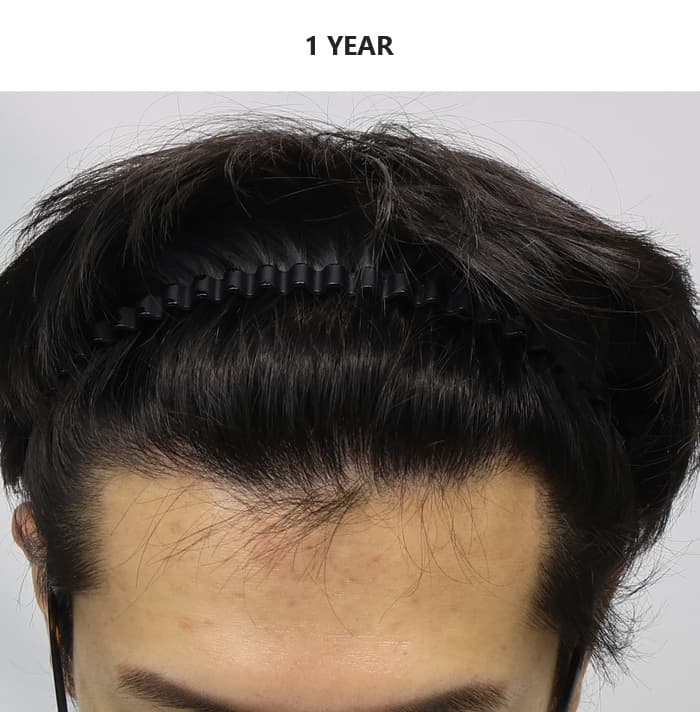
1 Year After Surgery
Early Post-Surgery Period: Protecting the Transplanted Area
Immediately after surgery, redness in the transplanted area, small scabs, and marks at the harvest sites may be observed. During this period, it is important to follow the instructions provided by the medical institution where you had the surgery regarding washing methods, sleeping position, exercise, and alcohol and smoking.
You should avoid scratching the transplanted area with your hands or forcibly removing scabs.
3 Months After Surgery: Observing Progress Even If Density Appears Reduced
After a hair transplant, the shafts of the transplanted hairs shed and the follicles go through a resting phase, so the density may actually appear lower than immediately after surgery.
This period is often referred to as the "ugly duckling phase" after a hair transplant. Its onset and duration vary from person to person, and the literature generally describes that new hair growth may be observed from around 3 months after transplantation.2
6 Months After Surgery: When Newly Grown Hair Becomes Visible
Newly growing hair may appear relatively thin or short rather than thick and long from the start. Over time, its length and thickness change and it blends in with the surrounding existing hair.
Therefore, 6 months is an important interim point, but the final result is not judged based on the appearance at this point alone.
1 Year After Surgery: Evaluating the Overall Change in the Hairline
Evaluating hair transplant results requires a sufficient growth period. Clinical guidelines generally describe evaluating results after considering a growth period of about 9 months or more after transplantation.
The actual growth rate differs from person to person and may also vary depending on the transplanted area, such as the hairline, frontal area, or crown.1, 2
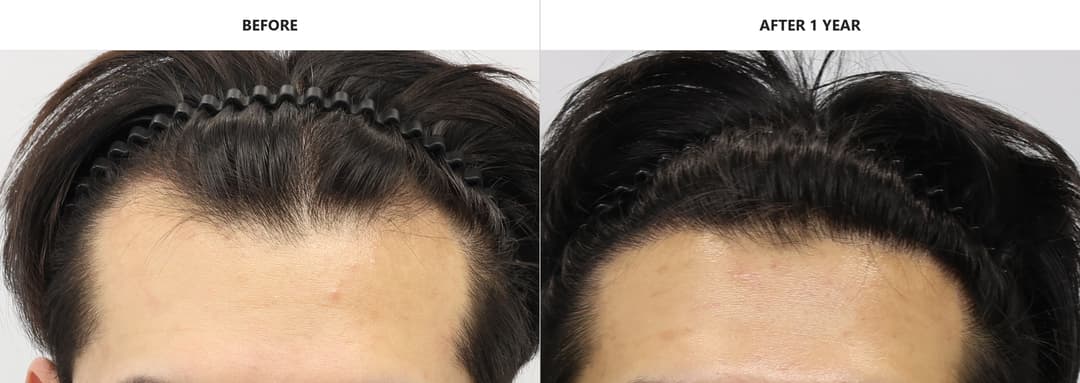
How Did the M-Shaped Hairline Differ Before Surgery and After 1 Year?
In the 1-year progress photo, you can directly compare both M-shaped areas that looked empty before surgery and the overall appearance of the hairline.
When viewing before-and-after hair transplant photos, rather than simply checking whether the hair "looks fuller," it is helpful to also look at the position of the hairline, the connection between both M-shaped areas, the harmony between existing and transplanted hair, and hair direction.
What Changes Did the Patient Feel After 1 Year?
In the interview, the patient said that after surgery he felt less self-conscious about the M-shaped areas than before and that his hairline looked neater.
He explained that people around him also told him his hairline looked good, and that as he became less preoccupied with his hair, there was also a change in terms of confidence.
Studies examining changes in appearance satisfaction and quality of life after hair transplantation have also observed improvements in psychological and social satisfaction measures in some patients. However, such changes do not appear equally in all patients.6
Therefore, before surgery, it is important to have a thorough consultation with the medical team about the hairline you expect and what can realistically be achieved.
Why He Decided on a Hair Transplant Together with His Father
Another notable aspect of this case is that the patient decided on a hair transplant together with his father, who had also been concerned about hair loss.
According to the patient, his father's hair loss in the crown area was more advanced than his own, and his father also evaluated the changes after surgery positively.
However, even within the same family, the type and extent of hair loss, donor area conditions, and the required transplant volume may differ.
In particular, an M-shaped hairline transplant and a crown transplant differ not only in the area required but also in the direction and whorl of existing hair and the sense of density that can be expected, so each requires a separate diagnosis and surgical plan.
If You Are Considering an M-Shaped Hairline Hair Transplant, What Should You Check First?
Before deciding on a hair transplant, the patient also named the cost of surgery as one of his important concerns.
However, when considering a hair transplant, accurately assessing your current hair loss condition should come first, rather than comparing only price or the number of hairs to be transplanted.
Male pattern hair loss can continue to progress in the surrounding existing hair, separately from the surgically transplanted area.
Therefore, it is important to make a long-term plan in the following order: current extent of hair loss → donor area condition → possibility of future hair loss progression → required transplant volume → care of existing hair.
Clinical guidelines also explain that male pattern hair loss is a progressive condition and that treatment to maintain existing hair should be considered as well.1, 2
M-Shaped Hairline Hair Transplant: Frequently Asked Questions
Does everyone need 2,600 hairs for an M-shaped hairline hair transplant?
No. The 2,600 hairs was the transplant volume applied in consideration of this patient's extent of hair loss, hairline design, and donor area condition. The number of hairs needed may vary depending on the size of the M-shaped area, the desired hairline position, hair thickness, existing hair density, and donor area condition.
Why might the hair look thinner at 3 months after a hair transplant?
Because the shafts of the transplanted hairs shed and the follicles then go through a resting phase, the density may appear lower than immediately after surgery. New hair grows gradually over several months.
Should hair transplant results be checked after 1 year?
Hair grows in stages over several months. Generally, interim progress is often checked at 6 months, and the overall change is evaluated from around 9–12 months. However, this varies depending on growth rate and the transplanted area.
Can swelling last 1–2 weeks after surgery?
Swelling is one of the recovery reactions that may occur after a hair transplant. Its degree and duration vary from person to person. If the swelling continues to worsen or is accompanied by severe pain, warmth, or discharge, you should consult the medical institution where you had the surgery.
If I get a hair transplant, will I no longer need hair loss medication?
A hair transplant is a treatment that relocates hair follicles to areas with hair loss, so hair loss may continue to progress in the surrounding existing hair that was not transplanted. Whether to use medication should be decided with the medical team after assessing your age, type of hair loss, rate of progression, and health condition.
Start by Checking the Hairline and Transplant Volume You Need
Even if M-shaped hair loss looks similar, facial proportions, hairline, hair thickness, donor area density, and the degree of hair loss progression differ from person to person.
It is important to first assess your current condition and then make a hair transplant plan that can be maintained over the long term.
This article is general health information based on a publicly available patient interview video, actual progress photos, and medical literature. The progress and satisfaction described reflect one individual's experience, and not all patients will experience the same results. The surgical method, transplant volume, recovery period, pain, swelling, hair growth rate, and final results may vary depending on the condition of the scalp and donor area, the degree of hair loss progression, and health status, and the actual treatment plan should be determined after examination by the medical team.
This content was written to provide general medical information about hair transplantation and the recovery process. The actual surgical method and transplant volume should be determined after assessing the patient's hair loss condition and donor area conditions.
References
- Mysore V, et al. Hair Transplant Practice Guidelines. J Cutan Aesthet Surg. 2021;14(3):265-284. PMID 34908769 · DOI
- Patwardhan N, Mysore V; IADVL Dermatosurgery Task Force. Hair transplantation: standard guidelines of care. Indian J Dermatol Venereol Leprol. 2008;74 Suppl:S46-S53. PMID 18688103
- Vasudevan B, et al. Hair transplantation by follicular unit extraction for male androgenetic alopecia: A retrospective observational study from two centers. Med J Armed Forces India. 2020;76(4):430-437. PMID 33162652 · DOI
- Kerure AS, Patwardhan N. Complications in hair transplantation. J Cutan Aesthet Surg. 2018;11(4):182-189. PMID 30886471 · DOI
- Sun Y, et al. Comprehensive Prevention for Edema after Hair Transplantation: A Multicenter Study of 1167 Patients. Plast Reconstr Surg. 2026;157(1):49e-57e. PMID 40663782 · DOI
- Maletic A, et al. Impact of Hair Transplantation on Quality of Life. Aesthetic Plast Surg. 2024;48(9):1825-1830. PMID 38123846 · DOI