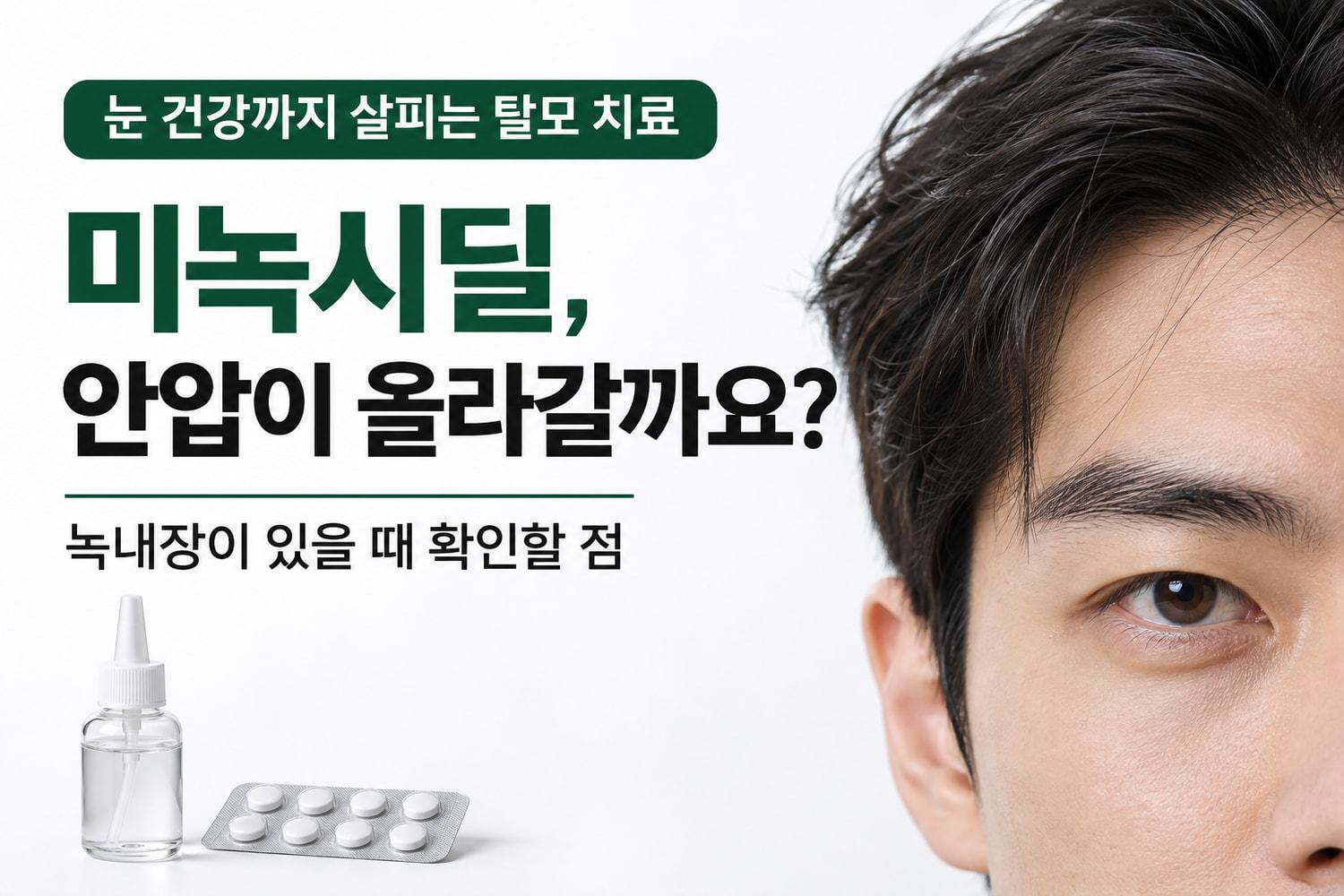
Minoxidil · Eye Pressure and Glaucoma
If You Are Concerned About Your Eye Health, How Should You Use Minoxidil?
“Does using minoxidil raise eye pressure?” “I have glaucoma—can I still receive hair loss treatment?” Based on the research available so far, it is difficult to conclude that minoxidil causes increased eye pressure or worsens glaucoma. However, the route of use (topical or oral), any existing eye conditions, and any symptoms that appear after use should all be reviewed together.
This article is based on a video by Director Yoo Hwa-jeong of Modi Hair Plant Clinic, and summarizes our review of the papers and product information covered in the video. We look at how to distinguish a feeling of discomfort around the eyes from an actual change in eye pressure, and what you should tell your doctor during a consultation.
Summary in 3 Points
- Based on current data, it is difficult to generalize that minoxidil raises eye pressure or worsens glaucoma.
- Eyelid swelling or stinging alone cannot indicate increased eye pressure, and any new change in vision requires an ophthalmology examination.
- It is advisable to share your glaucoma diagnosis, the eye drops and blood pressure medications you use, and the formulation and dose of your minoxidil so you can discuss a treatment approach suited to you.
Minoxidil and Eye Pressure: What Has Research Shown?
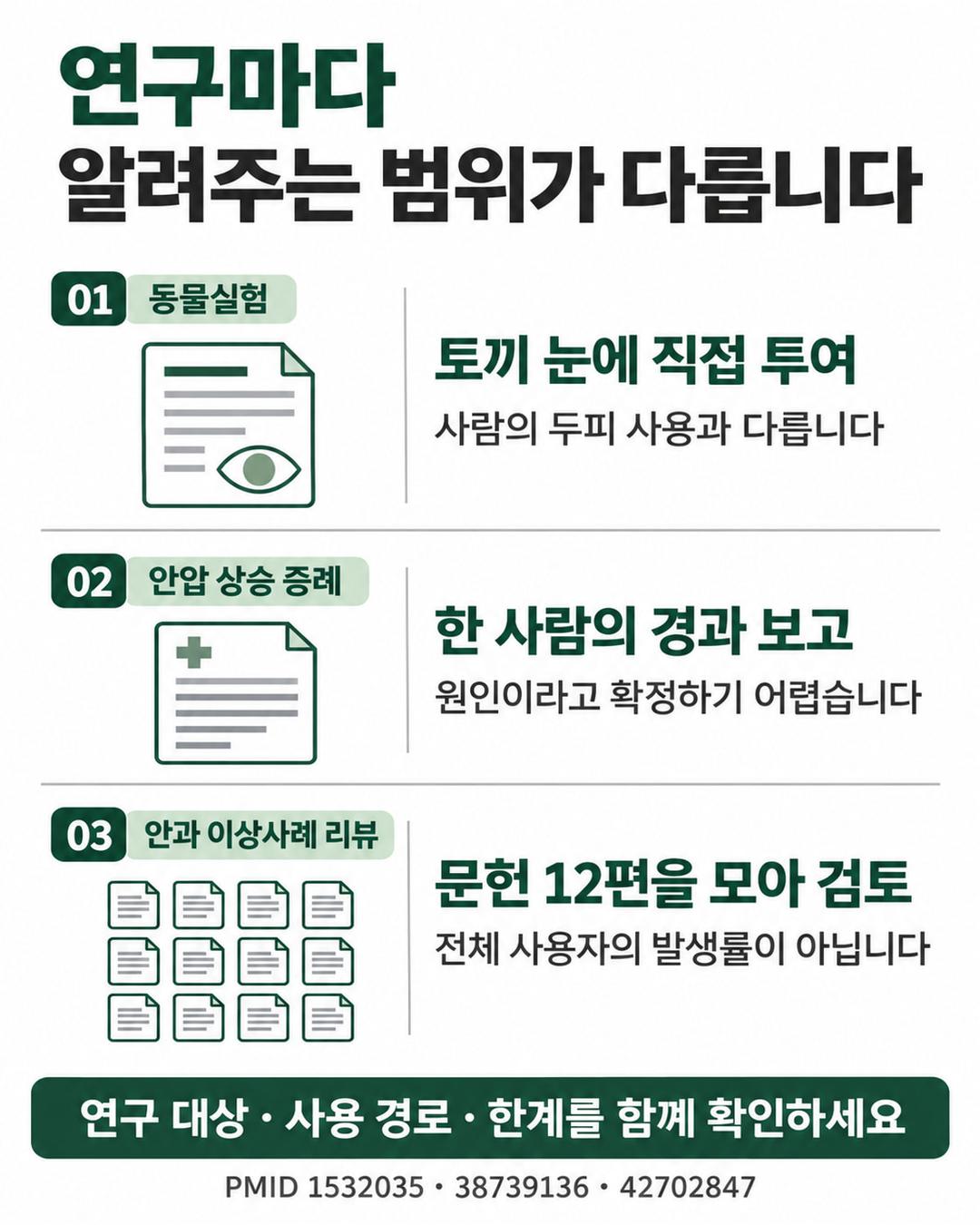
When reading a paper, you should first look at who the drug was used on and how it was used. An experiment in which the drug was applied directly to animal eyes, a case report documenting one person's clinical course, and a study analyzing many patients' medical records can each answer different questions.
An Experiment Applying the Drug Directly to Rabbit Eyes Differs from Scalp Use
In a 1992 study, a decrease in eye pressure was observed when 0.1% minoxidil was applied directly to rabbits' eyes. However, this study did not examine the results of applying minoxidil to the human scalp or taking it orally. This experiment should not be interpreted as evidence that minoxidil treats glaucoma in humans. Scalp products are not meant to be put in the eyes. [1]
A Case of Increased Eye Pressure Does Not Establish the Cause
In 2024, a case was reported in which high eye pressure was found in a 31-year-old man who had used topical minoxidil for 8 years. This patient stopped minoxidil and at the same time began treatment with eye drops to lower eye pressure. Later, his eye pressure rose again when the eye drops were changed. Because stopping the drug and treating the eye pressure occurred at the same time, it is difficult to confirm from this single case that minoxidil was the cause. [2]
A Review of 12 Ocular Adverse Event Reports Is Not an ‘Incidence Study’
A review published in 2026 examined 12 publications on ocular adverse events temporally associated with minoxidil use. These included retinal and optic nerve problems and increased eye pressure, but causality was generally assessed only at the level of possibility. The proportions among selected cases should not be read as the incidence of side effects among all users. This review alone cannot establish the risk of glaucoma worsening or the safety for all users. [3]
Taking the research together: There are reported cases of eye changes after minoxidil use, but current data do not provide sufficient grounds to conclude that increased eye pressure or glaucoma worsening is a typical outcome. Decisions should be based on each individual's eye condition and symptoms.
If Your Eyelids Are Swollen or Stinging, Has Your Eye Pressure Gone Up?
When the area around your eyes feels uncomfortable, it is easy to worry about eye pressure first. However, symptoms such as eyelid swelling or stinging alone cannot tell you whether eye pressure has increased. Eye pressure and optic nerve condition are checked through an eye examination. Glaucoma may have no early symptoms and can occur even with eye pressure in the normal range, so it should not be judged solely by the presence or absence of symptoms. [4]
If topical minoxidil gets into the eyes or is transferred to the area around the eyes by the hands, irritation may occur. Product information also advises avoiding contact with the eyes and, if contact occurs, rinsing with large amounts of cool tap water. If irritation persists or swelling recurs, stop use and see a doctor to identify the cause. [5]
Have Sudden Vision Changes Checked by an Ophthalmologist First
If you experience new blurred vision, decreased vision, or objects appearing distorted, do not wait while deciding on your own whether minoxidil is the cause. Suspend use and see an ophthalmologist promptly. In particular, if severe eye pain, redness, nausea, and blurred vision appear suddenly, go to an ophthalmologist or emergency room immediately. [3] [4]

Topical and Oral Medications Require Different Checks
Topical Minoxidil
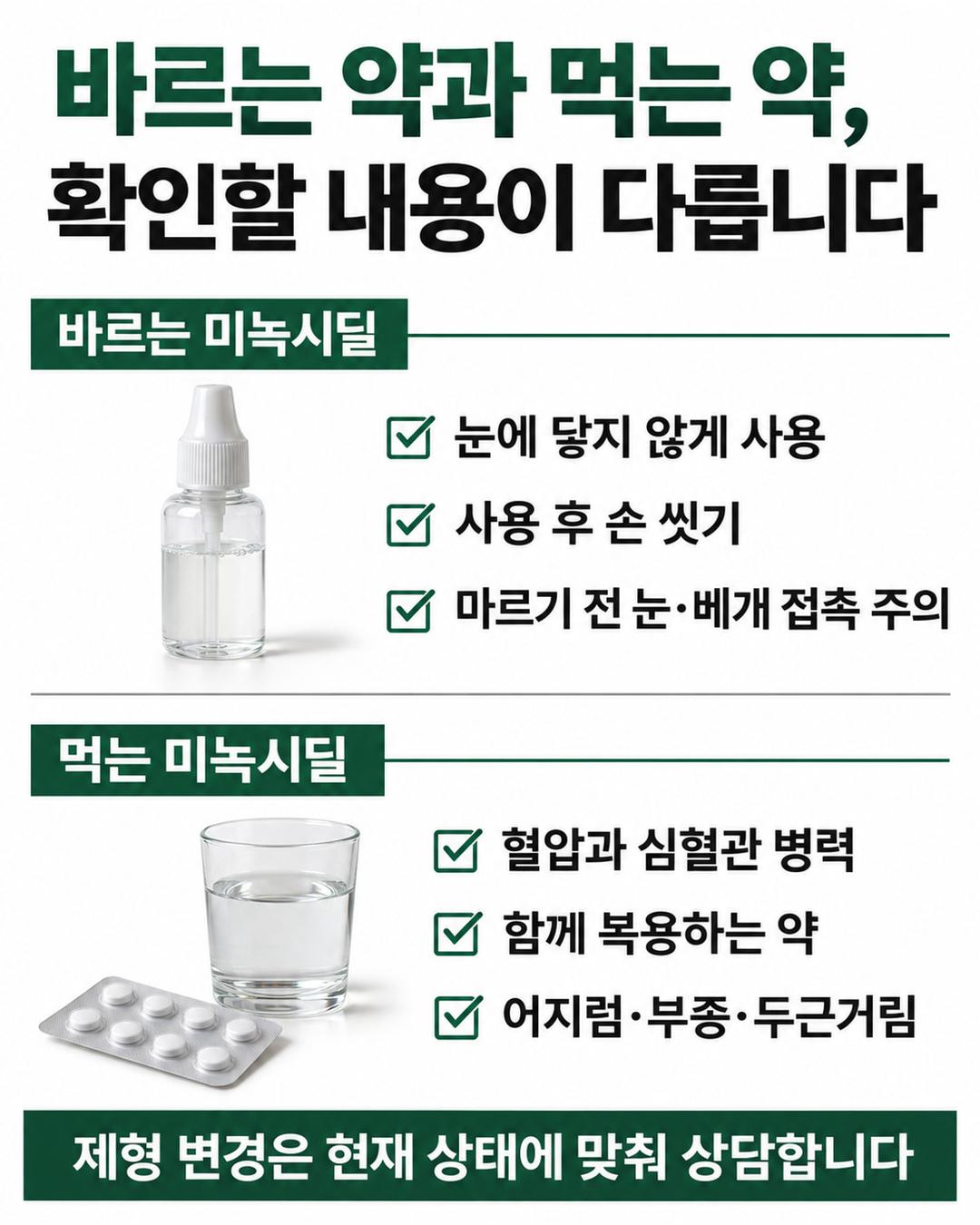
Check how you apply it so that the medication does not run down your forehead or reach your eyes via your hands. Wash your hands after use, and keep the medication from getting on the area around your eyes or on your pillow before it dries. If irritation around the eyes recurs, review the product, the amount used, and the application method together. [5]
Oral Minoxidil
Blood pressure, current medications, history of cardiovascular disease, and any swelling or dizziness are reviewed together. A study of low-dose oral minoxidil analyzing 1,404 patients reported hypertrichosis, dizziness, fluid retention, palpitations, and other effects. However, this was a retrospective study without a control group, and it did not separately examine changes in eye pressure or glaucoma progression. [6]
Rather than switching straight to the oral medication because of eye irritation, or deciding on all minoxidil use uniformly because you have an eye condition, please tell us specifically which formulation caused which symptoms. This helps in adjusting the treatment plan to your current condition.
At Modi, Please Tell Us About Eye Conditions and Medications Too
Continuing hair loss treatment over the long term requires looking at both changes in your hair and any discomfort during medication use. Based on the research introduced in the video, this article also summarizes what to check when sharing existing conditions and medications and responding to new symptoms.
If you are being treated for glaucoma or high eye pressure, please share your ophthalmology diagnosis and recent test results. If your ophthalmologist has given you any guidance related to hair loss treatment, it is helpful to pass that on as well. This helps in discussing the route and dose of minoxidil while continuing follow-up with your ophthalmologist.
5 Things to Prepare Before Your Consultation
- Ophthalmology diagnosis: Whether you have been diagnosed with glaucoma or ocular hypertension, and recent test results
- Current medications: Names or photos of eye drops, blood pressure medications, and other medications
- Minoxidil use details: Topical or oral, product name, concentration/dose, and duration of use
- Timing of symptoms: When and what changes occurred after starting use or changing the dose
- Previous medical guidance: Precautions for use given by your ophthalmologist or prescribing physician

Frequently Asked Questions
If topical minoxidil makes my eyes sting, can I just switch to the oral medication?
First, you need to check whether the medication got into your eyes or onto the skin around your eyes, and how you are using the product. The oral medication requires separate consideration of blood pressure, swelling, and other medications, so it is not an automatic substitute. If irritation recurs, share your current product and symptoms and discuss whether a change in formulation or a different treatment is needed.
Is it fine to use glaucoma eye drops and minoxidil if I just space them apart?
Leaving a gap of a few hours alone does not determine whether they can be used together. The ingredients of the eye drops, the route and dose of minoxidil, and your current eye condition all need to be reviewed together. Tell the physicians treating you on both sides the names of your eye drops and hair loss medications, and do not stop glaucoma eye drops on your own.
My eye pressure was normal at my last exam, but one eye has suddenly become blurry. Can I wait?
Even if your previous eye pressure was normal, that does not explain the cause of a new vision change. Suspend minoxidil use and see an ophthalmologist promptly. Sharing the product name, the date you started using it, and when the symptoms appeared helps with the evaluation. If severe eye pain, redness, or nausea accompanies it, immediate medical care is needed.
If the 1,404-patient study did not report increased eye pressure, does that mean it is safe for glaucoma?
It is difficult to interpret it that way. This study retrospectively analyzed adverse reactions among users of low-dose oral minoxidil; it did not systematically measure eye pressure or compare glaucoma progression. It is a reference when choosing a medication, but it does not replace individual ophthalmology care.
Consult on Hair Loss Treatment Suited to You, with Your Eye Health in Mind
If you are hesitant about using minoxidil, please share your current diagnoses, medications, and any changes you have noticed during use. At Modi Hair Plant Clinic, you can discuss a treatment direction suited to your scalp and hair condition and medical history.
Watch Director Yoo Hwa-jeong's Video
Starting with the question about increased eye pressure, the video explains in turn the animal experiment, the case of increased eye pressure, the review of ocular adverse events, and the oral minoxidil study. In this article, we have summarized the subjects and limitations of each study separately.
The research introduced in the video is information for reference when making treatment decisions. Reviewing the names of the medications you use together with your own test results allows for a more specific discussion during your consultation.
References and Resources
[1] Nathanson JA. Nitrovasodilators as a new class of ocular hypotensive agents. J Pharmacol Exp Ther. 1992;260(3):956–965. PMID: 1532035. PubMed
[2] Erichev VP, Zinina VS, Safonova DM. Minoxidil-induced ophthalmic hypertension (case report). Vestn Oftalmol. 2024;140(2 Vyp 2):90–93. DOI: 10.17116/oftalma202414002290. PMID: 38739136.
[3] Akiska YM, Boginskaya O, Mumtaz A, Sibbald C, Ali A. Ocular Events Temporally Associated With Minoxidil: A Structured Review. J Cutan Med Surg. Published online September 6, 2026. DOI: 10.1177/12034754261484559. PMID: 42702847.
[4] National Eye Institute. Glaucoma. Information on glaucoma, eye pressure, and symptoms requiring medical care. Accessed: November 26, 2026.
[5] DailyMed. Hair Regrowth Treatment—minoxidil solution 5%. Official product label. Refer to precautions for use, including eye contact and rinsing. For products sold in Korea, check the approved information and package insert for that product.
[6] Vañó-Galván S, et al. Safety of low-dose oral minoxidil for hair loss: A multicenter study of 1404 patients. J Am Acad Dermatol. 2021;84(6):1644–1651. DOI: 10.1016/j.jaad.2021.02.054. PMID: 33639244.
This article provides general medical information and does not replace individual diagnosis or prescription. Treatment responses and adverse reactions vary from person to person, and whether to use minoxidil, as well as its formulation and dose, is decided based on medical history and examination results.