
A Guide to Using Topical Hair Loss Treatments
Is It Okay to Apply Minoxidil Right After Shampooing?
As a basic rule, topical minoxidil should be used after the hair and scalp are thoroughly dry. Rather than how many minutes have passed since shampooing, what matters is checking whether any moisture actually remains. This article covers everything from the application sequence to hair dryer use and how to handle a missed dose.
Key Points
- If you have shampooed, apply only after sufficiently removing moisture from the hair and scalp.
- Do not apply it only to the hair; apply the amount specified for your product to the scalp in the treatment area.
- After application, let it air-dry, and do not increase the dose or frequency on your own.
What Kind of Treatment Is Topical Minoxidil?
Minoxidil is a therapeutic ingredient used for conditions such as androgenetic alopecia. Topical products are applied to the scalp, and the method of use may differ depending on the formulation, such as liquid or foam, and the concentration. Various actions related to hair growth have been studied, but the exact mechanism of action has not been fully identified. It is also not a treatment that has the same effect on all types of hair loss. [1]
Therefore, when choosing a product, rather than comparing concentration alone, you should also check your hair loss type and scalp condition, as well as the intended users and directions for that product.
Why It Should Be Used on a Dry Scalp Rather Than Wet Hair
MedlinePlus advises using it when the hair and scalp are dry. The official Korean guidance for Rogaine Foam likewise instructs users to dry the scalp completely before application. This principle is intended to avoid the medication being diluted by remaining moisture or running onto surrounding areas, and to use it under the conditions described in the guidance. [2] [3]
This does not mean that “applying it once to wet hair means it had no effect at all.” The usage guidance cited here alone cannot be used to calculate the difference in effect between a wet scalp and a dry scalp as a specific ratio. What matters is following the product's guidance from your next use onward.
How to Use Minoxidil After Shampooing
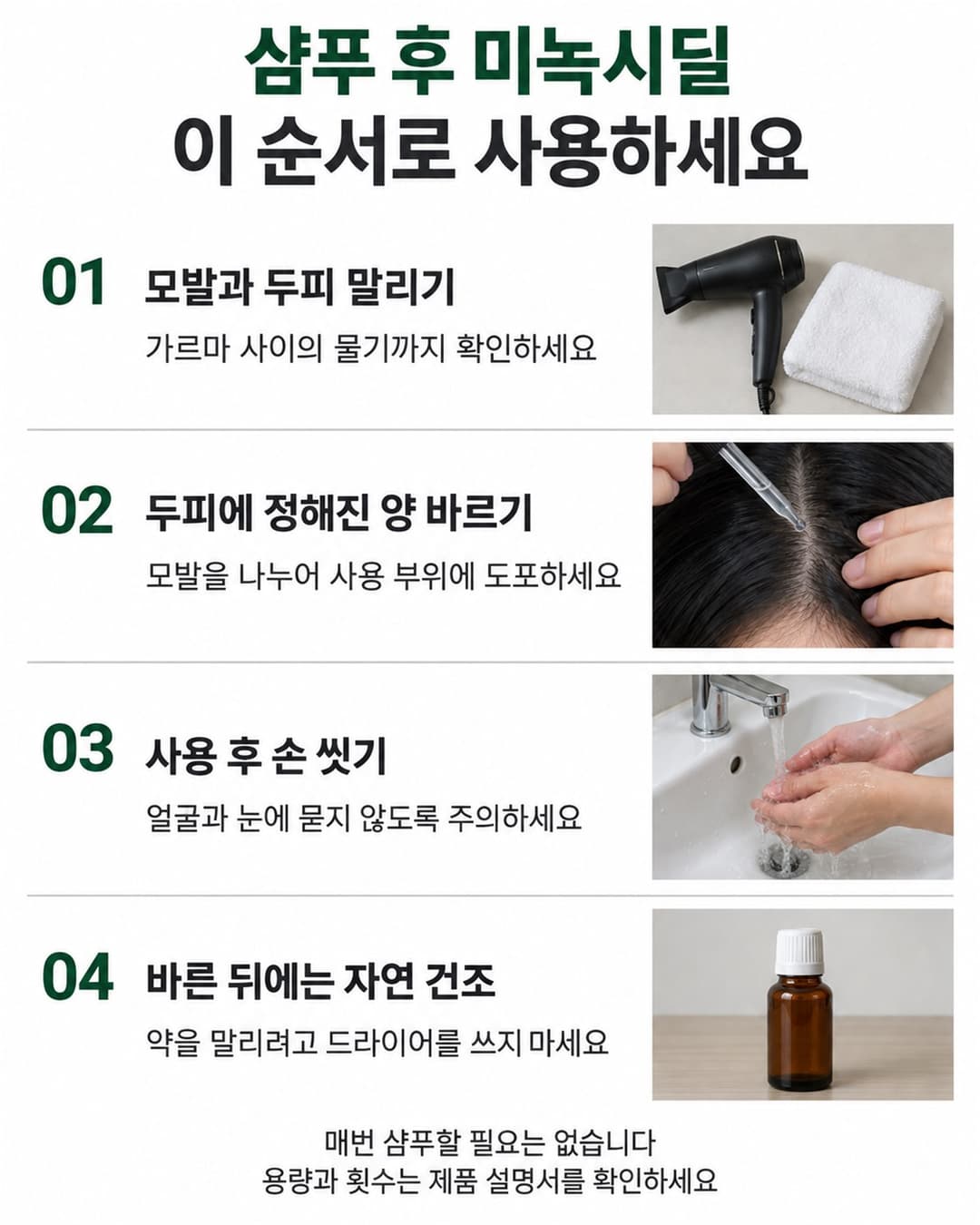
1. Check for moisture between the hairs and on the scalp
If you have only wiped the surface with a towel, moisture may remain along the parts in your hair. Part your hair and check whether it is dry down to the scalp. It is difficult to apply the same “waiting time after shampooing” to everyone.
2. Apply the specified amount to the scalp in the treatment area
Part the hair so the scalp is visible, then apply according to the applicator and directions included with the product. Do not decide on “how many drops” or “how many sprays” on your own; check the standard for that product.
3. Wash your hands after use
Wash your hands so that medication remaining on them is not transferred to your face or eyes. If it gets on an unintended area, rinse with water, and if irritation persists, a consultation is needed.
4. After application, let it dry naturally
The official Rogaine Foam guidance does not recommend using a hair dryer to dry the medication quickly. Styling your hair after the medication has dried should be distinguished from drying the medication immediately after application. [3]
You do not need to shampoo every time you apply it. The sequence above describes use on days when you have shampooed. If there are product instructions or individual guidance from your medical provider, follow those first.
Drying Before Application and Drying After Application Are Different
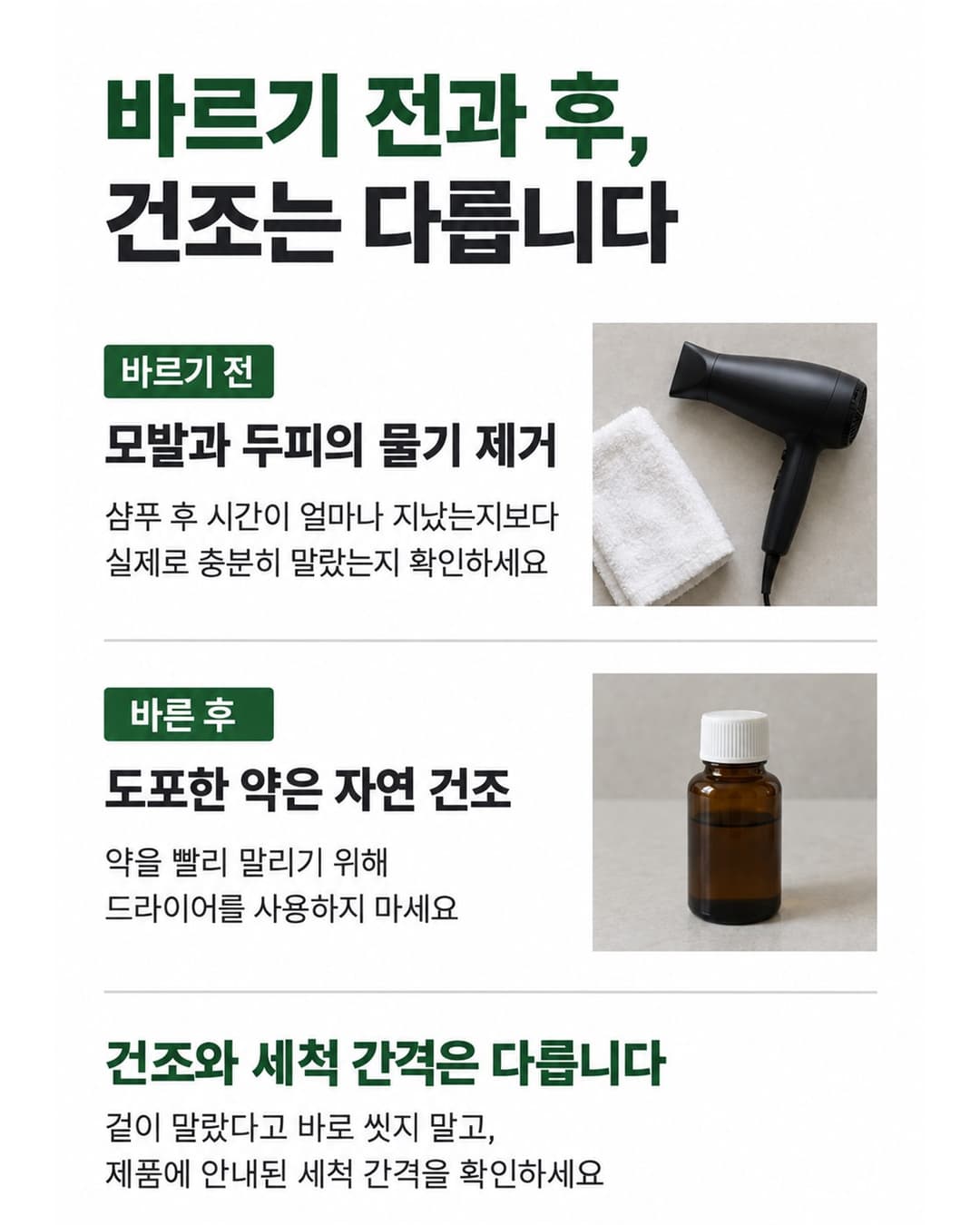
Before application, remove moisture
This is the step of drying the moisture left after shampooing. Check that the scalp and hair to be treated are dry.
After application, let the medication air-dry
This is the step of leaving the applied medication to dry. Do not use a hair dryer to finish more quickly.
Appearing dry on the surface does not mean the same thing as being ready to wash. Check the interval before shampooing or swimming after application separately in the instructions for the product you are using. It is best not to apply the guidance for a specific product uniformly to all liquid and foam products.
If the Concentration or Formulation Differs, Check the Dose and Frequency Too
Even with the same minoxidil, the intended users, amount per application, and number of daily uses may differ by product. Rather than simply copying how someone else uses it, check based on the name of your own product.
- Product name and concentration: Check not only whether it is the same ingredient but also the concentration.
- Formulation and measuring method: Do not calculate the amount of liquid and foam in the same way.
- Intended users and frequency: Check the product's guidance, which may vary by factors such as sex.
Using more or using it more often does not make it work faster. Using more than the recommended amount may increase the risk of side effects. [2]
Points to Consider When Assessing Results
Changes from minoxidil are not judged after one or two applications. Evaluating the response may take several months, and results vary between individuals. If there is no change despite adequate use, or if hair loss progresses, it is advisable to recheck the diagnosis and method of use rather than increasing the amount. [1]
The review in the references summarizes the effects and adverse reactions of minoxidil across multiple studies. It would not be appropriate to present it as a clinical trial that directly compared the effects of “wet hair versus dry hair.” The application sequence in this article is based on the medication's usage guidance.
Common Mistakes and Situations That Require Consultation
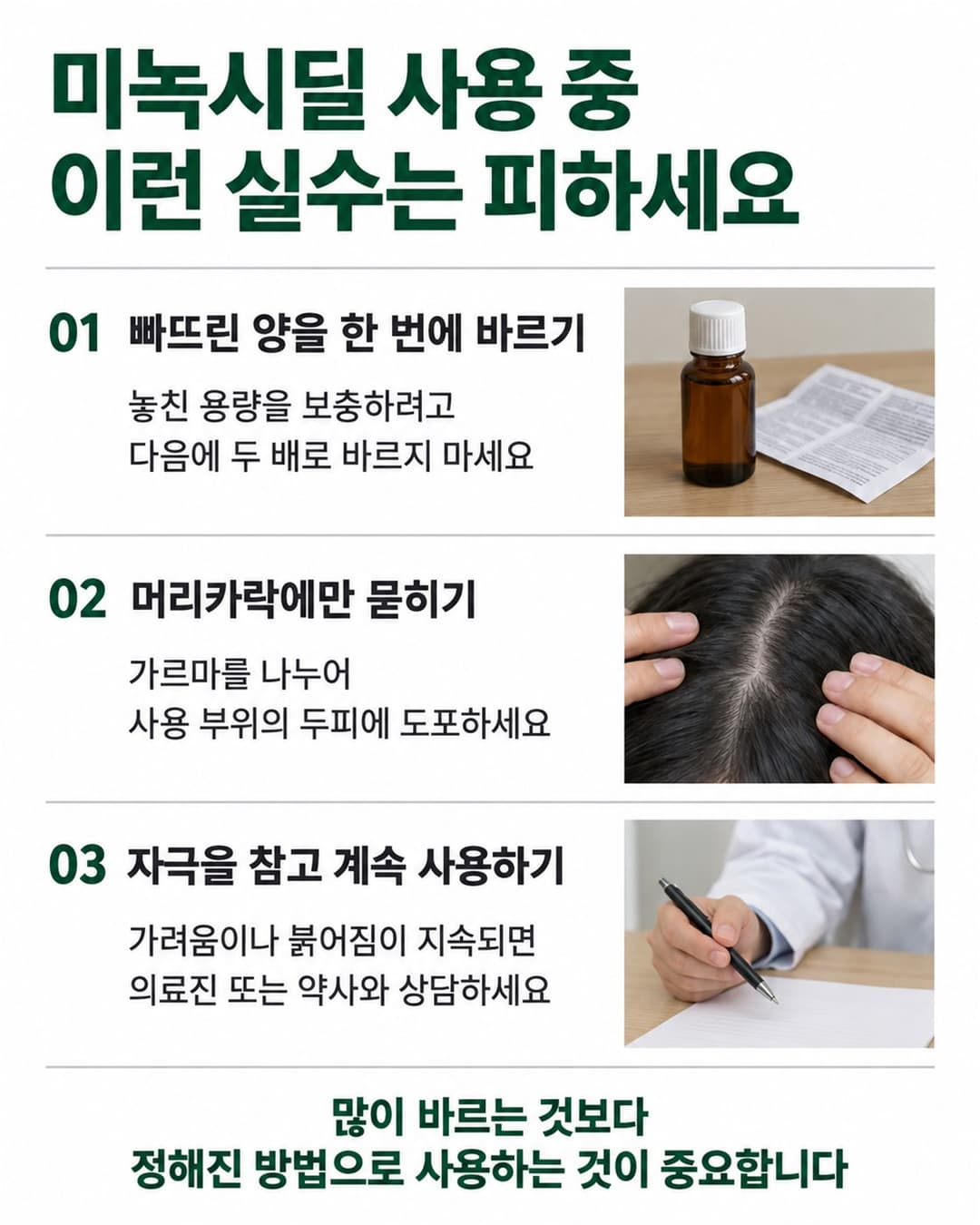
If you miss an application, do not make up for it by doubling the next one. Also, persistent itching, redness, or flaking should not automatically be interpreted as a sign that the medication is working. Other causes, such as scalp irritation or contact dermatitis, need to be checked. [2] [1]
In these cases, consult first about whether to use it
- If there is inflammation or a wound on the scalp, or severe irritation
- If you are pregnant, planning a pregnancy, or breastfeeding, or have existing medical conditions or take medications
- If you have just had a hair transplant and the surgical area is still healing
If chest pain, severe palpitations, dizziness, difficulty breathing, or swelling occurs during use, stop using it and seek medical care promptly. If symptoms are severe, emergency care is needed immediately. [2]
Frequently Asked Questions
If my scalp is dry but the ends of my hair are damp, can I apply it?
Rather than judging by touching only the scalp, using it after the hair is also sufficiently dry is consistent with the medication guidance. In particular, check whether moisture remains between the hairs in the application area.
If I washed my hair soon after applying it, should I apply it again?
Do not apply an extra dose on your own because you think it was washed off. It is advisable to tell a pharmacist the product you used and when you applied and washed, and confirm how to proceed with your next use.
Which should I use first, minoxidil or hair wax?
The official Rogaine Foam guidance instructs users to apply the medication and use styling products after it has completely dried. If you use a different product, check its instructions as well.
If the liquid makes my scalp itchy, will switching to foam solve the problem?
Additives differ by formulation, so the degree of irritation may differ, but switching does not necessarily solve the problem. Decide on a change after identifying the cause, such as a reaction to minoxidil itself or to an additive, or an existing scalp condition. [1]
If I had a hair transplant, can I immediately resume the minoxidil I was using before?
Even if it is a product you used before surgery, do not resume it on your own. After the healing of the transplant area and donor area has been checked, get guidance from your surgical team on when to resume use and where to apply it.
Remember: “Dryness, Application Area, Specified Amount”
If you have shampooed, dry thoroughly, apply the specified amount to the scalp in the treatment area, and let it air-dry. Even if results seem slow, it is advisable to check the product's directions and your scalp condition before increasing the amount.
If You Want to Know the Right Method for Your Scalp
Please note the name, concentration, and frequency of use of the product you currently use, along with any uncomfortable symptoms, and share them during your consultation. We can check your hair loss type and scalp condition and discuss a treatment approach.
References and Official Usage Guidance
- Suchonwanit P, Thammarucha S, Leerunyakul K. Minoxidil and its use in hair disorders: a review. Drug Design, Development and Therapy. 2019;13:2777–2786. DOI: 10.2147/DDDT.S214907. PMID: 31496654. View on PubMed
- American Society of Health-System Pharmacists. Minoxidil tópico. MedlinePlus drug information, Spanish edition. Document revised: November 15, 2017. View official drug information
- Kenvue Korea Sales. Rogaine Foam Official FAQ. Product guidance on drying before application, hair dryers, and styling. View official usage guidance
Sources verified: September 15, 2026. Product guidance applies to the respective product and does not replace the directions for other formulations or concentrations.
This article is intended to provide general medical information and does not replace individual diagnosis or prescription. Treatment response and adverse reactions may vary from person to person, and whether and how to treat is determined after a consultation. When actually using a product, follow its latest instructions and the guidance of your medical provider or pharmacist.