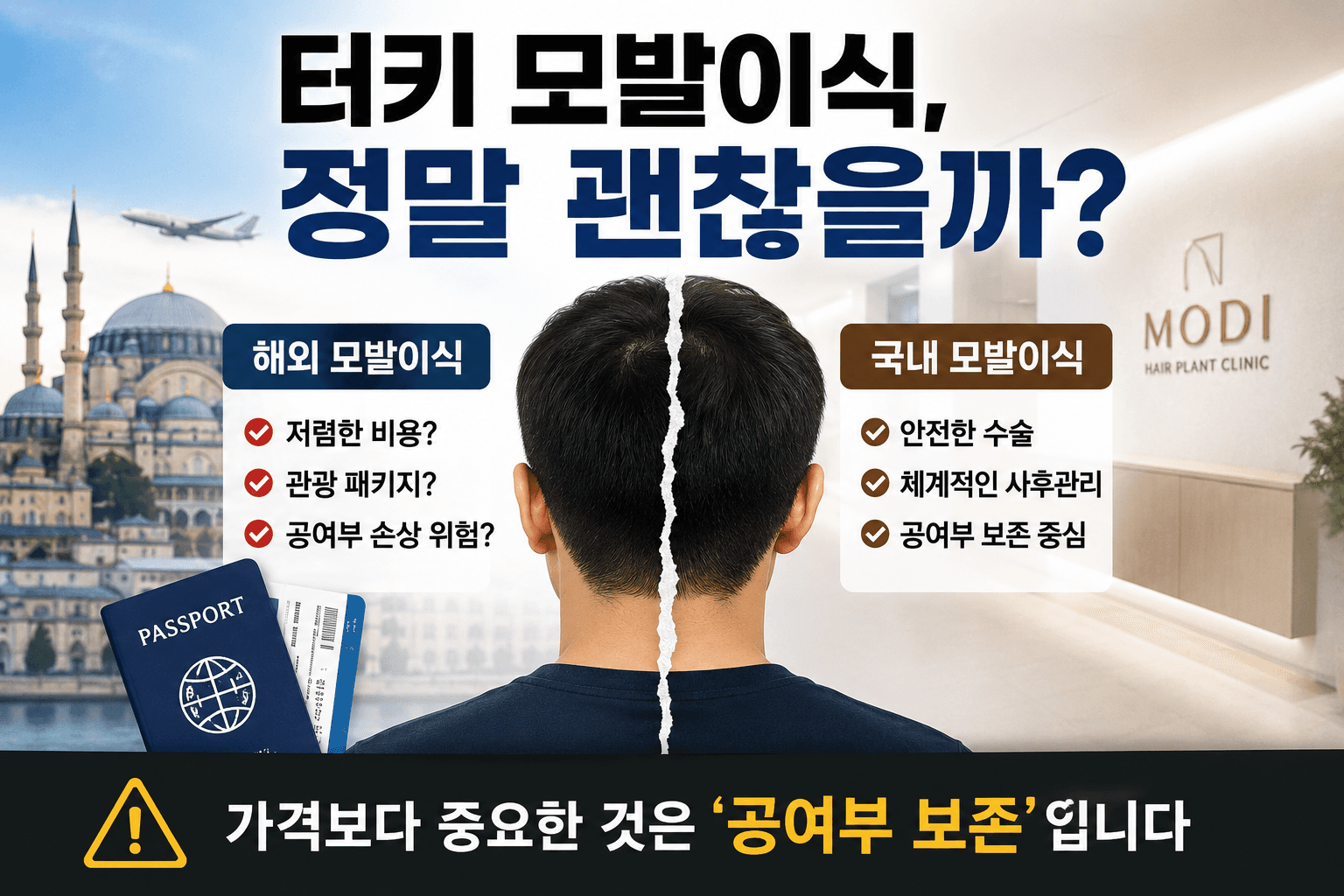
A hair transplant abroad has the advantage of costing less than in Korea, but with procedures performed overseas, such as a hair transplant in Turkey, damage to the donor area or excessive harvesting can make revision surgery difficult for the rest of your life. If you are considering a hair transplant abroad, you should check not only the price but also how the donor area is managed and what the surgical plan is.
Key Takeaways
✔ With a hair transplant abroad, preserving the donor area matters more than the price.
✔ Using a large punch can permanently damage the donor area.
✔ The donor area is a limited hair follicle resource that must last a lifetime.
✔ When choosing a clinic, check the harvesting method and long-term plan rather than the price.
“They say it's much cheaper in Turkey, and sightseeing is even included. Would it be okay to have it done there?”
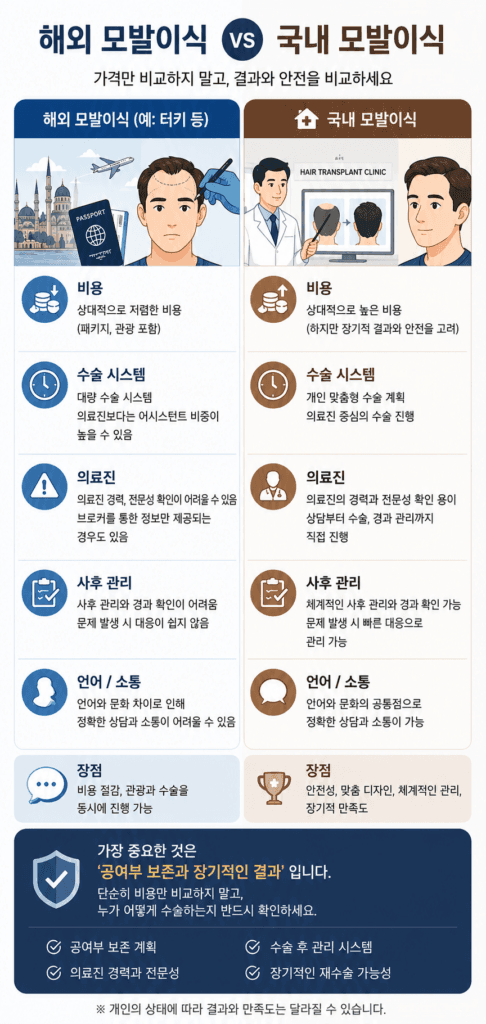
Demand for hair transplants abroad, particularly in one specific country, is still considerable. The joke that “I boarded the plane and it wasn't Turkish Airlines but ‘Turkish Hairlines’” has circulated widely, which also shows how many people travel overseas for the surgery. I am Yoo Hwa-jung, Director of Modi Hair Plant Clinic. Today, for those considering a low-cost hair transplant abroad, I would like to explain through one case why caution is needed.
Why Is a Hair Transplant Abroad So Inexpensive — and What Is Easy to Overlook?
The biggest draw of surgery abroad is the price. It is much cheaper than in Korea, and some packages even include sightseeing, which makes it tempting. Such procedures were once quite popular, and they declined noticeably for a time after poor outcomes became publicly discussed. However, some places still promote themselves with “cheap and lots of grafts,” and we continue to encounter such cases recently.
What truly matters in a hair transplant is not the immediate price but the result that remains for a lifetime. In particular, the condition of the back of the head, the donor area from which hair follicles are harvested, is key.
What a Surgery Performed 10 Years Ago Showed
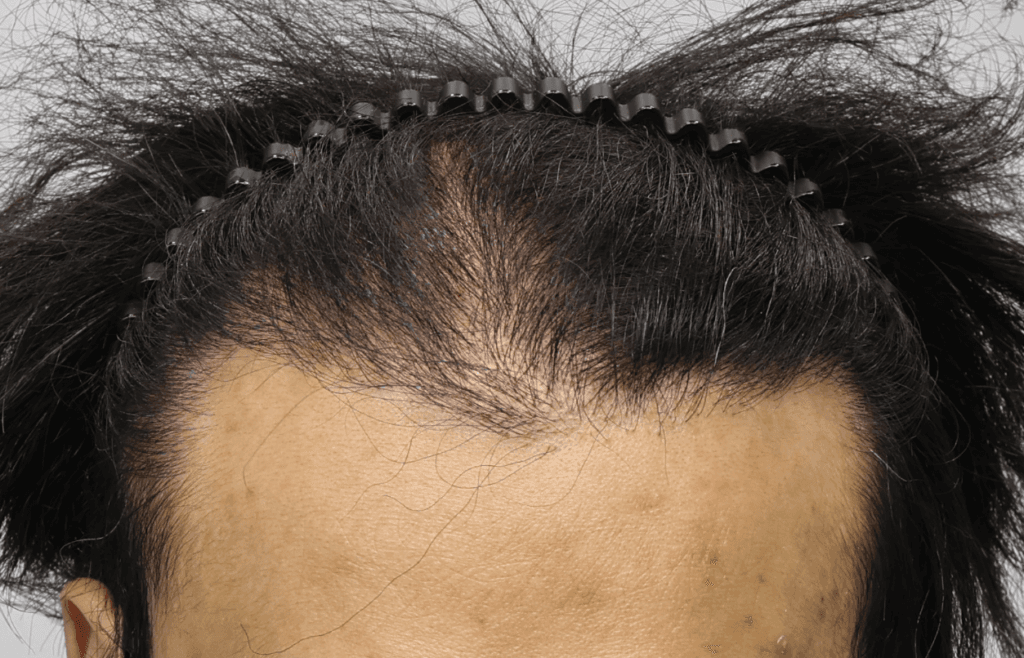
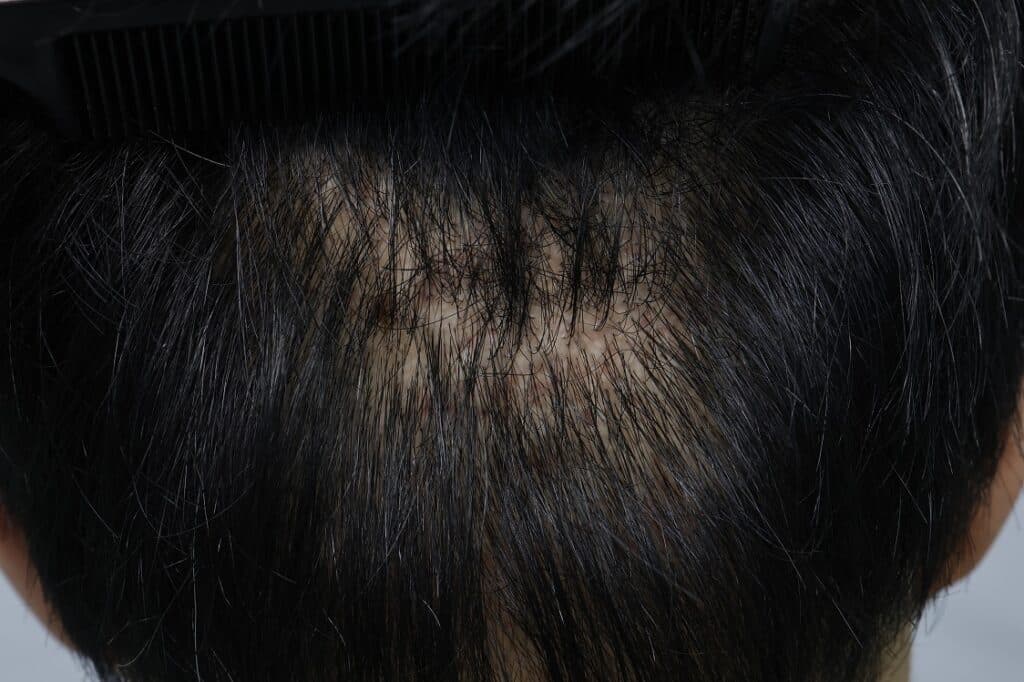
Recently, a man in his 30s visited us. He said he had received about 3,500 hairs through the non-incision (FUE) method abroad 10 years ago. The hairline design, density, and naturalness of the transplanted area were all difficult to consider satisfactory. But what truly surprised me was not the front but the back of his head.
Originally, he was neither someone with thin hair nor someone with severe hair loss. Yet the donor area where harvesting had taken place was severely damaged. The transplanted hair appeared to be far fewer than 3,500 hairs, while the back was so empty that the amount harvested was estimated at around 6,000 hairs.
The Core of the Problem — Donor Area Depletion Caused by a “Large Punch”
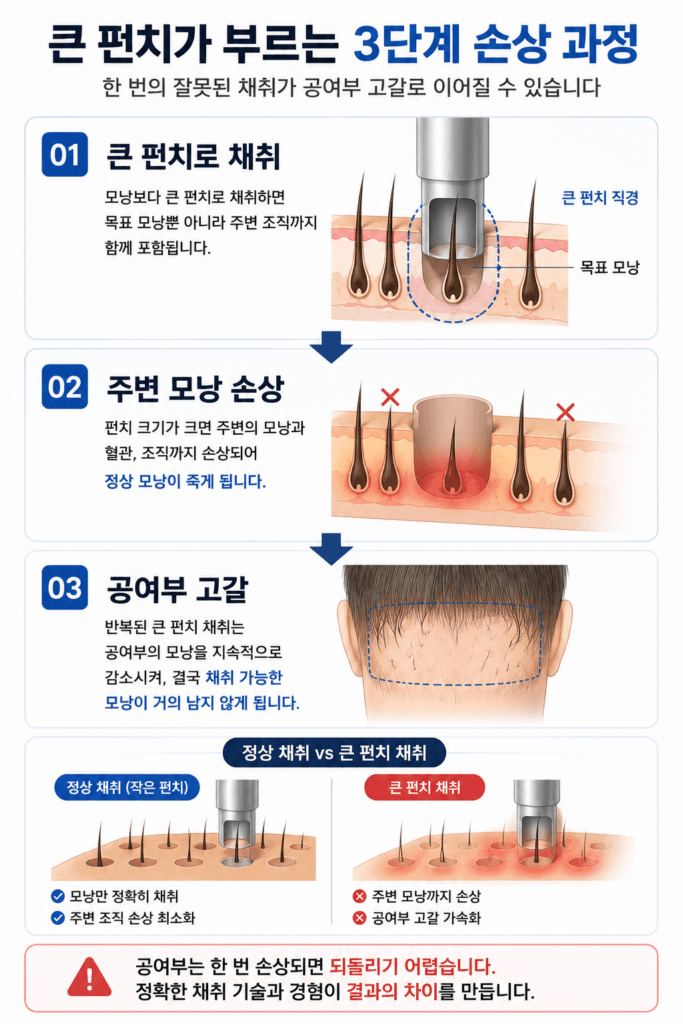
The reason the back of the head becomes so devastated is not simply that many hair follicles were harvested. The problem is the size of the punch used for harvesting.
Hair follicles are positioned at regular intervals on the scalp. However, if follicles are harvested with a punch much larger than the follicle in order to extract them quickly and easily, not only the targeted follicle but also surrounding follicles are damaged. As a result, follicles that should have remained die off, leaving a situation in which most of the surviving follicles in the donor area contain only a single hair.
Once a donor area has been damaged, it is very difficult to harvest follicles from it again. So in such cases, we have no choice but to set aside the desire for a more aesthetically ideal result and make a plan within a realistic range, such as reinforcing the density of existing areas using the remaining resources.
More Concerning Than the Price — An Irreversible Resource
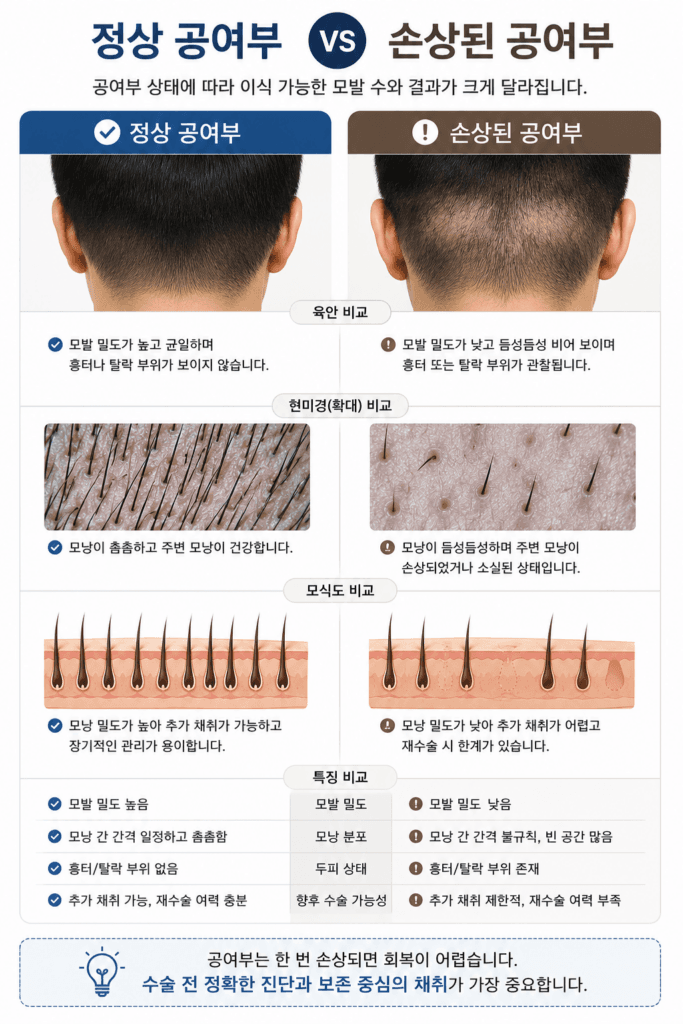
In a hair transplant, your own hair is a resource that cannot be bought back with money. Nor can someone else's hair be transplanted. That is how limited and valuable the hair follicles in the donor area are for each person.
However, if the back of the head is depleted for the sake of “cheap and lots of grafts,” especially in younger patients, there will be no capacity left to use in their 50s, 60s, and 70s. In a structure where it is difficult to take responsibility for long-term results, completing the immediate surgery can easily become the goal. Moreover, when surgery is performed in another country, it is realistically not easy to respond if problems arise.
Frequently Asked Questions
Should I never get a hair transplant abroad?
Not necessarily. If you have it done at a truly skilled facility, the fact that it is abroad is not itself the problem. However, we recommend carefully avoiding places that rely on brokers and tourism and advertise along the lines of “we transplant a lot for much less than in Korea.” The key is not the country but who performs the surgery and how.
If my donor area is already damaged, can it be restored?
A donor area once damaged by a large punch or similar is difficult to return to its original state. Since possible plans vary depending on the condition of the remaining follicle resources, what is possible and to what extent can only be determined after directly examining the scalp. We recommend seeking a consultation early.
What should I check when choosing a clinic?
Rather than looking only at price, it is advisable to check the hairline design, density, and above all, how the donor area is preserved during harvesting. See whether the clinic creates a plan that takes into account long-term results and capacity for future revision surgery.
Why is a hair transplant in Turkey cheaper than in Korea?
Cost differences may arise due to factors such as labor costs, exchange rates, and high-volume surgical systems. However, rather than choosing a clinic based on cost alone, it is important to also check the medical team's experience, donor area management approach, and aftercare.
In Summary
- The real risk of a low-cost hair transplant abroad lies in donor area damage, which is not easily noticed.
- Harvesting with an excessively large punch can kill surrounding follicles as well, depleting the back of the head.
- Your own hair is a limited resource that cannot be bought back, so caution is especially needed for younger patients.
- A skilled facility is fine even if it is abroad, but we recommend avoiding broker-driven surgeries that promote “cheap and lots.”
In a hair transplant, how you preserve the donor area you will use for a lifetime matters more than any single surgery. If you are considering a hair transplant abroad, we encourage you to seek a consultation covering not only the cost but also the condition of your donor area and a long-term surgical plan.
References
- Complications in follicular unit excision hair transplantation: current evidence and practical approaches. Frontiers in Medicine. 2026. View original
- Donor site preservation and long-term management in follicular unit extraction (FUE): a structured clinical framework for surgical planning and complication prevention. Cosmetics (MDPI). 2026. View original
- Donor harvesting: follicular unit excision. PMC (NIH). View original
- 💬 KakaoTalk consultation: https://pf.kakao.com/_ExmRuT
- 📞 Phone consultation: 02-544-8659
- 🌐 Website: http://www.modihairplant.com
This article was adapted from a YouTube video by Director Yoo Hwa-jung of Modi Hair Plant Clinic. This article is intended to provide general medical information and does not replace individual diagnosis or prescription.