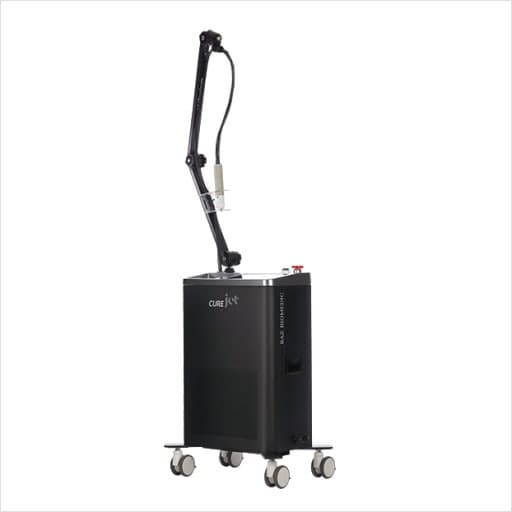
This article provides a detailed introduction to CureJet treatment, which eases concerns about ‘pain’ and ‘side effects’, among the biggest obstacles when considering hair loss treatment. From the working principle of needle-free microjet delivery to the specific differences from conventional scalp injection treatments, and Modi Hair Plant's distinctive protocol of using stem cell conditioned medium alone, we explain everything clearly from the perspective of our medical team.
Have You Been Hesitating About Hair Loss Treatment Because of Pain and Bruising?
Regardless of age or gender, hair loss has become one of the biggest appearance-related concerns for people today. It is well known that starting treatment promptly when early hair loss is detected can help preserve hair follicles and maintain hair density. However, when it actually comes to visiting a clinic and deciding on scalp care or injection treatment, many people find it hard to take that step.
The main reasons are ‘the pain felt during treatment’ and ‘bruising or irritation after the procedure’.
The scalp is a highly sensitive area of the body, with nerves and microvessels very densely distributed per unit area. Therefore, even with a fine needle, the process of repeatedly puncturing the scalp surface inevitably causes a sharp, tingling pain or a dull, aching sensation. In addition, red marks or bruises may remain on the scalp for several days after the procedure, and it is common for people to experience inconvenience in their daily work or social activities.
The innovative device introduced to overcome these limitations of conventional scalp injection treatment and to reduce the burden of pain and scalp damage for patients is CureJet.
In this article, we will explain in detail whether CureJet is truly less painful, the principle by which it delivers active ingredients deep into the scalp without needles, and how it differs from conventional scalp injections.
What Is CureJet Hair Loss Treatment? (The Principle of Needle-Free Microjet Technology)

CureJet is an advanced drug delivery device that, without directly inserting a needle into the skin or scalp surface, uses ultra-high-speed microjet pressure to deliver medication finely and precisely into the dermal layer.
1. Core Working Principle of Microjet Delivery
CureJet's core technology uses air pressure and a precision control system to convert liquid active ingredients into ultrafine micro-scale particles.
- Ultra-high-speed delivery: The medication is instantaneously sprayed onto the scalp surface at a speed so fast it is difficult to see with the human eye.
- Passage through the epidermis and penetration into the dermis: Rather than a needle tearing into the skin, the finely sprayed medication particles naturally pass through the epidermal layer of the scalp and reach the dermal layer where the hair follicles are located.
- No thermal damage or physical scarring: Because it does not use heat to penetrate the skin, there is no thermal damage, and no scars or deep wounds from needle marks are left.
2. Why Is the Depth of Drug Delivery Important in Hair Loss Treatment?
The ‘hair follicles’ and ‘dermal papilla cells’, the key structures that produce and grow hair, are located in the lower part of the scalp's dermal layer. No matter how good a scalp nutrient or growth factor may be, simply applying it to the outer surface of the scalp makes it difficult to pass through the firm scalp barrier and reach the hair follicles.
Because CureJet can deliver active ingredients that improve the environment around the hair follicles accurately and evenly to the target dermal depth, it allows a different approach to care from simply applying products to the scalp surface.
CureJet Hair Loss Treatment: Is There Really Less Pain and Bruising?
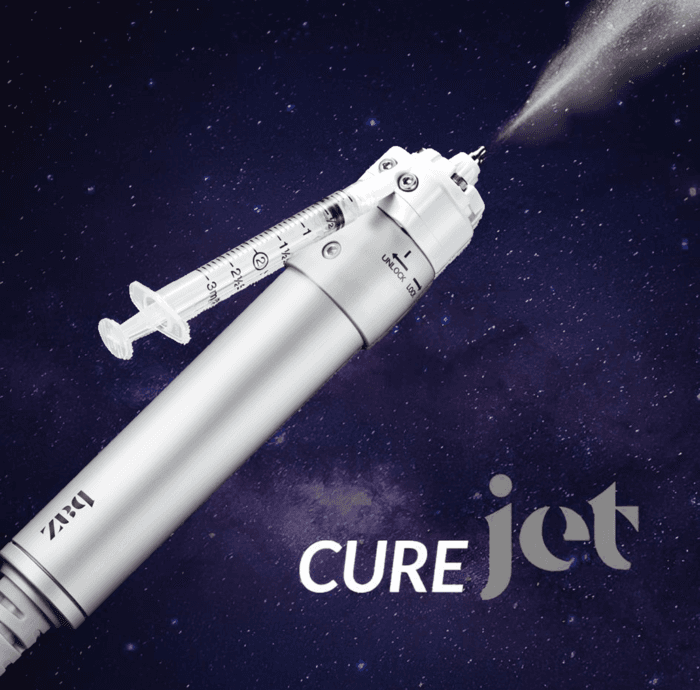
To state the conclusion first, CureJet treatment tends to involve less pain, bruising, swelling, and similar burdens compared with conventional needle injection treatment. The specific reasons are as follows.
1. No Sharp Needle Stimulation
In conventional injection treatment, a metal needle directly stimulates the pain receptors in the scalp. In contrast, because CureJet has no needle, it does not cause sharp, intense, stabbing pain. Rather than the feeling of being pricked by a needle, the sensation during the procedure is closer to very fine air bubbles or water droplets lightly tapping the scalp.
2. Reduced Bruising and Bleeding by Minimizing Microvascular Damage
Countless microvessels are intertwined like a net in the dermal layer of the scalp. When a procedure is performed with needles, these microvessels can rupture, easily causing bleeding or bruising. Because CureJet delivers medication in micro-particle form that permeates as if seeping through gaps, it reduces damage to larger vessels, so bleeding or bruising immediately after the procedure tends to be relatively minimal.
3. Individual Differences in Pain Sensitivity
Of course, the perception of pain may vary depending on individual scalp sensitivity and the area where hair loss is progressing. For example, areas where the scalp is thinner, such as the frontal hairline or temporal region, may feel the light flicking sensation somewhat more sensitively than the crown. Generally, it is at a level that can be performed without separate anesthesia.
Detailed Comparison of Conventional Scalp Injections and CureJet Treatment
To aid understanding, we compare conventional scalp mesotherapy injection treatment, which has mainly been performed at medical institutions, with CureJet microjet treatment by key category.
| Comparison Item | Conventional Scalp Injection (Needle Injection) | CureJet Treatment (Microjet Delivery) |
| Drug delivery tool | Metal injection needle | Needle-free high-pressure microjet nozzle |
| Pain during procedure | Stabbing pain and aching present | Light tapping sensation |
| Post-procedure bleeding/bruising | Needle marks, minor bleeding, and bruising possible | Relatively low likelihood of bleeding and bruising |
| Uniformity of drug delivery | Depends on the practitioner's technique and skill | Evenly delivered at a consistent depth via device control |
| Scalp stimulation effect | Regenerative response from needle wounds | Promotes blood flow through physical stimulation of high-pressure delivery |
| Application at Modi Hair Plant | Limitations in drug clumping and pain control | Verified stem cell conditioned medium single-ingredient protocol |
Why Modi Hair Plant Uses Only ‘Stem Cell Conditioned Medium’ for CureJet Treatment
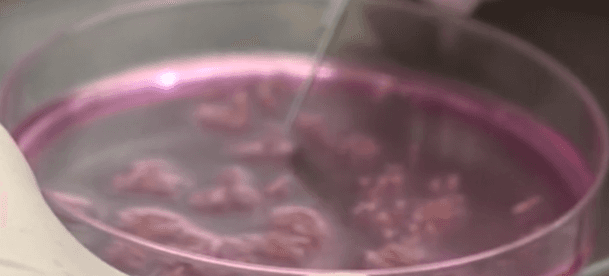
Even if the CureJet device has excellent drug delivery capability, ultimately it is the ‘quality and composition of the medication’ that goes deep into the scalp that determines the treatment outcome.
Many clinics mix and use exosomes, PDRN, dutasteride, and various other growth factor medications. However, at Modi Hair Plant, we do not indiscriminately mix other ingredients during CureJet procedures, and we adhere to the principle of using only a single, precisely verified ingredient: ‘stem cell conditioned medium’.
1. Advantages of Using Stem Cell Conditioned Medium Alone
Creating a regenerative environment for hair follicle cells: Stem cell conditioned medium contains high concentrations of a large amount of cytokines and growth factors that help activate dermal papilla cells and form microvessels around the hair follicles.
Reduced risk of interactions between ingredients and side effects: It reduces the potential for chemical interference between ingredients or scalp allergic reactions that may occur when multiple medications are combined, and delivers only the pure nutritional components needed by the hair follicles.
Synergy with precision delivery: CureJet's high-pressure micro-delivery technology distributes stem cell conditioned medium particles evenly throughout the dermal layer without clumping, increasing the absorption rate of the medication.
2. Dual Effect of Microjet Stimulation and Nutrient Supply
Stem cell conditioned medium care using CureJet does not stop at simply delivering medication.
Physical stimulation: The fine pressure stimulation delivered to the scalp surface and dermal layer during the delivery process promotes microcirculation in the scalp and induces a regenerative response.
Biological nutrient supply: Stem cell conditioned medium penetrates into the dermal spaces opened by physical stimulation, reinforcing the environment around the hair follicles from the roots.
Aftercare and Treatment Intervals for CureJet Hair Loss Treatment
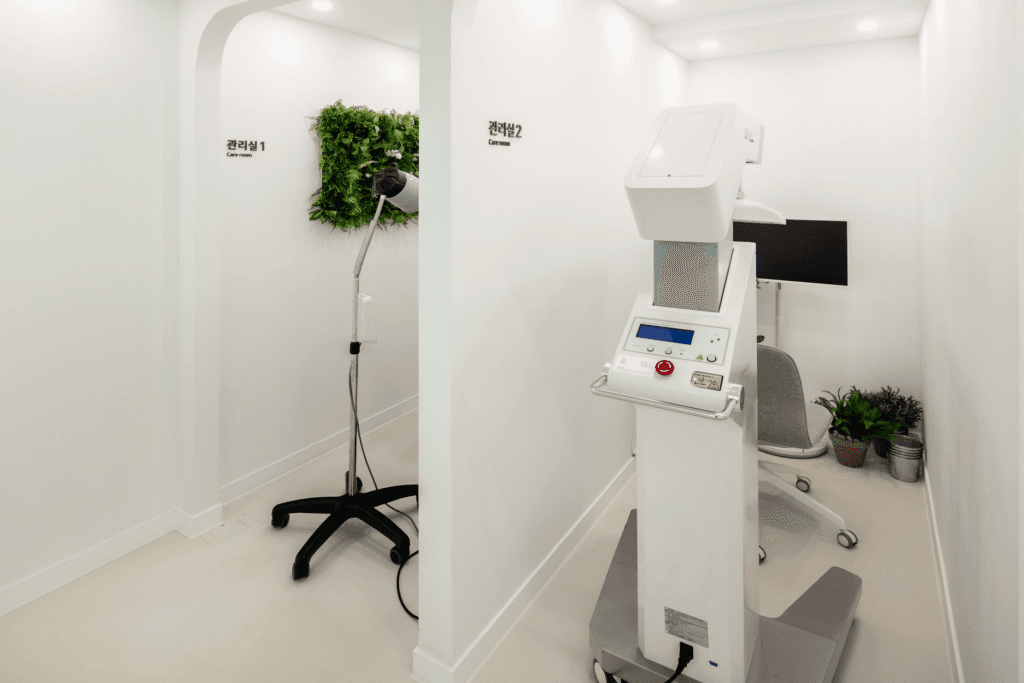
Although CureJet is a procedure with minimal skin damage, proper scalp care after the procedure and adherence to an appropriate treatment schedule are key to achieving satisfactory results.
1. Recommended Treatment Intervals and Number of Sessions
Treatment plans are individually tailored according to the degree of hair loss progression, the dryness or oiliness of the scalp, hair thickness, and the follicle engraftment environment.
- Initial/intensive care phase: Intensive care is usually performed 1 to 2 times at intervals of 1–2 weeks to quickly improve the environment around the hair follicles.
- Maintenance care phase: Once the scalp condition has stabilized, the interval is extended to about once every 3–4 weeks to maintain a regular supply of nutrients.
2. Post-Procedure Precautions and Scalp Care
Shampooing and washing on the same day: On the day of the procedure, it is best to rinse lightly with lukewarm water to avoid irritating the scalp as much as possible, or to dry with lukewarm air at the time advised by the medical team.
Alcohol and excessive exercise: On the day of the procedure and for 2–3 days afterward, refraining from excessive drinking, saunas, and strenuous exercise that cause heat in the scalp helps the scalp settle.
Sun protection: Since the scalp may be temporarily sensitive right after the procedure, it is advisable to block direct sunlight with a hat or parasol during outdoor activities.
Frequently Asked Questions About CureJet Treatment (FAQ)
Question 1. I am taking oral hair loss medication (finasteride/dutasteride). Can I combine it with CureJet treatment?
Yes, they can be combined, and complementary management can be expected. Oral hair loss medication works to suppress the hair loss–causing factor (DHT) produced by male hormones, while CureJet stem cell conditioned medium care works to supply nutrients directly to weakened hair follicles and improve the scalp environment. Because their mechanisms differ, combining the two treatments allows for more comprehensive hair care.
Question 2. Can I receive CureJet treatment after hair transplant surgery?
Yes. In fact, many patients at Modi Hair Plant also receive stem cell conditioned medium care in combination. There are many cases in which CureJet care is combined after a hair transplant to help the transplanted hair engraft stably and to prevent existing hair from thinning. However, since scalp irritation should be avoided during the engraftment period right after surgery, the appropriate timing for care should be determined through a thorough consultation with the medical team who performed the transplant surgery.
Question 3. How long does redness or irritation last after the procedure?
In most cases, redness right after the procedure subsides naturally within a few hours, and returns to normal by the evening of the same day or the next morning at the latest. Because no needle-related bruises or wounds are left, in most cases it does not significantly interfere with daily life or going to work.
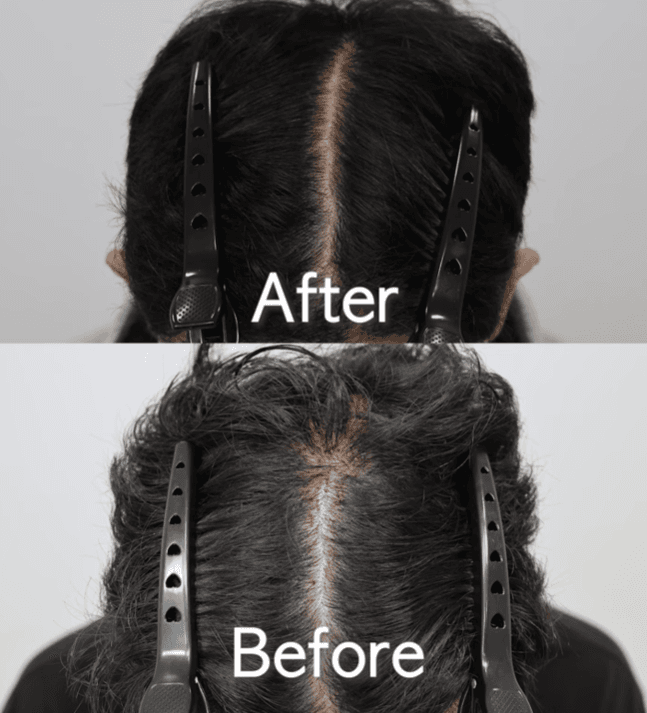
*This is the case of an actual patient, a man in his 30s with a wide part due to crown hair loss, who received hair follicle stem cell treatment delivered with CureJet. Drug delivery is only one part of the treatment, and results reflect the combined effect of multiple treatments. Individual results may vary.
The medical team determines whether to apply this treatment after evaluating the patient's condition. It is not a treatment performed identically for all patients.
Want to Learn More About Modi Hair Plant Clinic?
▶Hair follicle stem cell treatment principles page
▶Customized diagnosis by hair loss type page
References
- Bekkers VZ, Bik L, van Huijstee JC, Wolkerstorfer A, Prens EP, van Doorn MBA. Efficacy and safety of needle-free jet injector-assisted intralesional treatments in dermatology — a systematic review. Drug Deliv Transl Res. 2023;13(6):1584–1599. doi:10.1007/s13346-023-01295-x (PubMed)
The above paper is a systematic review summarizing the efficacy and safety of drug delivery using needle-free jet injectors in dermatology. CureJet itself is not a device that treats hair loss; it is used as one method of drug delivery.
This post was written directly by Modi Hair Plant Clinic for the purpose of providing medical information in compliance with the Medical Service Act, and was reviewed by our medical team. With all hair loss treatments, treatment effects and progress may vary depending on each patient's scalp condition, cause of hair loss, constitution, and health status, and reactions such as temporary irritation or redness may occur. Please be sure to make your decision after a thorough consultation with a qualified medical professional before the procedure.