
“What should you do if your eyebrows look even more unnatural after three eyebrow transplants?”
An eyebrow transplant is performed on a small area, but the factors that determine how natural the result looks are more delicate than you might think. This is because, rather than simply implanting a large number of hairs, what matters is which hairs are selected, in what direction and at what angle they are implanted, and how the curl of the hair is matched.
In 2026, the dermatology journal Actas Dermo-Sifiliográficas presented the case of a patient who underwent three eyebrow transplants for scarring hair loss of the eyebrow following an accident, but still required correction because the transplanted hairs were thick and grew in inconsistent directions.
Hello, I am Director Yoo Hwa-jung of Modi Hair Plant. Today, based on this published case, I will explain why hairs can look unnatural after an eyebrow transplant and how Preview Long Hair FUE, the technique used to correct it, works.
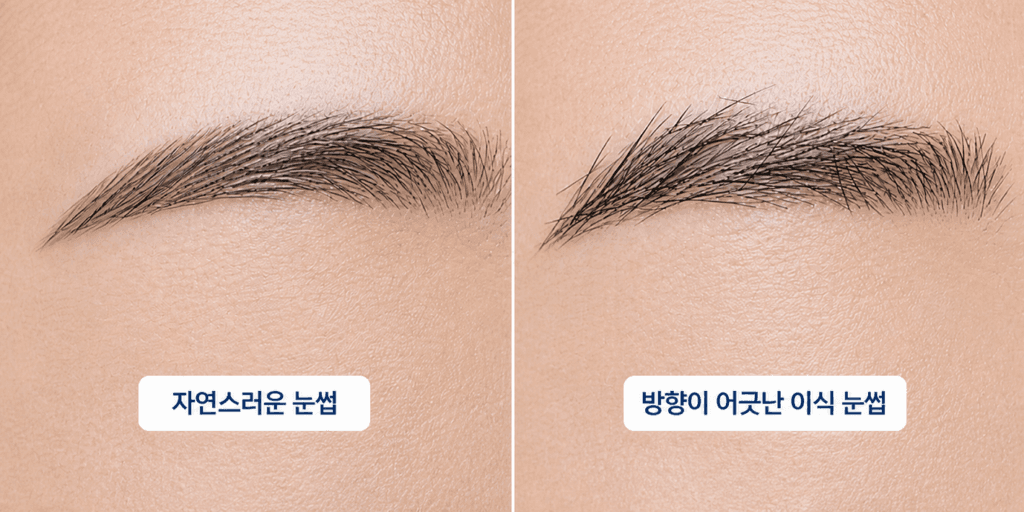
This is an AI-generated image created for illustrative purposes and is not a photo of an actual patient.
Key Takeaways
- The natural appearance of an eyebrow transplant is influenced not only by the number of hairs but also by hair thickness, direction, angle, curl, and donor area selection.
- In conventional FUE, the hair is trimmed short, which may limit the ability to see the actual curve and flow of the hair as it appears when long.
- Preview Long Hair FUE is a method in which the hair is kept long so that donor hairs can be selected and placed while checking their thickness, curl, and direction.
- In eyebrow revision surgery, first evaluating the condition of the previously transplanted hairs, scarring, and the remaining donor area is more important than simply implanting additional hairs.
Why Hairs Can Look Unnatural After an Eyebrow Transplant
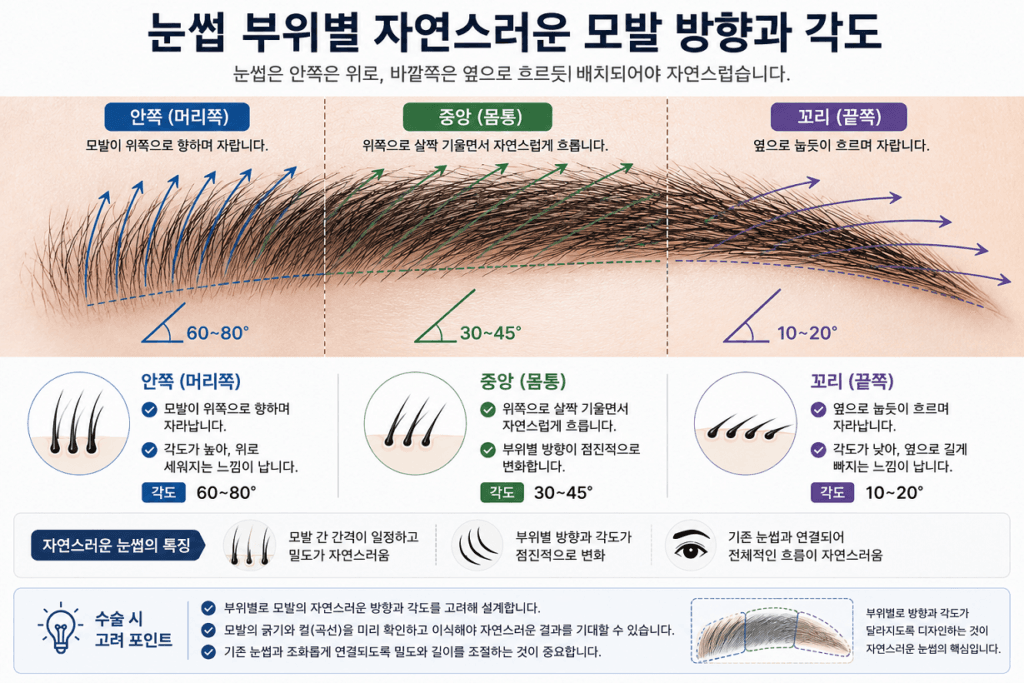
The eyebrows are an area of the face where the direction and angle of the hairs are arranged very precisely. Hairs at the inner part of the eyebrow point relatively upward, and from the center toward the outer part they gradually flow sideways, lying flatter.
Therefore, in an eyebrow transplant, how naturally the hairs are implanted to connect with the existing eyebrow is more important than simply filling empty spaces. The main causes of an awkward transplant result can broadly be divided into direction and curl, and the thickness and characteristics of the donor hair.
1. When It Is Difficult to Match Hair Direction and Curl
In conventional FUE, the hair in the donor area is trimmed short, and then hair follicles are harvested one by one. In this case, with only the short remaining hair, it may be difficult to directly see which way the hair actually curves when long or what curve it follows as it grows.
On the scalp, small differences in direction may not be very noticeable, but on the eyebrows, even a difference of a few degrees in angle or a subtle difference in curl can make hairs appear to stick up or look out of place relative to the surrounding eyebrow hairs.
2. Which Hairs Are Selected Also Matters
Even among scalp hairs, thickness and follicular unit composition can differ depending on location.
The central occipital area may contain follicular units with relatively thick hairs or multiple hairs. If such hairs are much thicker than the existing eyebrow hairs, they may stand out among the eyebrow hairs or give a stiff appearance.
On the other hand, finer and softer hairs can sometimes be found around the ears or at the nape of the neck, so these areas may be considered as donor areas for eyebrow transplants.
However, this does not mean that hair from a particular area is automatically suitable for every patient. In actual surgery, the process of individually selecting single hairs that match the existing eyebrow in thickness, curl, and direction is what matters.
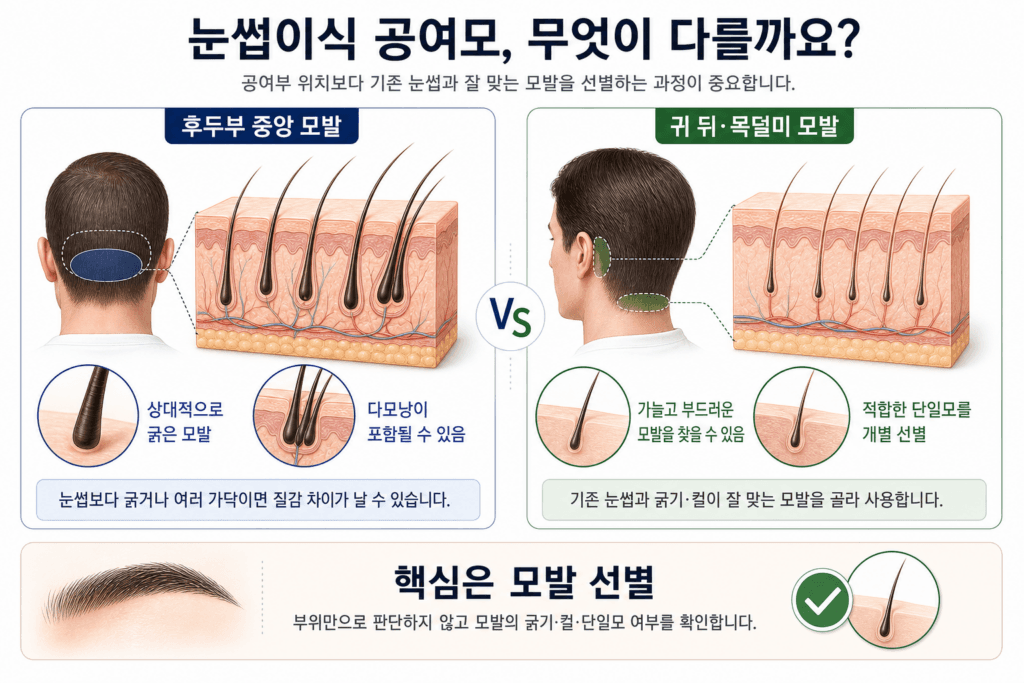
In an eyebrow transplant, “how to select hairs that match the existing eyebrow and how to place them” matters more than “how many hairs are implanted.”
The Published Case: Why the Eyebrow Still Looked Unnatural After Three Transplants
The paper presents the case of a 30-year-old male patient who developed scarring hair loss in one eyebrow due to an accident.
The patient underwent eyebrow transplants at other medical institutions three times, in 2015, 2017, and 2020, but the shape of the eyebrow still did not look natural, and he sought correction.
In this case, the following problems were observed in the previously transplanted area.
- Transplanted hairs thicker than the existing eyebrow hairs
- Direction and angle not matching the surrounding eyebrow
- Hairs with differing curls
- Multi-hair follicles, with several hairs growing from a single follicular unit
- Some hairs growing outside the original eyebrow boundary
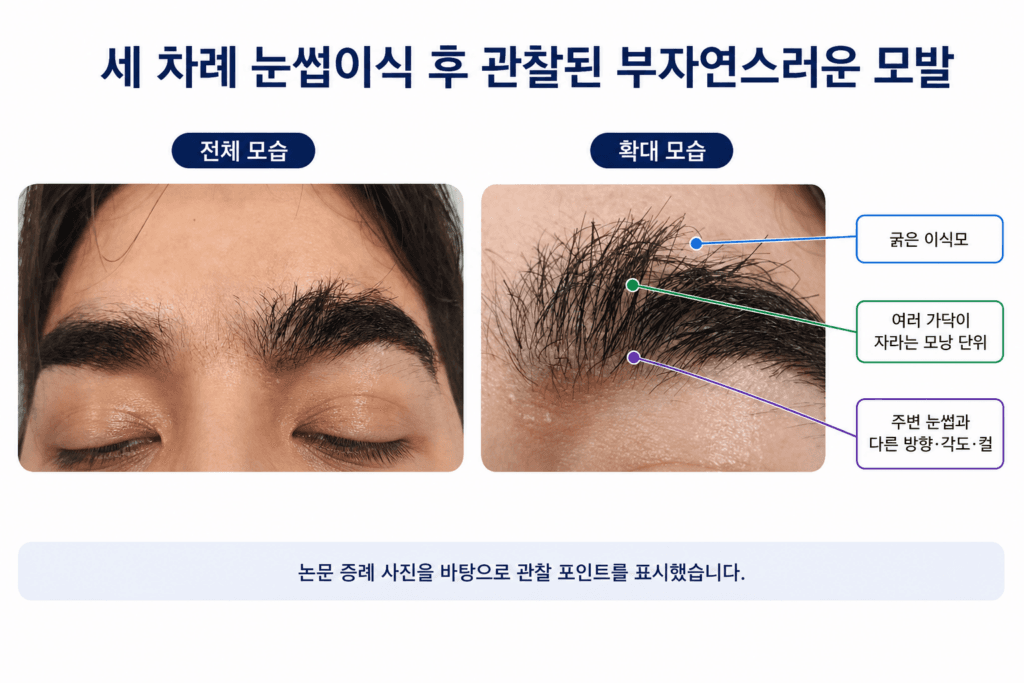
This is a case reported in the literature, not a photo of a patient of our clinic. Source: Mir-Bonafé et al., Actas Dermo-Sifiliográficas, 2026
In other words, the problem was not simply an insufficient number of transplanted hairs; it can be seen as a condition in which the donor hair selection and direction design did not harmonize with the existing eyebrow.
How Can Poorly Implanted Eyebrow Hairs Be Corrected?
Eyebrow revision surgery may not be resolved simply by implanting additional new hairs. If thick or misdirected hairs are already established, some of the transplanted hairs may first need to be removed and a new direction redesigned.
In the published case, a substantial portion of the follicular units that had been growing unnaturally were individually removed, and a new eyebrow direction was then redesigned.
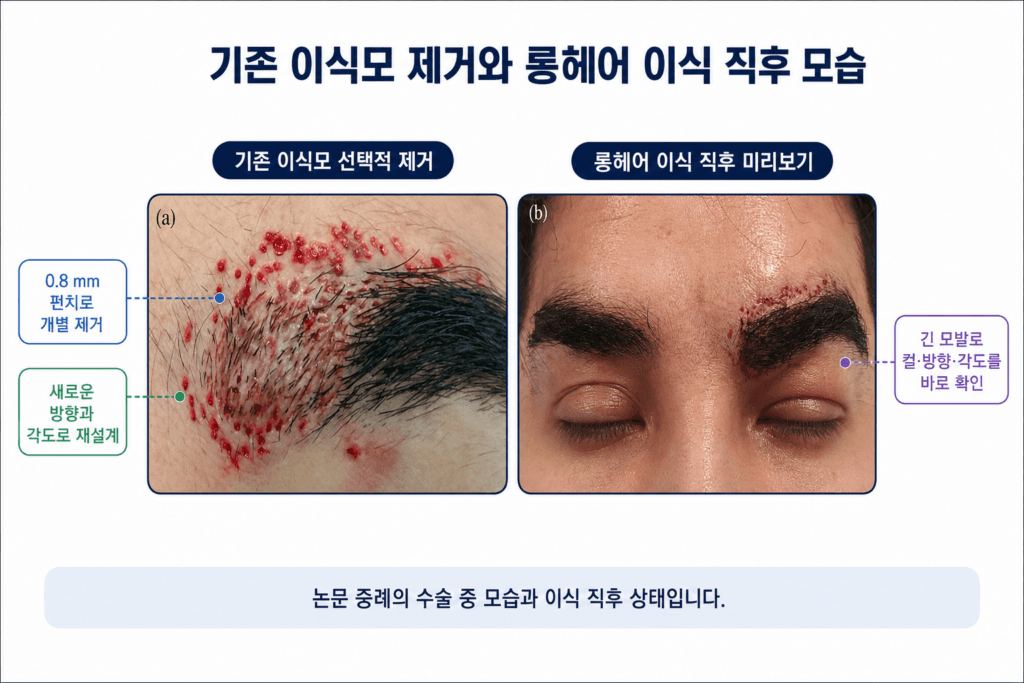
This is a case reported in the literature, not a photo of a patient of our clinic. Source: Mir-Bonafé et al., Actas Dermo-Sifiliográficas, 2026
Removing all the previously transplanted hairs at once and re-transplanting after a certain period may also be considered, but because this patient did not want a period with an empty eyebrow, an approach was chosen in which removal of the previously transplanted hairs and transplantation of new hairs were performed on the same day.
As such, eyebrow revision surgery must take into account the position and angle of the previously transplanted hairs, the condition of scars, the condition of the skin, and even the available donor area, so its design can be more complex than that of the first surgery.
What Is Preview Long Hair FUE?
The key method used in this case was Preview Long Hair FUE.
The core of Preview Long Hair FUE is not simply that “the head is not shaved.”
Because the follicles are harvested while the hair is kept long rather than cut short, the thickness, actual curve, and growth direction of the hair can be checked even before harvesting.
Each hair is then placed according to the inner, central, and tail portions of the eyebrow, taking into account its curl and direction.
In other words, the name ‘Preview’ is used in the sense that the actual flow of the hair, which is difficult to see when the hair is cut short, can be checked in advance during the surgical process.
However, being able to see how the long hairs lie immediately after surgery does not mean that the long-term result is guaranteed in advance. The final result may vary depending on the engraftment process, skin condition, scarring, and individual hair growth characteristics.
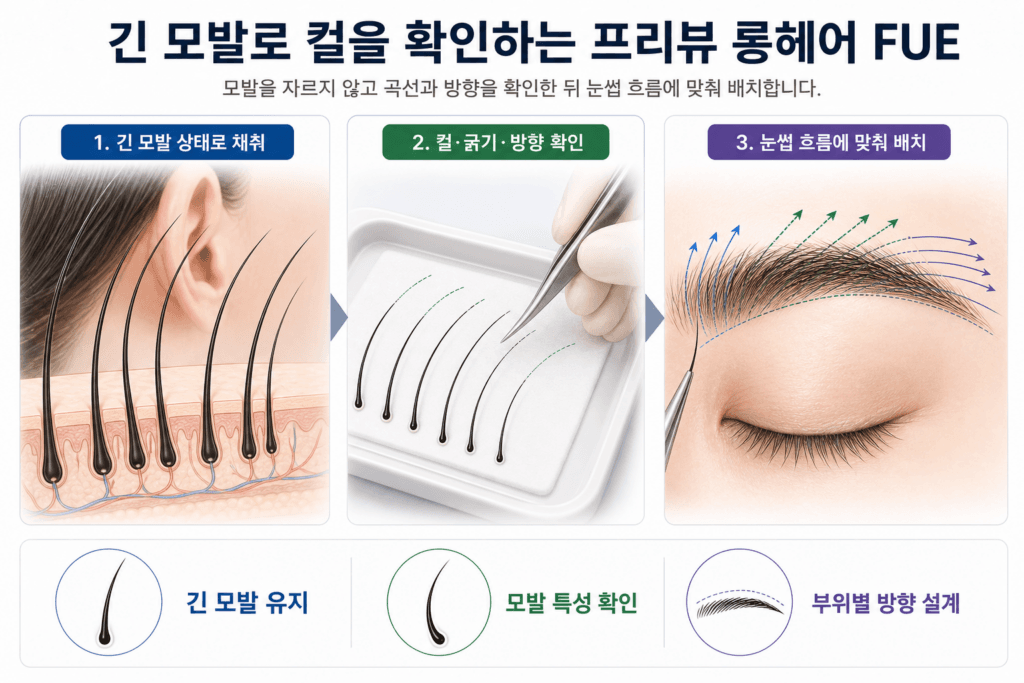
Key Surgical Points of Preview Long Hair FUE in the Paper
In the case presented in the paper, follicles that had been growing incorrectly were selectively removed, and then fine single hairs suitable for the eyebrow were selected from around the ears and harvested in their long state.
- Selective removal of a substantial portion of the unnatural previously transplanted hairs
- Redesign of the new eyebrow direction and angle
- Harvesting of 180 fine single-hair follicles from around the ears
- Maintaining hair length to directly check the curl and direction of each hair
- Placing the transplanted hairs to match the flow of the existing eyebrow
The paper reported that, 1 year after surgery, the patient’s eyebrow shape, symmetry, and direction of transplanted hairs had improved compared with before. However, this is the result of a single case and does not mean that the same result will occur in every patient.
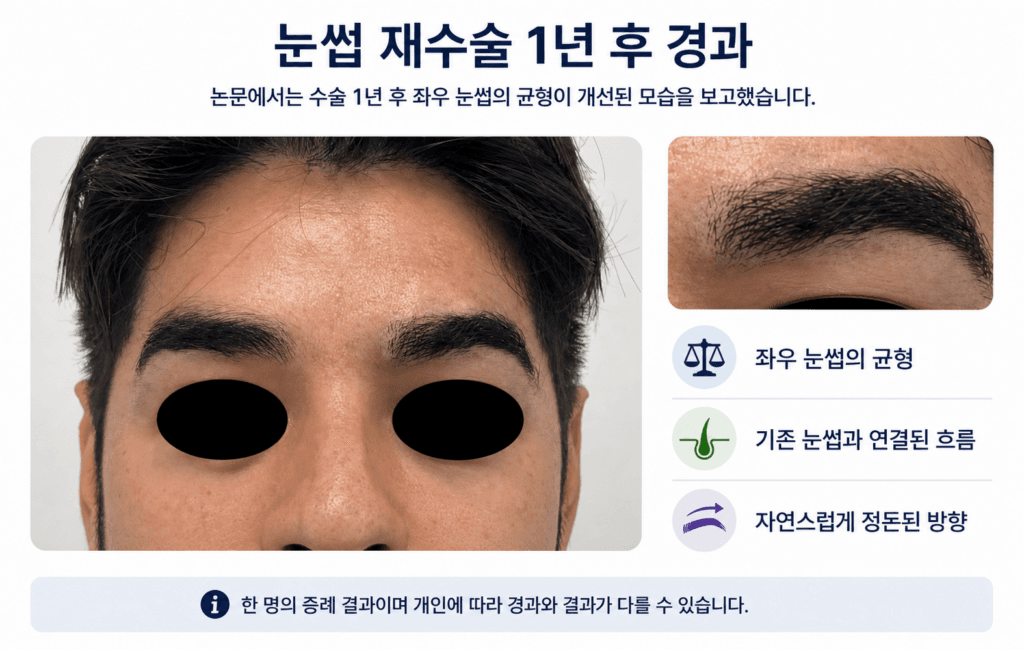
This is a case reported in the literature, not a photo of a patient of our clinic. Source: Mir-Bonafé et al., Actas Dermo-Sifiliográficas, 2026
Differences Between Conventional FUE, the Incision Method, and Preview Long Hair FUE
| Category | Conventional FUE | Incisional Follicle Harvesting | Preview Long Hair FUE |
|---|---|---|---|
| Harvesting method | Non-incision | Partial scalp incision | Non-incision |
| Donor hair length | Trimmed short | Long hair can be used | Long hair maintained |
| Checking hair curl | Limited ability to check curl in long state | Possible | Possible |
| Donor hair selection | Possible | Selection within the harvested area | Selection while checking thickness, curl, and direction in long state |
| Considerations for eyebrow use | Donor hair selection and direction design are important | Linear scar and harvest site must be considered | Requires meticulous selection and a high level of surgical skill |
It is difficult to say that any single method is absolutely superior for all patients. It is important to determine the surgical method by evaluating the shape of the eyebrow, the condition of any previous transplant, the presence of scarring, and the characteristics of the donor hair together.
How Does Modi Hair Plant Approach Eyebrow Transplants?
At Modi Hair Plant, there are two main things we consider important in eyebrow transplants.
- First, direction and curl — We analyze the flow of the existing eyebrow and design the direction and angle so that the transplanted hairs connect naturally.
- Second, hair quality — Rather than simply using hair from a particular area, we select fine single hairs that match the existing eyebrow in thickness and curl.
In particular, for revision surgery patients who have already had one or more eyebrow transplants, it is important to first analyze why the previously transplanted hairs look unnatural rather than automatically adding more hairs.
The revision surgery method may also differ depending on whether the problem is hair thickness, direction, angle, or existing scarring.
Eyebrow revision surgery is not “a surgery to implant many hairs again”; what matters is the process of first identifying why the previous result went wrong and then redesigning.
Frequently Asked Questions
I have had several eyebrow transplants, but they still look unnatural. Is revision surgery possible?
It may be possible depending on your condition. After first checking the thickness and direction of the previously transplanted hairs, scarring, skin condition, and the remaining donor area, a decision is made on whether to remove some of the existing follicles or to supplement areas that are lacking.
Why is hair from behind the ears or the nape used for eyebrow transplants?
Relatively fine hairs can sometimes be found around the ears or at the nape, so these areas may be considered as donor areas for eyebrow transplants. However, actually selecting single hairs that match the existing eyebrow in thickness, curl, and direction is more important than the location itself.
Can’t the previously implanted follicles just be removed and re-implanted as they are?
If the previously transplanted hairs themselves are too thick or do not match the eyebrow in hair quality, the same unnatural appearance may recur even if only their position is changed. Therefore, in revision surgery, whether to reuse the existing hairs or select new donor hairs must be judged on an individual basis.
Is Preview Long Hair FUE simply the same as no-shave FUE?
They may share the feature of not shaving a wide donor area, but the core of Preview Long Hair FUE is that the hair is kept long so that donor hairs can be selected and placed while checking their thickness, curl, and direction.
Will the transplanted hairs keep growing long after an eyebrow transplant?
Hair harvested from the scalp may retain some of its original growth characteristics after transplantation, so it may grow longer than the existing eyebrow hairs. Therefore, regular trimming may be needed after the transplant.
Is a transplant possible on a scarred eyebrow?
Whether it is possible depends on the thickness of the scar, skin condition, blood flow, and whether there has been a previous transplant. Because areas of scarring hair loss may have different conditions from normal skin, it is advisable to have the feasibility of transplantation and the scope of surgery assessed after a consultation.
In Summary
To achieve a natural result in an eyebrow transplant, the process of selecting hairs that blend well with the existing eyebrow and precisely matching direction, angle, and curl is more important than simply implanting many hairs.
In particular, if you have already had an eyebrow transplant but thick hairs stand out, the direction is misaligned, or you are considering revision surgery due to left-right asymmetry, the priority is to accurately assess the condition of the currently implanted hairs rather than automatically implanting again.
A revision surgery plan should be made after a comprehensive evaluation of how many previously transplanted hairs need to be removed, which donor hairs can be used, and whether re-transplantation into the scarred area is possible.
Results and the recovery process may vary depending on each individual’s condition, skin, and hair characteristics, so please confirm the method that is right for you through a thorough examination and consultation.
Modi Hair Plant Consultation Information
References
Mir-Bonafé JM, Mir-Bonafé J, Mir-Bonafé M. “Preview long hair FUE” technique in eyebrow transplantation. Actas Dermo-Sifiliográficas. Published online 2026. doi:10.1016/j.ad.2026.104699.
This article was written and reviewed by our medical staff.