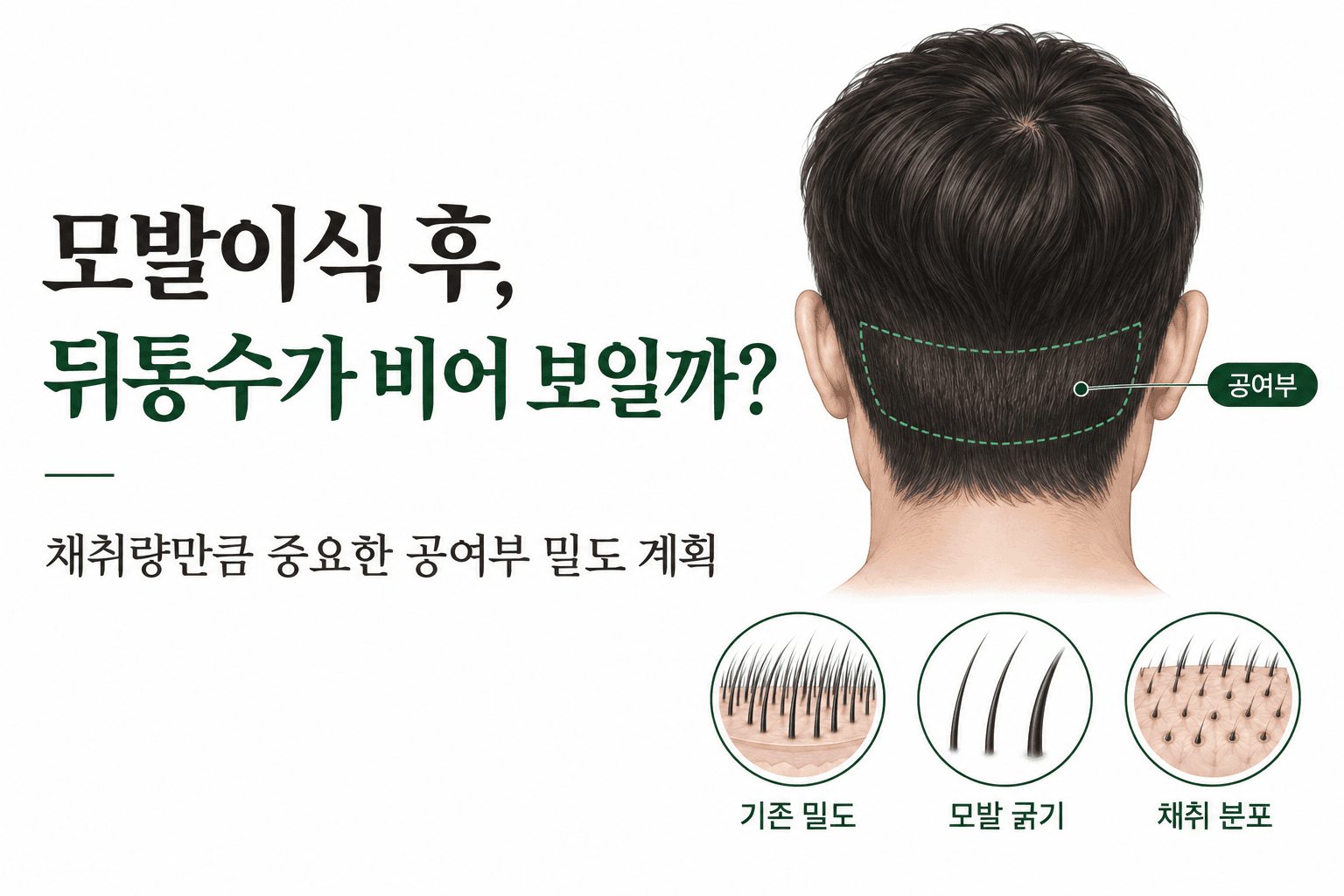
Hair Transplant · Donor Harvesting and Density Planning
After a Hair Transplant, the Hair That Remains at the Back of the Head Matters as Much as the Hair That Is Transplanted
Are you worried that the back of your head may look thin after a hair transplant? When hair follicles are harvested through a non-incision hair transplant, the number of hair follicles remaining in the donor area decreases. However, how different it looks can vary depending not only on the harvesting volume but also on existing density, hair thickness, harvesting location and distribution, and hairstyle.
Summary in 3 Points
- Because non-incision harvesting reduces the number of hair follicles remaining in the donor area, planning that considers the post-harvest condition is necessary.
- Even with the same harvesting volume, the appearance of the back of the head can vary depending on existing density, hair thickness, harvesting distribution, and hair length.
- No-shave is a method that preserves hair length. Evaluating donor density and planning the harvesting volume is still required separately.
What Is the Donor Area?
The donor area refers to the region from which hair follicles are harvested for transplantation. In scalp hair transplants, suitable areas of the occipital (back) and temporal (side) regions are mainly evaluated.
Just because the back of the head appears to have a lot of hair does not mean the same amount can be harvested from any location. Density and thickness may differ by zone, and there may be hair thinning or effects from previous surgery.
The donor area is not an unlimited resource that can be drawn on as much as needed. The hair needed for the current surgery, the hair that will remain after harvesting, and future treatment plans should all be considered together.
Do Harvested Hair Follicles Grow Back at the Back of the Head?
A non-incision hair transplant is not a procedure that trims the ends of the hair; it is a surgery that relocates hair follicles. You should not expect a completely harvested hair follicle to regrow as the same follicle in its original location.
The appearance may change as wounds heal and surrounding hair grows, but this does not mean the number of harvested hair follicles has returned to the original. Therefore, it is important to consider the remaining hair from the harvesting stage.
Even With the Same Harvesting Volume, Distribution Must Also Be Considered
Even if a similar number of hair follicles is harvested, concentrating harvesting in a specific zone can make the remaining density in that area relatively lower. This is why it is necessary to look not only at the total harvesting volume but also at how much remains in each zone.
Considering distribution does not mean harvesting as widely as possible. Locations and spacing should be planned within the donor area suitable for each individual, while checking existing density and hair condition.

Spreading out the harvest does not mean that any amount can be harvested. Along with harvesting distribution, the total harvesting volume, existing density, hair thickness, and the long-term condition of the donor area must be considered.
How Thin the Back of the Head Looks Is Not Determined by Hair Count Alone
1. Density Differs Even Before Harvesting
Areas where hair follicles are originally dense and areas that are relatively sparse will be left in different conditions even if the same amount is harvested. Looking full to the naked eye and actually having high follicle density are not necessarily the same.
2. Hair Thickness Affects How Well the Scalp Is Covered
Not only the number of remaining hairs but also their thickness affects appearance. If the hair is fine or uneven in thickness, it is necessary to check the cause and distribution before harvesting.
3. Hair Length and Hairstyle Differ
Long hair covers the surrounding area, whereas with short hairstyles the scalp or dot-shaped scars may be more visible. Please let us know during consultation not only your current style but also whether you plan to cut your hair short in the future.
4. Color Contrast Between Scalp and Hair Differs
If there is a large color difference between the scalp and hair, the scalp visible between hairs may be more noticeable. In photos, density may also look different depending on lighting, camera angle, and whether the hair is wet.

Does No-Shave Eliminate Concerns About Donor Density?
Modi Hair Plant Clinic's no-shave method keeps the surrounding hair and the hair to be harvested long, without cutting it short. It is meaningful in reducing the burden of hairstyle changes, as it does not create zones trimmed short for harvesting.
However, preserving hair length is different from preserving the number of hair follicles. Even with no-shave, the number of hair follicles remaining in the donor area decreases by the amount harvested, so density evaluation and harvesting planning are required separately.
What to Check for No-Shave
Check how the length of the surrounding hair and the hair to be harvested is maintained.
What to Check in Donor Planning
Discuss how much will be harvested from which zones, and what condition is expected after harvesting.
What Kind of Evaluation Does Research Emphasize?
Literature reviewing non-incision follicle harvesting explains that excessive harvesting can lead to sparseness of the donor area or visible scarring. This means remaining density and donor area condition should be considered when determining harvesting volume. [1]
A review on magnified observation of the donor area explains the importance of evaluating not only hair density but also differences in thickness, thinning, and the possibility of other hair loss conditions. [2]
Both sources are literature summarizing surgical principles and evaluation methods. They are not evidence that a specific harvesting volume is safe for everyone or that guarantees the results of any particular clinic.
Consider Not Just One Surgery but the Donor Area Going Forward
The progression of hair loss in existing hair and the need for future additional surgery differ from person to person. If you have had a hair transplant before, checking your harvesting history, scars, and remaining density becomes even more important.
Rather than focusing only on harvesting as many hairs as possible from the first consultation, it is advisable to discuss both the area that needs transplantation and what the donor area can sustain.
Hair count and follicular unit count do not mean the same thing, so please also confirm which unit the numbers given during consultation refer to.

Can Over-Harvesting Be Judged From a Single Post-Surgery Photo?
Immediately after surgery, appearance may look different due to shortened hair, scabs and redness, or clumped hair. Temporary hair shedding must also be distinguished from actual density reduction due to harvesting.
It is difficult to determine over-harvesting or the possibility of recovery from a single photo. Pre-surgery photos, harvesting records, the time point in recovery, and the condition seen on direct examination should be reviewed together.
If sparse-looking areas persist or you are concerned about changes, please inform the clinic where you had surgery about your progress. If you have worsening pain, redness, pus, or fever, please seek medical care without delay.
Frequently Asked Questions
Will the hair follicles harvested from the back of the head fill back in over time?
You should not expect completely harvested hair follicles to regrow in their original location. How well the area is covered may change as surrounding hair grows, but this is different from the number of hair follicles returning to the original.
If I have the same number of hairs transplanted as a friend, will the back of my head look similar?
Even with the same hair count, existing density and thickness, number of hairs per follicular unit, and actual harvesting volume and distribution may differ. It is difficult to predict the appearance of your own donor area based only on someone else's hair count.
I usually wear my hair long, but is it okay to cut it short later?
Short hair may make the scalp and dot-shaped scars more visible. It is advisable to share your desired future hairstyle during consultation and to receive an explanation of the limitations of appearance after harvesting.
Even with no-shave, can the back of my head look sparse after surgery?
Yes, it can. No-shave is a method of maintaining hair length, not a method that does not harvest hair follicles. Changes in appearance may occur depending on harvesting volume, distribution, and the existing condition of the donor area.
Can I avoid burdening the donor area by dividing the surgery into several sessions?
Even if surgery is divided, the total harvesting volume accumulates. Before the next surgery, the previous harvesting range and remaining hair condition must be re-evaluated, and spacing out surgeries alone does not eliminate the risk of excessive harvesting.
If the back of my head looks thin, can I immediately get an additional transplant or scalp micropigmentation?
The cause and progress should be checked first. The appropriate order is to evaluate whether it is a change during recovery, temporary shedding, or actual density reduction or scarring, and then discuss the necessary response.
Consult About Both the Hairs to Be Transplanted and the Donor Area That Will Remain
If you are considering a hair transplant, check the condition of the hair at the back and sides of your head as well as the recipient area. At Modi Hair Plant Clinic, you can consult on an individualized plan based on your current donor area condition, desired hairstyle, and previous surgical history.
References
[1] Garg AK, Garg S. Donor Harvesting: Follicular Unit Excision. Journal of Cutaneous and Aesthetic Surgery. 2018;11(4):195–201. DOI: 10.4103/JCAS.JCAS_123_18. PMCID: PMC6371717.
[2] Issa NT, Tosti A. Trichoscopy for the Hair Transplant Surgeon—Assessing for Mimickers of Androgenetic Alopecia and Preoperative Evaluation of Donor Site Area. Indian Journal of Plastic Surgery. 2021;54(4):393–398. DOI: 10.1055/s-0041-1739245. PMID: 34984075.
This article is intended to provide general medical information and does not replace individual diagnosis or surgical planning. The locations and figures in the illustrations do not represent individual harvesting ranges or safety standards. After a hair transplant, infection, scarring, temporary hair shedding, sensory changes, donor area sparseness, and differences in graft survival may occur. Results and recovery vary from person to person, and whether and how to treat is decided after examination by the medical team.