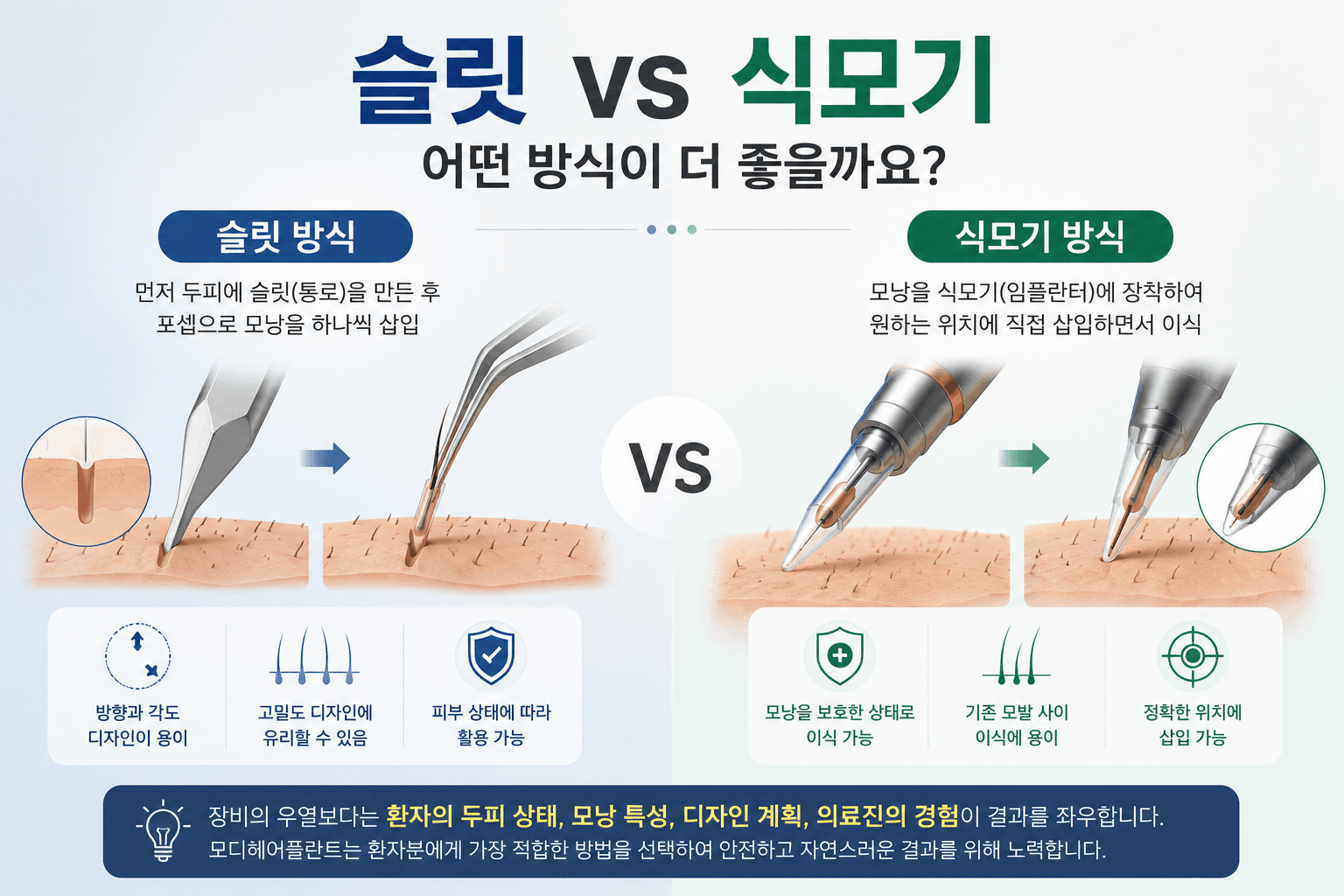
When researching hair transplants, you will come across a variety of opinions, such as “the slit method is better” or “the implanter is better.” Because each clinic uses a different method, many people find it difficult to decide which option to choose.
To begin with the conclusion: at present, it is difficult to state definitively that either the slit method or the implanter method is superior in all cases. Both have been used for hair transplantation for a long time, and each has its own characteristics and advantages.
Actual hair transplant results are influenced more by the medical team's experience and design, how well hair follicles are transplanted without damage, and how accurately the patient's scalp and hair loss condition have been analyzed than by the type of equipment used.
With these considerations in mind, Modi Hair Plant currently uses the implanter method. In this article, we explain in detail the differences between the slit and implanter methods, the characteristics of the implanter method, and why Modi Hair Plant has chosen the implanter method.
Key Summary
✔ The slit and implanter methods differ in how hair follicles are transplanted.
✔ Each has advantages and disadvantages, and it is difficult to say that one method is absolutely superior.
✔ For good results, the medical team's experience, design, and follicle handling matter together, more than the equipment.
✔ Modi Hair Plant performs hair transplants using the implanter method.
What Is the Difference Between the Slit and Implanter Methods?
| Category | Slit Method | Implanter Method |
|---|---|---|
| Basic principle | Channels for transplantation are created first, then follicles are inserted | Follicles are loaded into an implanter and inserted |
| Main tools | Slit needles/blades, forceps, etc. | Sharp implanter or blunt implanter |
| Channel creation | Created in advance, before follicle insertion | Created at the same time as insertion, or pre-made channels are used |
| Direction and angle | Follow the direction and angle of the pre-made channels | Direction and angle are adjusted while inserting the implanter |
| Characteristics | Easier to plan transplant positions and arrangement in advance | Transplantation can be performed with the follicle loaded in the device |
| Common points | The medical team's planning, skill, and follicle handling are important | The medical team's planning, skill, and follicle handling are important |
The slit method involves first creating small channels in the recipient area and then inserting hair follicles using tools such as forceps.
The implanter method involves loading hair follicles into a pen-shaped implanter and inserting them at the desired location. Depending on the type of implanter used, channel creation and transplantation may be performed simultaneously, or the implanter may be used to place follicles into pre-made channels.
Therefore, it is more accurate to understand that the two methods differ not simply in the equipment used, but in when the transplant channels are created and how the follicles are inserted.
What Are the Characteristics of the Implanter Method?
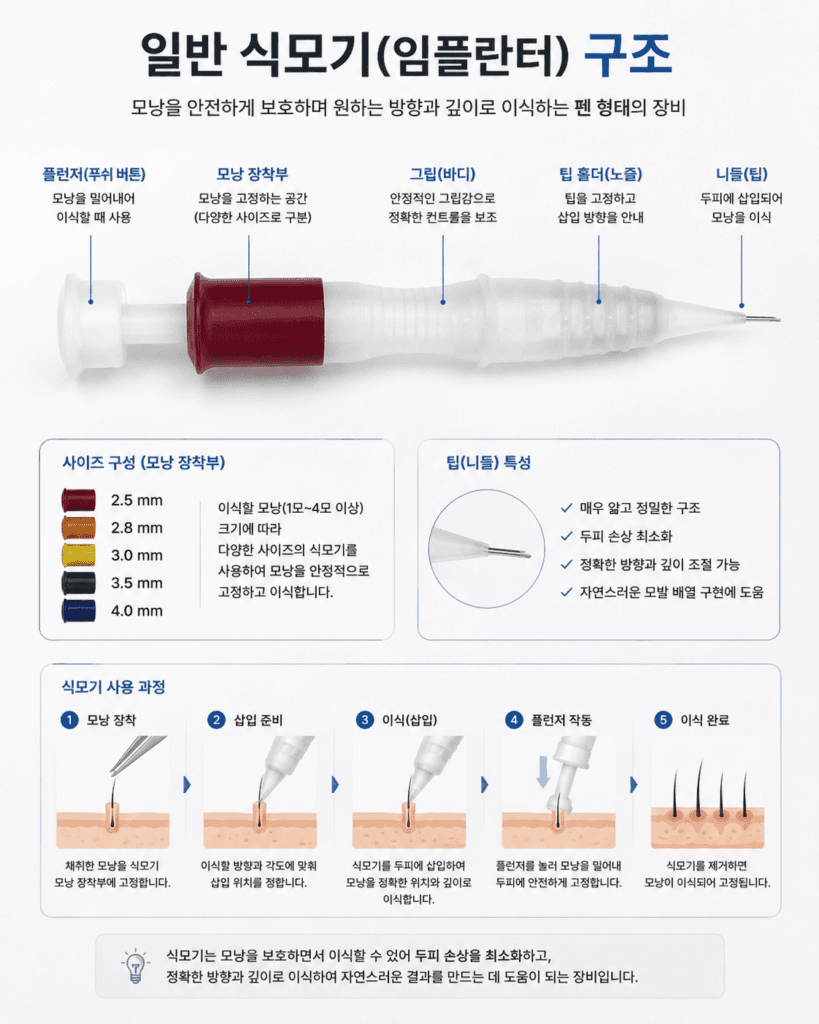
With an implanter, hair follicles are placed inside a pen-like device and then transplanted at the desired location.
Because follicles are transplanted while loaded in the device, the insertion process is relatively consistent, and transplantation can be performed while adjusting direction and depth.
It is also commonly used when filling in between existing hairs or when the direction of hair growth needs to be taken into account.
However, results are not determined by the implanter alone. Results may vary depending on the experience and skill of the medical team using it.
Slit vs. Implanter: What Determines the Results?
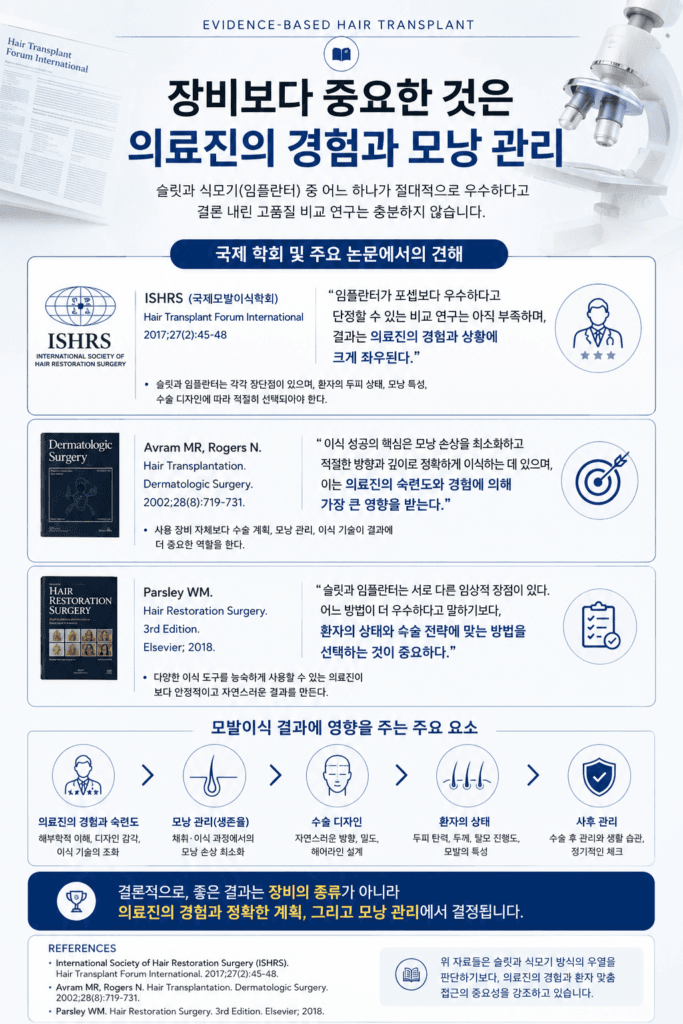
This is the question many people are most curious about.
The slit and implanter methods each have advantages and points of caution, and based on the research published to date, it is difficult to conclude that either method is consistently superior for all patients.
Studies on the implanter method describe features such as reduced direct handling of follicles and the ability to adjust direction and angle during transplantation. On the other hand, bleeding during transplantation, the phenomenon of already-placed follicles being pushed back out (popping), and the operator's skill level are also described as factors to consider.
In addition, implanters can be used not only to create channels and transplant simultaneously, but also to insert follicles into pre-made slits. Therefore, actual hair transplant techniques are difficult to categorize simply with the two terms “slit” and “implanter.”
A recent multicenter retrospective study also observed no significant differences in survival rates or complications between different transplantation methods, showing that there are limits to explaining results by equipment alone.
Why Does Modi Hair Plant Use the Implanter Method?
Modi Hair Plant currently uses the implanter method for general hair transplants.
A key feature of the implanter is that direction, angle, and depth can be adjusted while inserting a loaded follicle at the planned location. It can also be used when the flow of existing hair needs to be considered or when detailed arrangement is needed for each recipient area.
However, using an implanter does not in itself determine a good result. This is because hair transplantation is a procedure in which every stage is connected—from consultation and design to follicle harvesting, separation, storage, and transplantation.
Modi Hair Plant places importance on analyzing the patient's hair loss progression, scalp condition, and the density and direction of existing hair, and establishing a transplant plan suited to them.
During transplantation, we also carefully check the planned direction, angle, and depth, and focus on reducing unnecessary stress on the hair follicles.
Ultimately, what matters is not the name of the equipment, but establishing a plan suited to the patient's condition and how precisely each step is carried out. Based on these principles, Modi Hair Plant applies the characteristics of the implanter method to its procedures.
FAQ
Q. Which is better, the slit method or the implanter method?
Based on research to date, it is difficult to conclude that either the slit or the implanter method is superior for all patients. Both have been used for hair transplantation for a long time, and the suitable method may vary depending on the medical team's experience and the patient's condition.
Q. Does the implanter method have a higher graft survival rate?
Graft survival rate is not determined by the equipment alone. Multiple factors together have an influence, including the follicle harvesting process, storage conditions, the transplantation process, the medical team's skill, and post-operative care. Therefore, it is difficult to state definitively that the implanter alone results in a higher survival rate.
Q. What are the advantages of the implanter method?
A feature of the implanter is that follicles can be transplanted at the desired position and direction while loaded in the device. Because insertion depth and direction can be adjusted during transplantation, precise placement is possible according to the medical team's plan.
Q. What method does Modi Hair Plant use for hair transplants?
Modi Hair Plant currently performs hair transplants using the implanter method. Rather than focusing on the equipment itself, we place importance on thoroughly considering the patient's scalp condition, hair direction, and design plan, and on a transplantation process that minimizes follicle damage.
Q. What has the greatest influence on hair transplant results?
Good results are not determined by equipment alone. Multiple factors together have an influence, including the medical team's experience and design, the follicle harvesting and storage process, transplantation technique, the patient's hair loss condition and scalp condition, and post-operative care.
Q. Can the implanter method produce more natural-looking results?
Natural-looking results are influenced more by how hair direction, angle, and density are designed and transplanted than by the implanter itself. Even with the same equipment, results may vary depending on the medical team's experience and design.
Q. Is the implanter method painful?
It is difficult to state definitively that the implanter method causes more or less pain. Pain during surgery is influenced by the local anesthesia process and individual pain sensitivity, and is not determined by the transplantation method alone.
References
- Park JH, Ho YH, Manonukul K. A Practical Guide to Hair Graft Placement Using the Sharp Implanter Method. Clinical, Cosmetic and Investigational Dermatology. 2023;16:1777-1785. doi:10.2147/CCID.S411488.
- Bansal A, Sethi P, Kumar A, Sahoo AK, Das P. Use of Implanters in Premade Recipient Sites for Hair Transplantation. Journal of Cutaneous and Aesthetic Surgery. 2019;12(4):250-254. doi:10.4103/JCAS.JCAS_33_19.
- Zhao Y, Tang Q, Zhang J, et al. Premade Incisions vs. Stick and Place: A Multicenter Retrospective Comparison of Hair Transplantation Outcomes in China. Aesthetic Plastic Surgery. 2025;49(13). PMID: 40316792.
Conclusion
Both the slit and implanter methods have been used for hair transplantation for a long time.
Based on research to date, it is difficult to conclude that either method is superior for all patients.
What matters is accurately analyzing the patient's condition and establishing a plan suited to it.
In hair transplantation, what matters is not whether the slit or implanter method is used. Accurately analyzing the patient's condition, establishing a surgical plan suited to it, and transplanting hair follicles without damage are the key to good results. Based on these principles, Modi Hair Plant uses the implanter method and strives for natural-looking results.