
Hair Transplant Consultation Guide
What Should You Consider When Choosing a Hair Transplant Clinic?
When choosing a hair transplant clinic, it is advisable to look not only at cost and before-and-after photos, but also at whether surgery is needed, who the attending medical staff are, the long-term design, the graft volume and harvesting plan, safety checks, explanations of expected results, and aftercare.
What matters more than advertising copy is whether you can receive a thorough explanation of a surgical plan suited to your condition and the reasons behind it. Asking each clinic the same questions makes it easier to compare differences in consultation content and surgical plans.
3-Line Summary
- First, confirm why surgery is being recommended. An explanation of your hair loss condition and non-surgical treatment options should come first.
- Look at the overall plan rather than the graft volume alone. The long-term design, distribution by area, and the harvesting plan for the back of the head should be explained together.
- Confirm the attending medical staff, costs, and scope of aftercare in specific terms. Comparing consultations using the same questions makes the differences easier to understand.
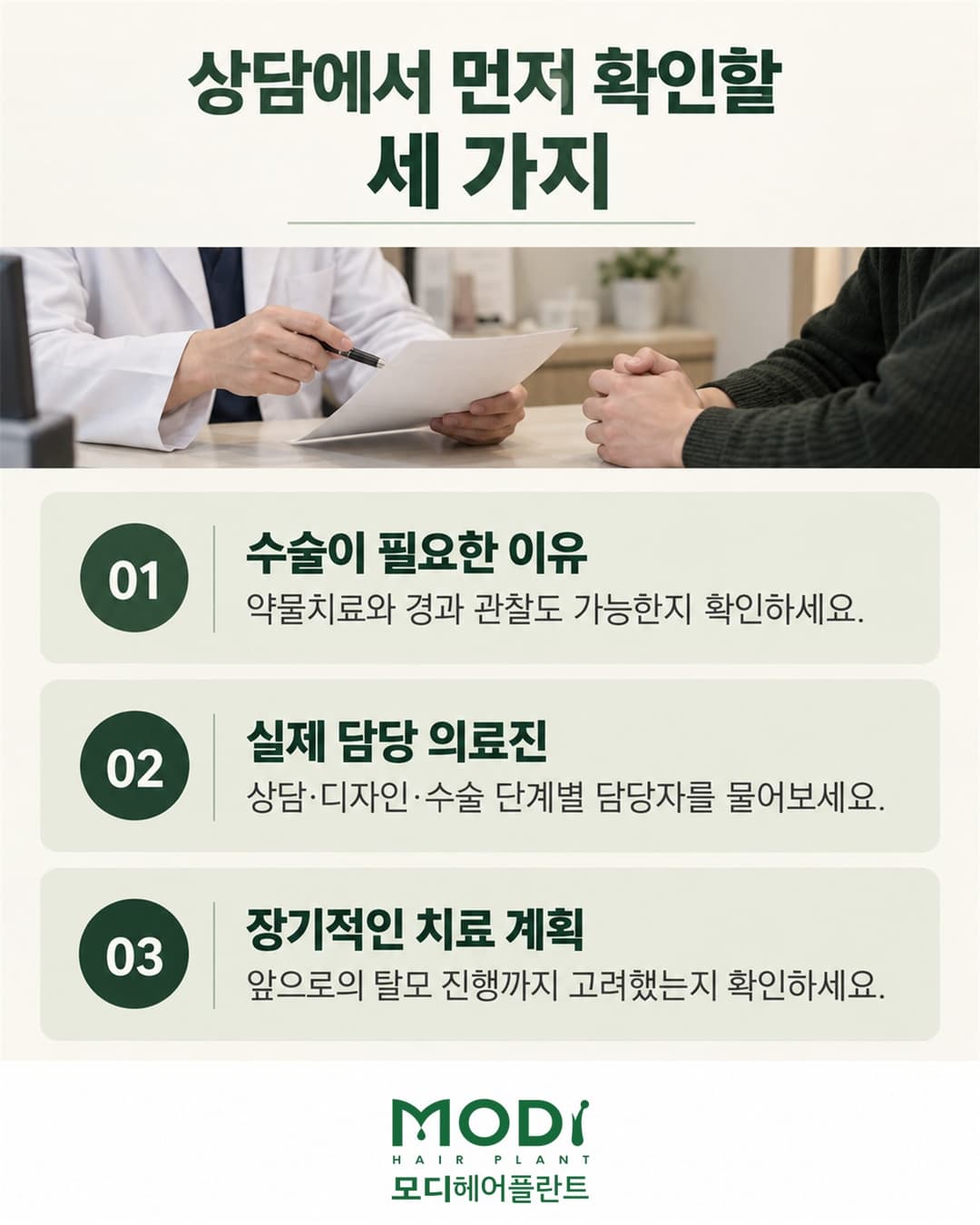
1. Does the clinic explain why a hair transplant is needed now?
A thinning scalp or a receding hairline does not mean that a hair transplant is the first step in every case. Whether surgery is appropriate should be determined by examining the cause and progression of hair loss, as well as the condition of existing hair and the hair on the back of the head.
The American Academy of Dermatology states that when evaluating suitability for a hair transplant, the scalp and hair are examined, and additional tests may be performed if necessary. Medication may be considered before surgery, and treatment to maintain existing hair may be needed even after surgery. [1]
Ask this during your consultation
“Why are you recommending a hair transplant for my condition now? Could medication or monitoring be considered first?”
Rather than rushing into surgery, ask for an explanation of the respective roles of surgical and non-surgical treatments for your current condition. Whether the clinic explains both the treatment options and their limitations is also an important point to check.
2. Who is responsible for each stage of the consultation and surgery?
You should confirm whether the medical staff introduced on the website are the same as those who actually conduct the consultation and surgery. Ask specifically who participates in each stage—such as examination and design, harvesting and implantation—and what role each person plays.
The International Society of Hair Restoration Surgery also advises confirming, before surgery, the roles of the people involved in the procedure, as well as their education, training, qualifications, and experience. [2]
- Who will examine my hair loss condition and develop the surgical plan?
- Who decides the design of the hairline and transplant areas?
- Who participates in the harvesting and implantation processes, respectively?
- Is there a possibility that the attending medical staff will change on the day of surgery?
- If a problem arises after surgery, who will see me?
A physician's career history and academic society activities are only one point of reference.
No particular career history or affiliation alone guarantees surgical results. Please also confirm the actual scope of surgical responsibility and the explanation of your condition.
3. Does the design take into account not only current but also future hair loss?
If you have photos of a hairline you would like, feel free to bring them to your consultation. However, the same shape and height cannot simply be applied to everyone.
The design should take into account the currently thinning area, facial balance, hair thickness and direction, and the condition of the back of the head, as well as the possibility that hair loss will progress in the surrounding hair. Consultation materials from the International Society of Hair Restoration Surgery also explain the need to discuss long-term appearance and treatment planning together. [3]
Ask this during your consultation
“Why did you design it at this height and in this shape? If the surrounding hair falls out in the future, how will the overall hairline look?”
Check the design not only from the front but also from the side and with your hair swept back. If what the patient wants differs from the plan the medical staff consider appropriate in the long term, it is necessary to hear the reasons fully and go through a process of adjustment.
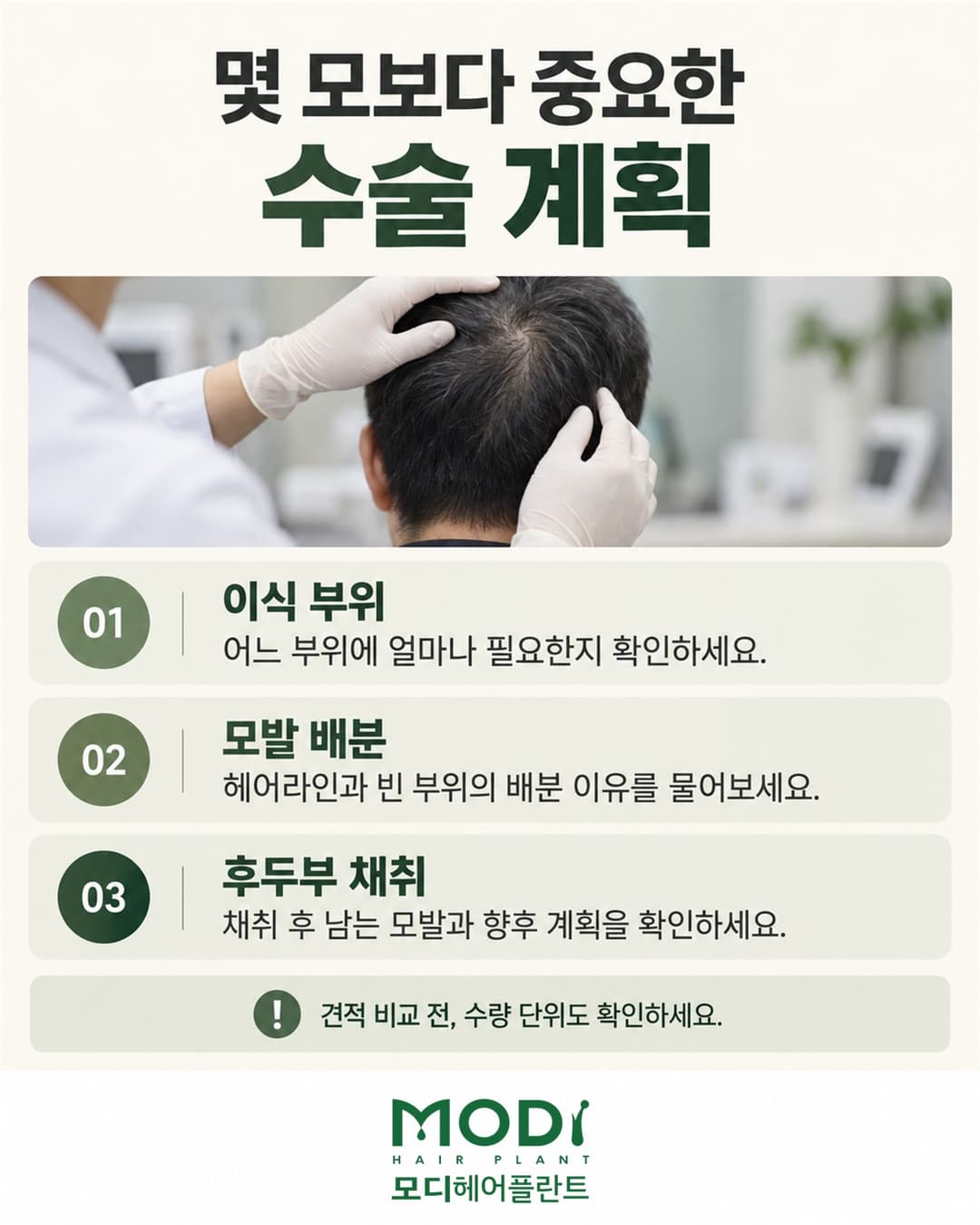
4. Does the clinic explain the proposed graft volume together with the donor harvesting plan?
When clinics propose different graft volumes, the larger number may seem like the better plan. However, you should first confirm how the grafts will be distributed to each area and why that amount is needed.
Hair on the back of the head is not an unlimited resource. In addition to the amount needed for this surgery, you should also consider how the back of the head will look after harvesting and how much should be preserved for the possibility of future additional surgery.
Ask this during your consultation
“How will the proposed graft volume be distributed across each area? How have you taken into account the condition of the back of my head after harvesting and the possibility of future additional surgery?”
Check the unit of quantity before comparing quotes.
You should confirm whether the number the clinic provides refers to individual hairs or follicular units. Even with the same number, if the unit or surgical scope differs, the quotes may not be based on the same conditions.
If you have been recommended either the incision or non-incision method, also confirm why that method is being recommended, the expected type of scarring, and differences in the recovery process. The non-incision method is also a surgery that creates small wounds in the skin, so it should not be understood as a surgery that leaves no scars at all. [2]
5. Does the clinic check safety-related matters such as underlying conditions and medications?
In a hair transplant consultation, it is important to share not only information about your scalp condition but also any previously diagnosed conditions, conditions currently being treated, oral medications and injections, and allergies.
Rather than simply comparing whether there are more or fewer test items, you should receive an explanation of which tests are needed for your condition and how the surgical plan may change depending on the test results.
- When and how should I share information about my underlying conditions and medications?
- What pre-operative tests are needed given my health condition?
- If an abnormality is found in the tests, how will additional examinations or schedule adjustments be handled?
- Are there monitoring and response procedures in place in case of abnormal situations during surgery?
- When will I receive instructions on fasting and taking medication on the day of surgery?
Do not stop taking your medication on your own.
Share the names and dosages of your medications in advance, and follow the guidance of your prescribing physician and surgical team regarding whether any medication should be adjusted before surgery.
6. Does the clinic explain the conditions of before-and-after photos and the limitations of expected results?
Before-and-after photos are a reference for reviewing a clinic's surgical cases, but it is difficult to conclude from photos alone that you will achieve the same result.
Even with a similar area of hair loss, the visual result may differ if hair thickness and color, degree of curl, the color contrast between scalp and hair, donor density on the back of the head, and the surgical plan differ.
- Timing: How long after surgery was the photo taken?
- Photo conditions: Are the lighting, angle, hair length, and style similar?
- Surgical details: In which area and how much was transplanted in this case?
- Concurrent treatment: Was medication also used before and after surgery?
- Individual differences: How does my hair condition differ from this case?
Ask this during your consultation
“Could I see cases similar to my condition? Please also explain how my hair condition differs from those cases and what may be difficult to expect.”
If you are given a graft survival rate figure, you can also ask about the timing and method of evaluation, the patients included, and the criteria used. It is advisable not to accept a figure with unclear measurement conditions as a guarantee of your individual surgical results.
7. Are the total cost and scope of aftercare specific?
Cost is an important selection criterion. However, rather than comparing only the final amount, you should confirm which items are included and in what cases additional costs may arise.
What to check regarding cost
- Surgical scope and unit of quantity included in the quote
- Whether pre-operative tests and prescription medications are included
- Post-operative washing and care costs
- Conditions under which additional costs arise
- Information on rescheduling and cancellation
What to check regarding aftercare
- Schedule for the first visit and subsequent follow-up checks
- How guidance on shampooing and daily care is provided
- How to get in touch if abnormal symptoms occur
- When surgical results are evaluated
- Procedures for deciding on additional examinations or supplementary treatment
If terms such as “guarantee program” or “responsible care” are used, do not rely on the name alone; confirm in writing the applicable period, eligibility, evaluation criteria, exclusions, and whether additional costs apply. Such programs do not mean that a specific graft survival rate or desired result is guaranteed.

7 Questions to Save Before Your Consultation
- Why are you recommending surgery for my current condition?
- Who is responsible for each stage of the consultation and surgery?
- Does the design take future hair loss progression into account?
- How were the graft volume and donor harvesting plan determined?
- What tests and preparation are needed given my health condition?
- What results can be expected, and what are the limitations?
- What is the total cost, and what does the aftercare cover?
How to Compare Consultations from Multiple Clinics
If you consult with multiple clinics, ask the same questions and note the answers item by item. Even if the proposed graft volume or surgical method differs, comparing the reasons makes it easier to understand the differences between plans.
| Comparison Item | What to Check |
|---|---|
| Diagnosis and treatment direction | Current condition, reasons for recommending surgery, and non-surgical treatment options |
| Surgical plan | Design, transplant areas and quantity, and donor harvesting plan |
| Attending medical staff | Person responsible for each stage: consultation, design, harvesting, and implantation |
| Expected results | Explanation of expected changes, limitations, and individual differences |
| Cost and care | Included items, conditions for additional costs, follow-up checks, and problem response procedures |
You need not focus only on whether you get the answer you want to every question. Also observe whether the clinic explains thoroughly when you ask again about something you did not understand, and whether it discusses both the advantages and limitations of each option.
The 7 items in this article are not an official clinic rating scorecard.
This guide compiles patient information materials from academic societies and practical questions to ask during a hair transplant consultation. Meeting any particular item does not guarantee surgical results or prove the superiority of any specific clinic.
Frequently Asked Questions
Each clinic recommends a very different graft volume. Which one is right?
It is difficult to judge which plan is more appropriate based on the proposed number alone. First, confirm whether each clinic's unit of quantity refers to hairs or follicular units, then compare the distribution by transplant area, target density, whether grafts will be placed among existing hair, and the available donor harvesting range on the back of the head. It is advisable to hear the reasons for the different numbers and then decide whether the plan fits your priorities and long-term goals.
Should I avoid a clinic that will not create the low hairline I want?
Not necessarily. A lower hairline requires more hair, and the possibility that it may look unnatural relative to surrounding areas if hair loss progresses later must also be considered. If the medical staff did not simply accept your request, check whether they explain their reasoning based on facial proportions, the required graft volume, donor reserve on the back of the head, and the likelihood of future hair loss. Conversely, if a predetermined design is presented without sufficient explanation, further questions are needed.
A physician conducted my consultation, but how can I confirm who actually performs each part of the surgery?
A statement that “the physician performs the surgery” alone does not make clear who is responsible for each stage. Ask specifically who participates in each process, such as design, follicle harvesting, making incisions or slits at the recipient site, and separating and inserting follicles. It is also advisable to confirm before surgery the names of the attending medical staff, the possibility of changes on the day of surgery, and how you will be notified of any changes.
If a before-and-after photo shows hair loss similar to mine, can I expect the same result?
Even with a similar area of hair loss, the visual result may differ depending on hair thickness and color, degree of curl, the color contrast between scalp and hair, and donor density on the back of the head. You should also check the medication used and graft volume for the patient in the photo, as well as when and under what conditions the photo was taken. Use similar cases as a reference, but you should receive a separate explanation of the changes and limitations expected for you.
How should I compare the graft survival rates or guarantee programs that clinics mention?
If a graft survival rate is presented, confirm the timing of evaluation, measurement method, calculation criteria, and patients included. For guarantee programs, it is advisable to confirm in writing the applicable period, eligibility, how results are evaluated, exclusions, and costs for additional surgery or treatment. Even programs with similar names may differ in actual scope from clinic to clinic.
If hair loss medication was not mentioned during my consultation, is there a problem with the surgical plan?
Medication is not necessary for every patient, and whether it can be taken also varies from person to person. However, if there was no explanation at all about the possibility of continued hair loss in existing, non-transplanted hair or about post-operative care, it may be worth asking. Discuss with your medical staff not only whether medication is needed, but also its expected effects, side effects, and alternatives if it is difficult for you to take.
If You Would Like to Know About a Hair Transplant Plan Suited to Your Condition
Choosing a hair transplant clinic does not end with checking the cost. It is important to make a decision after understanding why surgery is needed, what changes are possible, and the preparation for safety and aftercare.
If you are considering a consultation at Modi Hair Plant Clinic, please bring the list of questions above. You can discuss the treatment direction and surgical plan based on your scalp and hair condition with our medical staff.
This article provides general medical information for reference when consulting about a hair transplant and choosing a clinic. It does not replace individual diagnosis or treatment recommendations. Surgical suitability, surgical method, graft volume, and the recovery process vary from person to person, and whether to proceed with treatment and the specific plan are determined after examination by medical staff.
References
The materials below are patient education and consultation guidance from academic societies and professional organizations. They are not comparative studies evaluating the performance of specific clinics or ranking clinics.
- American Academy of Dermatology. A hair transplant can give you permanent, natural-looking results. American Academy of Dermatology: Hair Transplant Information
- International Society of Hair Restoration Surgery. Ask Your Hair Restoration Surgeon: Questions to Have Confidence Before Surgery. ISHRS: Consultation Questions Guide
- International Society of Hair Restoration Surgery. Touching All the Bases: Questions and Discussion Points. Treatment Planning and Consultation Discussion Points
- International Society of Hair Restoration Surgery, Fight the FIGHT. Hair Transplant Black Market Red Flags. Cautions When Choosing a Hair Transplant Clinic
Sources accessed: September 11, 2026.