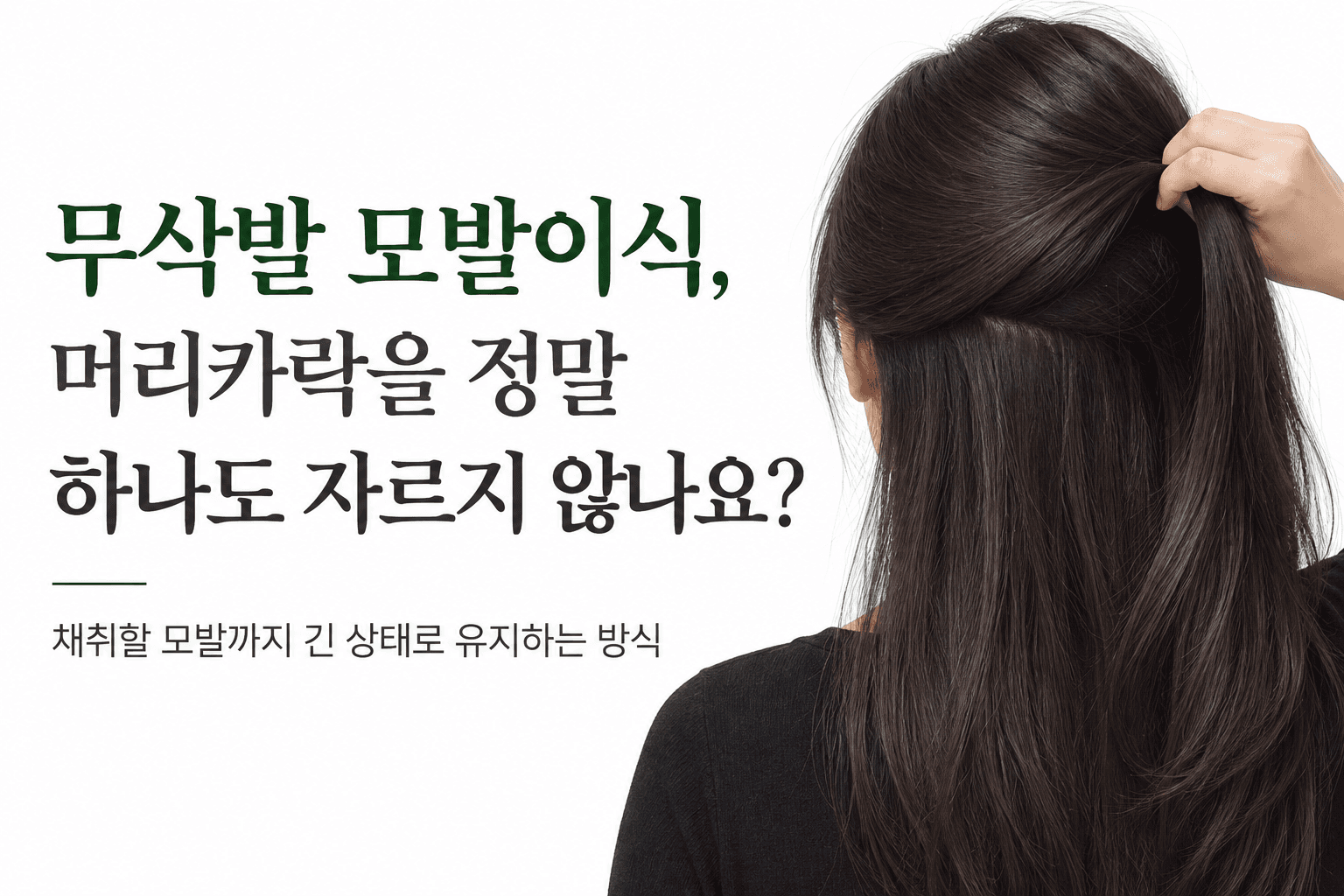
No-Shave Non-Incision Hair Transplant · Hair Length and Harvesting Method
No-Shave Hair Transplant: Is Not a Single Hair Really Cut?
The no-shave method at Modi Hair Plant is not a method in which the harvesting area is cut short and then covered with the surrounding hair. Not only the surrounding hair but also the hair to be harvested is kept long, without being cut short, throughout the procedure. However, because the way the terms "non-shave" and "no-shave" are used may differ from clinic to clinic, it is important to confirm which areas of hair are actually cut.
3-Line Summary
- Non-incision refers to the method of harvesting hair follicles, while no-shave is a term concerning the extent and length to which hair is cut.
- Modi performs a no-shave non-incision method in which neither the surrounding hair nor the hair to be harvested is cut short.
- Maintaining hair length may help reduce changes to your hairstyle and the burden of growing hair back, but it does not eliminate post-operative wounds or the recovery process.
What Do Non-Incision and No-Shave Each Mean?
When researching hair transplants, you will come across terms such as "non-incision," "non-shave," "no-shave," and "long hair." These terms do not all describe the same criteria.
Non-incision is a method of harvesting hair follicles
Instead of removing a strip of scalp, this refers to a method of individually harvesting follicular units using a small punch.
No-shave is a term concerning hair length
This term relates to which areas of hair are cut, and by how much, during the harvesting process. The actual extent to which length is maintained should be confirmed according to the clinic and surgical method.
Therefore, an explanation that "the surgery is performed using non-incision" alone is not enough to conclude that hair will not be cut. Conversely, the name "no-shave" alone does not make it clear whether even the hair to be harvested is kept long.
Incision vs. Non-Incision: How Are Hair Follicles Harvested?
Incision method: Harvesting a strip of scalp, then separating it
FUT, commonly referred to as the incision method, involves harvesting a strip of scalp from the back of the head and separating it into follicular units for transplantation. The harvesting area is sutured, and a linear scar may remain.
Non-incision method: Individually harvesting follicular units
FUE, the non-incision method, uses a small punch to separate the tissue surrounding each hair follicle and harvest it as a follicular unit. Although no strip of scalp is removed, small harvesting wounds and dot-shaped scars may remain.

Non-incision does not mean that no wounds are made in the skin. The extent to which hair is cut, harvesting wounds, and post-operative recovery should each be understood separately.
Even with Non-Incision, the Extent of Hair Cutting Differs
Even in non-incision surgery, there are various ways to prepare the hair in the harvesting area. A wide area may be trimmed short, only certain sections may be trimmed, or only the hair to be harvested may be selectively cut short.
The academic literature also describes, under the name "nonshaven FUE," methods in which the hair to be harvested is trimmed short in advance and methods in which the hair is cut short during the harvesting process. Therefore, rather than checking only the name, it is advisable to ask about the actual process as well. [1]
| Category | How the Hair Is Prepared | Points to Check |
|---|---|---|
| Full shave | The hair across a wide harvesting area is trimmed short. | The actual extent of trimming |
| Partial shave | Certain sections are trimmed short while the surrounding hair is kept. | The location and size of the sections, and how well they are covered by surrounding hair |
| Selective hair trimming | The hair to be harvested is trimmed short while the surrounding length is maintained. | When, and how short, the hair to be harvested is cut |
| Modi no-shave | Neither the surrounding hair nor the hair to be harvested is cut short; length is maintained. | Individual harvesting plan and hair length in the recipient area |

Modi's No-Shave Method Keeps Even the Hair to Be Harvested Long
The no-shave method described by Modi Hair Plant is distinct from methods that cover a short-trimmed harvesting area with long hair. It is a method in which the hair to be harvested is itself not cut short, and harvesting is performed while the long hair is maintained.
In this article, this is described as a no-shave non-incision method that preserves long hair. Terms such as no-shave, non-shave, and long hair used by other clinics do not all refer to the same process, so please confirm the specific surgical method.
This distinction does not mean that one method is better for everyone. The appropriate method should be determined by evaluating the required transplant area, donor area condition, hair characteristics, and surgical plan together.
What Changes When the Hair Is Not Cut?
1. It reduces the burden of changing your hairstyle for harvesting
Because wide sections or strip-shaped sections are not trimmed short, changes in hair length caused by harvesting preparation can be avoided. If you usually keep your hair long or tie it up, this is an important point to review during your consultation.
2. It reduces the burden of growing back short-cut sections
Sections where hair has been trimmed short may need time to match the length of the surrounding long hair. Modi's no-shave method is meaningful in that it does not create short sections for harvesting, which helps reduce the burden of such length differences.
However, not cutting the hair does not mean that changes in density or signs of surgery will be completely invisible after harvesting. How visible they are may vary depending on the amount and distribution of harvesting, existing density, and hairstyle.
3. It can be used to check the texture of long hair
Maintaining long hair makes it possible to check the hair's curvature and direction and use this information in placement planning. However, it cannot be concluded that the graft survival rate or final results will be better simply because long hair was preserved.

Maintaining Hair Length and Recovery Are Separate Matters
No-shave non-incision surgery is also a surgical procedure in which hair follicles are harvested and transplanted. Even if the hair is not cut short, small wounds form in the harvesting area, and redness, scabs, swelling, and the like may appear in the recipient area.
The degree to which existing hair covers the surgical area may differ from the actual state of recovery. You should receive guidance on when you can return to work, wear a hat, tie your hair, wash, and so on, according to the extent of surgery and your progress.
"Not shaving" is not the same as "no signs of surgery at all." Even when long hair is maintained, the recovery process and post-operative care are necessary.
How Is This Described in Research?
A 2017 study applied two nonshaven FUE methods to 42 patients and compared harvesting time, follicle transection rate, and other factors. The hair harvested in this study was short, so it can serve as a reference for understanding that the term "nonshaven" does not necessarily mean that long hair is preserved as is. This is not a study evaluating Modi's surgical results. [1]
A 2021 publication reviews the instruments and techniques of FUE that preserves long hair and introduces the authors' experience. It is a review describing technical characteristics and is not a large-scale randomized comparative trial demonstrating that the method is superior to other methods or offers faster recovery in all patients. [2]
During Consultation, Ask More Specifically Than "Is It No-Shave?"
Go a step beyond confirming the name, and ask separately about the surrounding hair and the hair to be harvested. It is also advisable to check separately how the existing hair in the recipient area, not just the harvesting area, will be prepared.

Frequently Asked Questions
I booked a no-shave procedure, but I was told the harvesting area would be cut a little. What should I check?
Check separately whether there are sections that will be trimmed short, whether only the hair to be harvested will be cut, and whether hair length will be shortened during the harvesting process. Modi's no-shave method is described as one in which even the hair to be harvested is not cut short.
If the back of the head is not cut, will the front hair and recipient area also be kept as is?
The harvesting area and recipient area should be checked separately. Because the preparation process may vary depending on the length and density of existing hair and the transplant area, please consult separately about the plan for maintaining length in the recipient area as well.
If long hair is transplanted as is, can I see the final result right away?
Even if long hair is visible immediately after surgery, this is not the final result. Afterward, the hair may fall out and grow back, and density may change, so progress should be observed over a sufficient period.
Can people with short hair also choose the no-shave method?
Your current hair length and donor area condition need to be examined in person. Not cutting the hair further and the harvesting area being well concealed are separate matters, so it is advisable to also discuss how it will look with your current hairstyle.
With no-shave, can I tie my hair right after surgery?
Maintaining hair length does not mean all styling is possible immediately. Because actions that pull strongly or press on the surgical area should be avoided, please follow the medical team's guidance on when and how to tie your hair.
Does the no-shave method also have a higher graft survival rate?
It cannot be said that the graft survival rate is higher based solely on the condition that hair is not cut. Multiple factors, including follicle harvesting and storage, the transplant process, scalp condition, and post-operative care, all have an influence.
Consult Based on Your Own Hairstyle
Modi Hair Plant performs a no-shave non-incision method in which even the hair to be harvested is kept long. Letting us know your usual hair length and style, desired transplant area, and post-operative schedule helps us consult with you on a plan suited to you.
References and Clinic Information
[1] Park JH, You SH. Pretrimmed versus Direct Nonshaven Follicular Unit Extraction. Plastic and Reconstructive Surgery – Global Open. 2017;5(3):e1261. DOI: 10.1097/GOX.0000000000001261. PMID: 28458975.
[2] Trivellini R, Perez-Meza D, Renaud HJ, Gupta AK. Preview long hair follicular unit excision: An up-and-coming technique. Journal of Cosmetic Dermatology. 2021;20(11):3422–3426. DOI: 10.1111/jocd.14026. PMID: 33629463.
Clinic information: Modi Hair Plant No-Shave Non-Incision Hair Transplant. The clinic's description of its surgical method and the results of academic research have been explained separately.
This article provides general medical information and information about the clinic's surgical method. It does not replace individual diagnosis or treatment planning. Infection, scarring, temporary hair shedding, changes in sensation, differences in graft survival, and other effects may occur after a hair transplant, and results and recovery periods vary from person to person. Whether to undergo treatment and the treatment method are determined after an examination by the medical team.