
Safety Criteria to Check Before a Hair Transplant
Overseas Hair Transplant: What Should You Check Besides Price?
Some things are just as important as surgery costs and travel schedules: who performs the surgery, how infection control is carried out, and where you can receive care if a problem arises after you return home.
In this article, based on a video by Director Yoo Hwa-jung and infection cases reported in an academic journal, we look at what to check before deciding on an overseas hair transplant.
Key Summary
- Surgery is not dangerous simply because it is overseas, nor safe simply because it is domestic. You need to check the medical team and the care system.
- A paper reported two patients who received long-term treatment for nontuberculous mycobacterial infection after an overseas hair transplant.
- If you have recurring pus, increasing swelling, or worsening pain after surgery, seek medical care without waiting for a scheduled follow-up date.
Overseas Hair Transplant: Is There a Plan for After the Surgery?
“The price is low, and they say they'll arrange the hotel and transportation. Is that okay?”
When researching an overseas hair transplant, cost and convenience are important points of comparison. However, a service that helps with booking and transportation does not guarantee the safety of the surgery or care in the event of complications.
During consultation, it is advisable to check the plan for the day of surgery and the plan for when problems arise separately. In particular, since it may be difficult to revisit the local clinic after returning home, find out specifically about the point of contact and how you will be connected to care.
The Infection Treatment Course of Two Patients Reported in a Paper
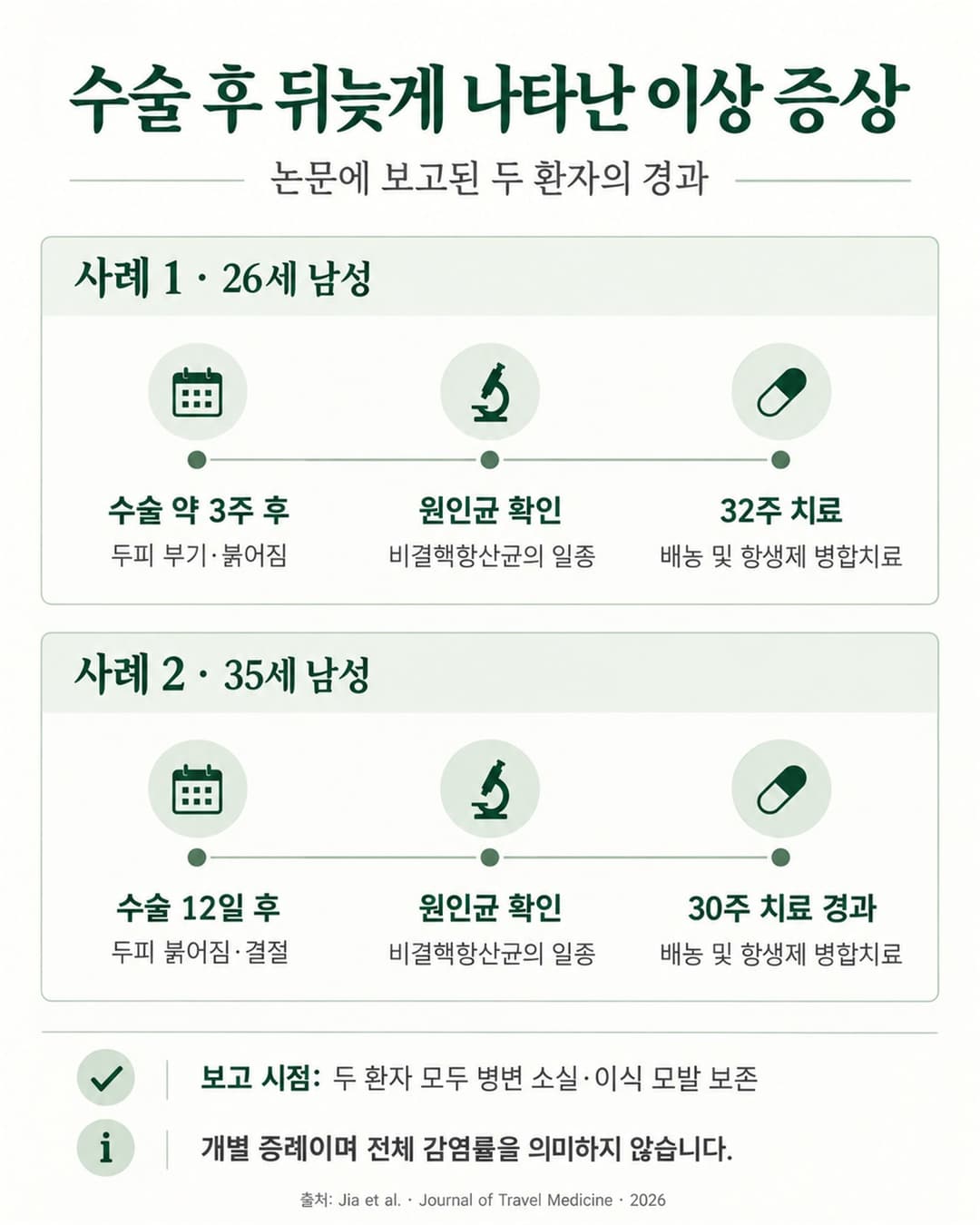
A report published in the Journal of Travel Medicine in 2026 covers infection cases in two patients who received hair transplants at the same overseas clinic. Below is a brief summary of the paper's key points.
Before Viewing the Photos
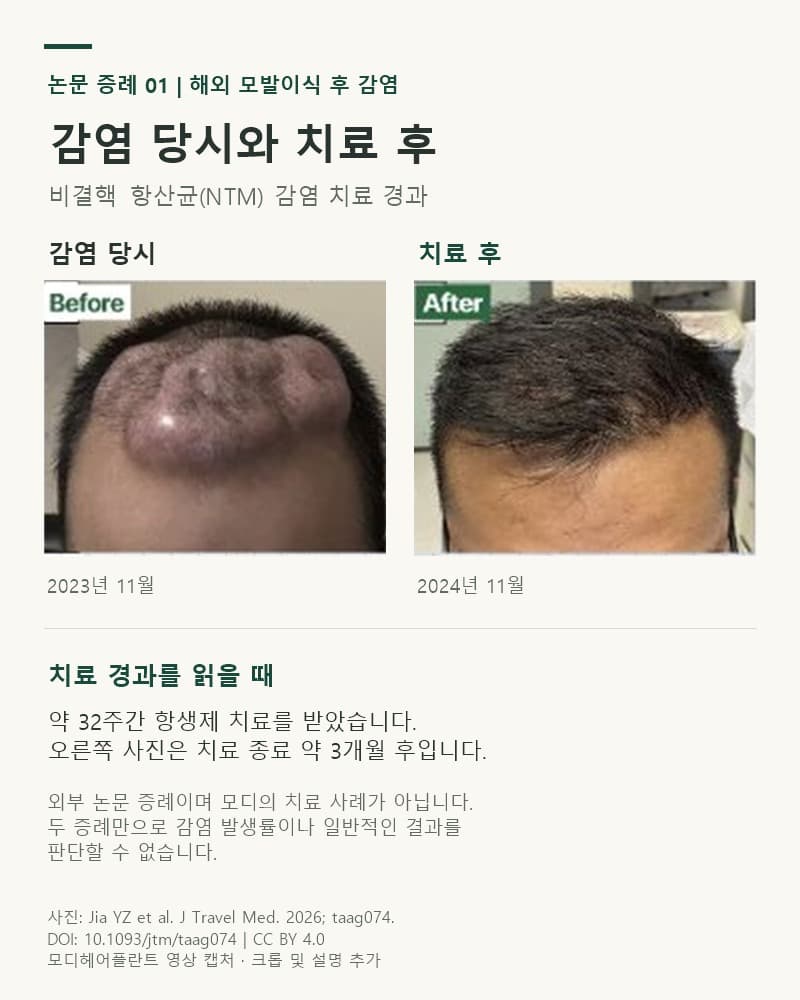
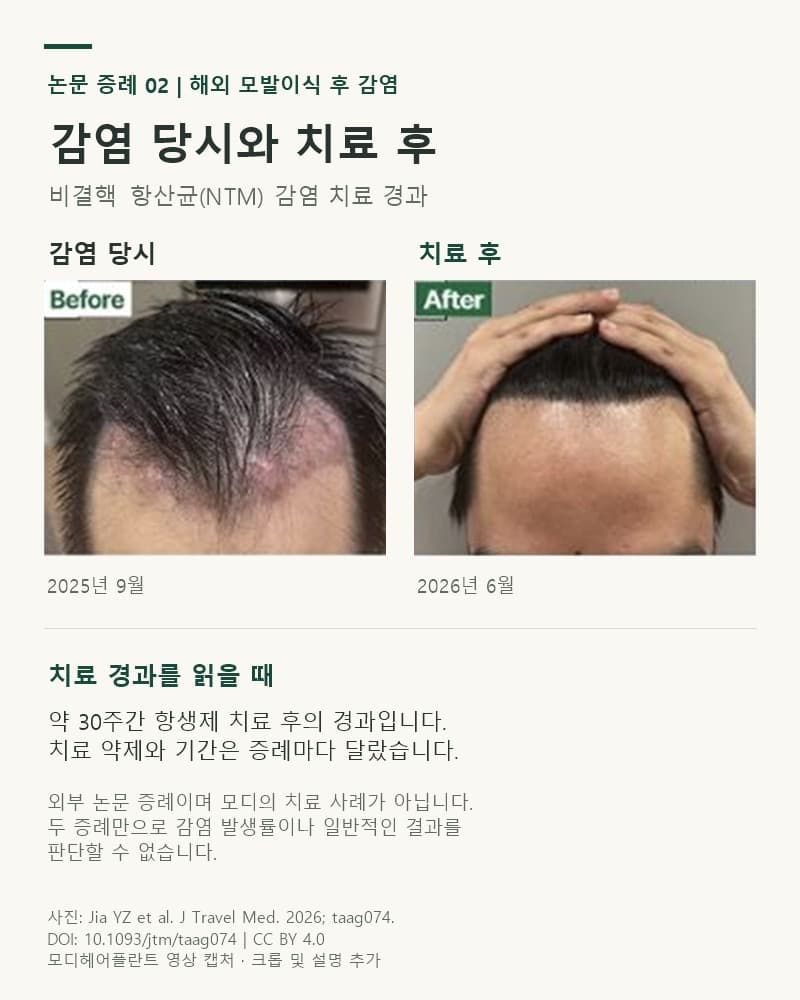
The photos below are comparison photos, published in an external paper, taken at the time of infection and after treatment. These are not cases treated at Modi Hair Plant, nor are they photos showing typical before-and-after results of hair transplant surgery. They include photos of scalp lesions.
Patient 1: A Case Treated for About 32 Weeks
A 26-year-old man developed swelling and redness of the scalp starting about 3 weeks after a non-incision hair transplant. Mycobacterium abscessus infection was subsequently confirmed, and he received treatment for about 32 weeks.
Patient 2: A Case Treated for About 30 Weeks
A 35-year-old man developed scalp redness and nodules starting 12 days after surgery. Infection by the same organism was confirmed, and the paper reports his course after about 30 weeks of treatment.
What the Same Clinic and Genomic Analysis Suggest
The two patients underwent surgery at the same clinic in Istanbul, Türkiye, about 2 years apart. Genomic analysis of the causative organism showed a difference of 1 SNP, raising the possibility of a common source of infection. However, no specific contaminated instrument or water supply was confirmed as the source.
Limitations of This Study
As this is a case report of two patients, it cannot be used to compare the overall incidence of infection after overseas hair transplants or safety by country. View the original paper
What Changes After Surgery Warrant Medical Care?
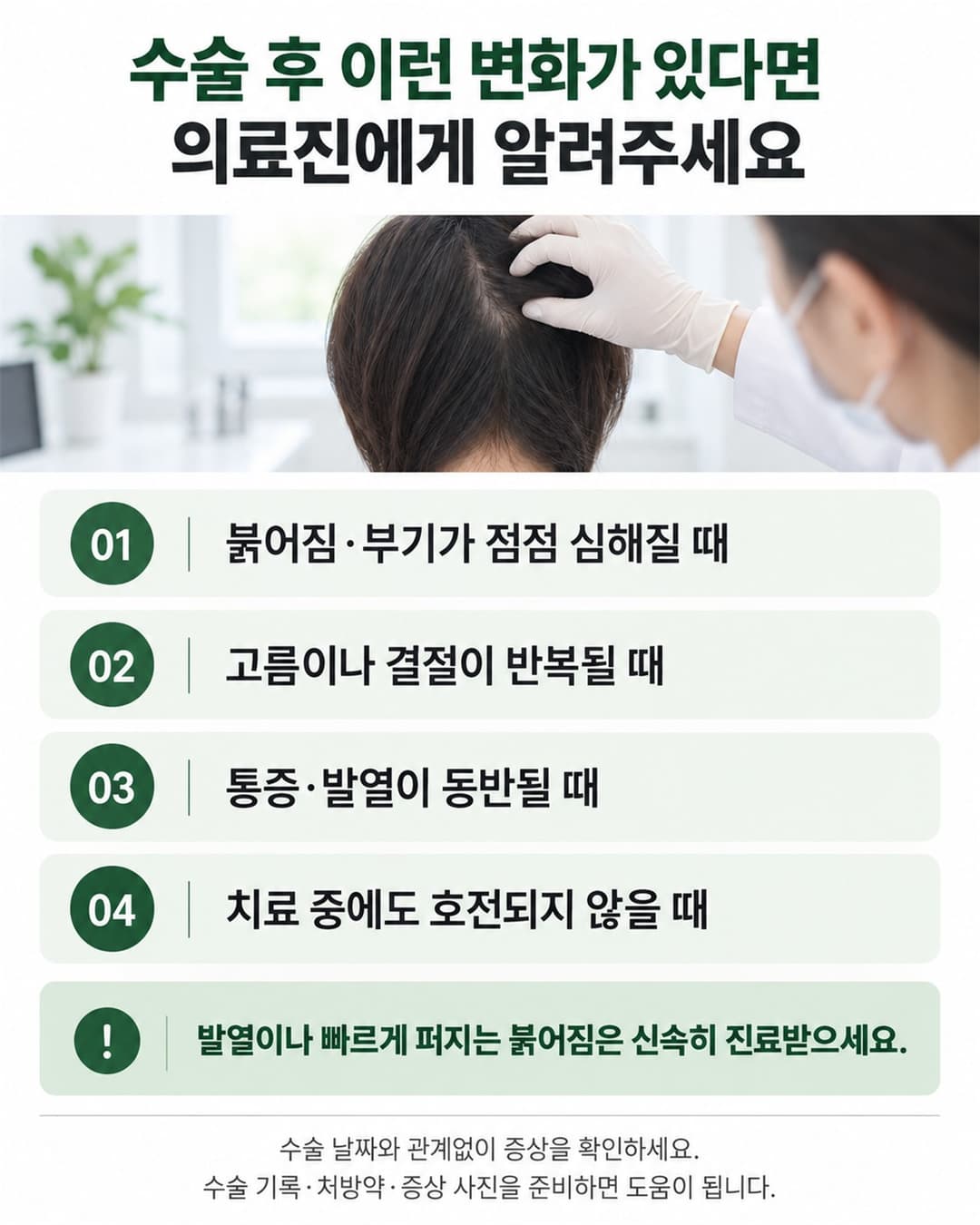
It is difficult to distinguish normal recovery from infection by photos alone. If you notice the following changes, inform the clinic that performed your surgery and, if necessary, see a nearby medical facility in person.
- The red area spreads, or swelling and pain gradually worsen
- Pus appears, or similar lesions keep recurring
- There is no improvement, or symptoms worsen again, despite the prescribed treatment
- Fever, chills, or a marked decline in general condition accompany the symptoms
This does not mean that “problems only arise after several weeks following surgery.” Regardless of timing, rapid worsening or accompanying systemic symptoms require prompt evaluation.
Please Share This Information When Seeking Care
Bringing the date and country of surgery, when symptoms began, medications taken orally or by injection, and previous test results will help with your care. The medical team will determine whether tests such as cultures or acid-fast bacilli tests are needed. Please avoid taking leftover antibiotics on your own or squeezing lesions yourself.
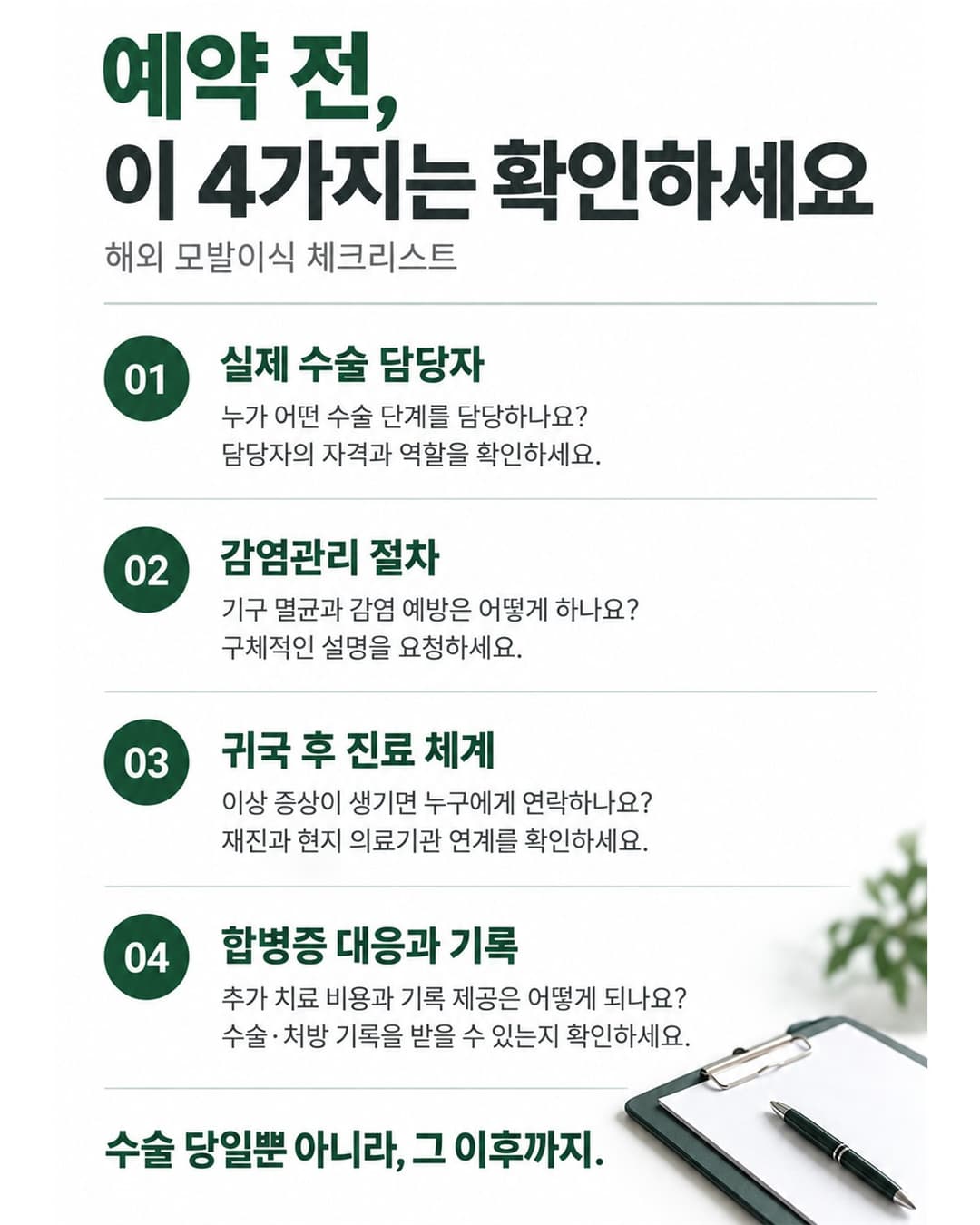
4 Things to Check Before Booking an Overseas Hair Transplant
1. Who Provides the Consultation and Performs the Surgery?
Check the medical staff in charge and their qualifications, their roles at each stage of surgery, and which medical staff are responsible for care if a problem arises. You should also distinguish between the roles of the booking agency and the actual medical facility.
2. How Do They Explain Infection Control?
Ask about instrument sterilization and use of disposable supplies, hygiene management of the surgical space, and the response process when infection is suspected. These are difficult to verify through facility photos or reviews alone.
3. How Will Care Continue After You Return Home?
Check how you can contact the medical team and their response time, situations requiring in-person care, and whether you can be connected to care after returning home. Problems may arise that cannot be handled through online consultation alone.
4. What Happens with Records and Costs If a Problem Arises?
Check whether you can receive your surgical records and prescription history, and who bears the cost of additional tests, treatment, and return visits. It is better to get this in writing rather than relying only on verbal explanations.
Don't Decide Based on Low Prices or Good Reviews Alone
A low price does not necessarily mean infection control is inadequate. Conversely, safety is not guaranteed simply because the cost is high or there are many reviews.
What matters is getting specific answers to your questions. Have the medical staff in charge, surgical process, infection control, and post-operative care system explained to you, and compare based on what you have verified yourself.
A hair transplant is not a treatment in which the entire process ends on the day of surgery. It is advisable to include, among your criteria for choosing a clinic, whether changes during recovery can be checked and whether you can receive care again when needed.
Frequently Asked Questions
I'm taking antibiotics, but pus has come back. Does that mean the medication isn't enough?
This cannot be judged by the amount of medication alone. It may be necessary to re-evaluate the causative organism, the response to the medication, and whether additional procedures such as drainage are needed. Do not increase or change medications on your own; inform the medical team of the medications you have taken and how your symptoms have changed.
The clinic that performed my surgery only asks me to send photos. Is online consultation enough?
Photos are helpful for sharing your progress, but they cannot confirm everything, such as pain, warmth, or the depth of a lesion. If you have pus, worsening swelling or pain, or fever, it is safer to receive in-person care rather than waiting with photo consultations alone.
What documents should I get if I plan to visit another clinic after returning home?
Prepare the surgery date and method, the names and duration of prescribed medications, test results, and the contact information of the clinic that performed the surgery. It also helps to record the date symptoms began and how they have changed.
If it doesn't look like these photos, can I assume it isn't an infection?
No. The photos only show specific patients at specific points in time. Even if the appearance differs, there may still be a problem, so pay attention to whether symptoms persist or worsen rather than whether they resemble the photos.
Watch the Video
Director Yoo Hwa-jung explains the infection cases in the paper and what to check before an overseas hair transplant. Detailed figures and photo timing for the cases can be found in the article above and the references.
Check Not Only the Day of Surgery, but Everything After It
The point of this article is not to avoid overseas surgery altogether. Wherever you have surgery, check who performs it, under what management it is carried out, and how care can continue if a problem arises.
During Your Hair Transplant Consultation, Ask About Aftercare Too
In addition to the surgical method and cost, ask about what to check before surgery, the follow-up schedule during recovery, and how to get in touch if you have abnormal symptoms.
If you currently have pus, fever, or worsening pain, see a nearby medical facility rather than waiting for a reply to an online consultation.
References and Video Source
Jia YZ, Boschung KF, Grant JM, Leung V, Connors WJA. Cluster of genomically linked Mycobacterium abscessus infections following hair transplantation in Turkey. Journal of Travel Medicine. 2026;taag074. doi:10.1093/jtm/taag074.
Case photo source: Figure 1 A–D of the above paper. © The Author(s) 2026. Creative Commons Attribution 4.0 International. Photos shown in the Modi Hair Plant video were captured, cropped, and annotated in Korean.
Video source: Director Yoo Hwa-jung, Modi Hair Plant. Video explaining overseas hair transplants and infection cases.
This article is intended to provide general medical information and does not replace individual diagnosis or prescription. The cases and photos presented reflect the course of specific patients, and not all patients will experience the same results. Whether and how to treat is determined by the medical team after assessing the patient's condition.