When Should You Take Hair Loss Medication?
Finasteride and dutasteride can be taken with or without food, and there is little difference in effect between taking them in the morning or in the evening.
However, you can choose the dosing time that suits you based on your drinking habits or whether you experience side effects.
During hair loss treatment consultations, there is one question patients ask most frequently.
“When should I take my hair loss medication?”
We receive a variety of questions, such as whether morning or evening is better,
whether it should be taken before or after meals,
and whether it is okay to take it on days when drinking alcohol.
Finasteride and dutasteride are the most widely used medications for treating male pattern hair loss, but there is quite a lot of misinformation about when to take them.
In fact, they can be taken with or without food, and what matters more than the dosing time is the habit of taking them consistently at the same time every day.
In this article, we take a detailed look at the correct way to take finasteride and dutasteride, based on FDA approval documents and their pharmacokinetic properties.
Finasteride and Dutasteride Can Be Taken With or Without Food.
For many medications, the absorption rate varies depending on food.
For example, there are
- medications that are better absorbed on an empty stomach,
- medications that must be taken after meals, and
- medications that are difficult to take on an empty stomach due to gastrointestinal irritation.
However, the hair loss medications
- finasteride and
- dutasteride
are somewhat different.
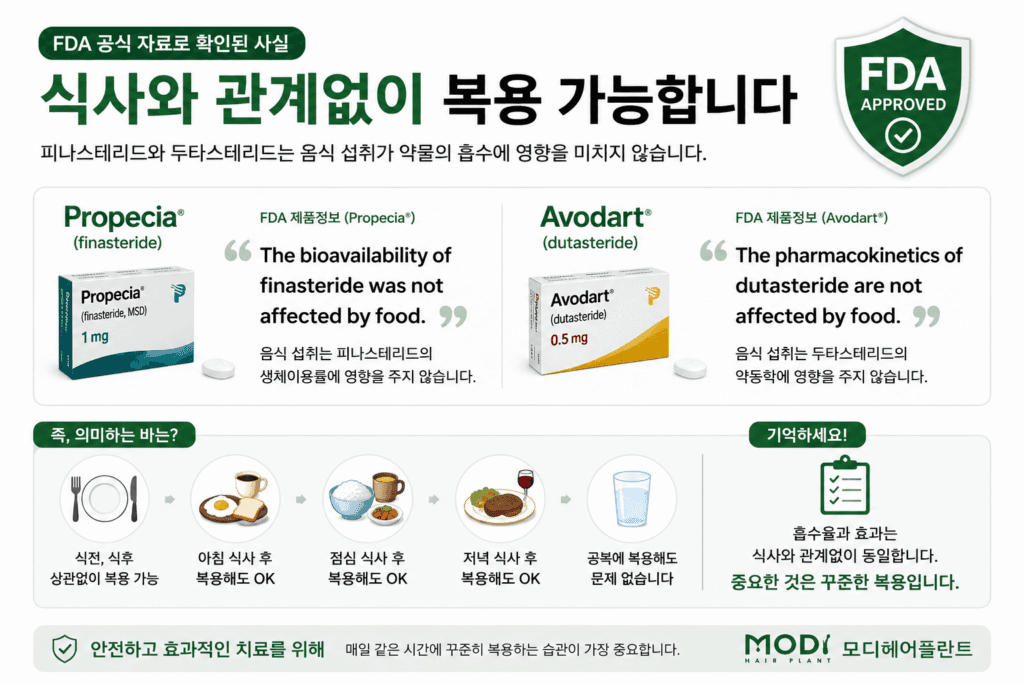
The FDA approval documents and product labels (Propecia®, Proscar®, Avodart®) all explicitly state that food does not affect the absorption of the drug.
FDA Product Information
“The bioavailability of finasteride was not affected by food.”
“The pharmacokinetics of dutasteride are not affected by food.”
In other words,
✔ You may take them on an empty stomach, and
✔ you may take them after meals.
There is no need to force yourself to take them around mealtimes.
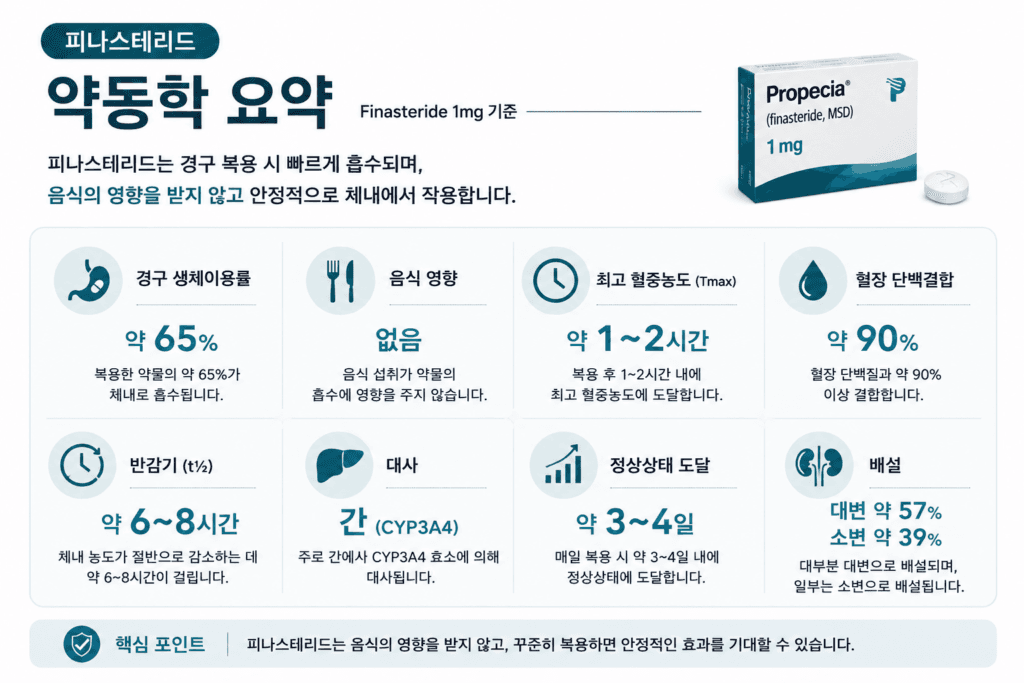
Finasteride Pharmacokinetics Summary
The Same Applies to Dutasteride.
With dutasteride as well,
there is little difference in absorption whether taken before or after meals.
However,
after a high-fat meal, the time to peak blood concentration (Tmax) may be slightly delayed,
but the total amount ultimately absorbed into the body (AUC) is nearly the same.
In other words,
there is no meaningful difference in effect.
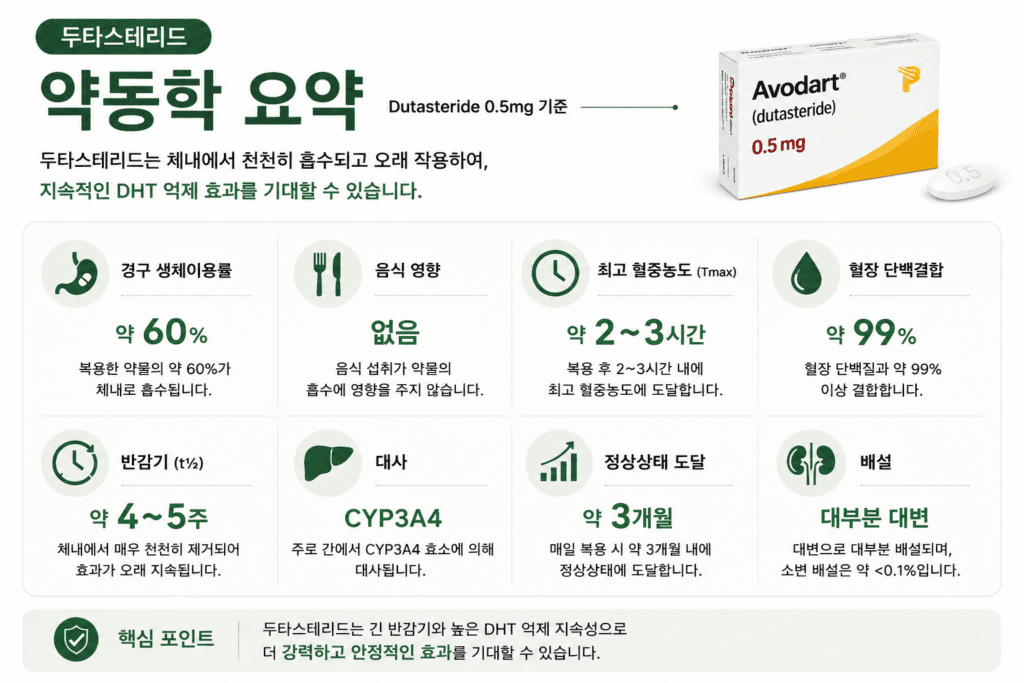
Dutasteride Pharmacokinetics Summary
So, Is Morning Better? Or Evening?
To start with the conclusion:
There is no difference in effect.
What matters most is
the habit of taking it at the same time every day.
This is because, for the medication to work, it is important to take it consistently once a day and maintain a steady concentration.
If You Drink Often, Taking It in the Morning Is a Good Option.
Both finasteride and dutasteride
are metabolized in the liver via the CYP3A4 enzyme.
Since alcohol is also metabolized in the liver,
“Is it okay to take them together?”
is a question we are often asked.
Of course, reducing alcohol consumption is ideal,
but if you drink frequently,
considering morning dosing can be a good option.
Since most drinking happens in the evening,
the idea is to avoid overlap between the time the drug reaches peak blood concentration and the time you drink.
What If You Feel Drowsy or Foggy After Taking the Medication?
Although rare,
some patients
- Fatigue
- Drowsiness
- Brain fog
- Reduced concentration
report symptoms such as these.
If you experience these symptoms,
taking it before bedtime may actually be more comfortable.
Conversely, if the morning is more comfortable for you,
it is fine to switch to the morning.
In some patients, simply changing the dosing time may reduce discomfort, but there is no clear evidence for this.
Can Changing the Dosing Time Reduce Sexual Side Effects?
Unfortunately, to date, there is no clear evidence that changing the dosing time
reduces sexual side effects.
However, since each individual's response to medication can differ,
if you experience discomfort, it is advisable to consult with your medical team to find the dosing time that suits you.
What Are the Differences Between Finasteride and Dutasteride?
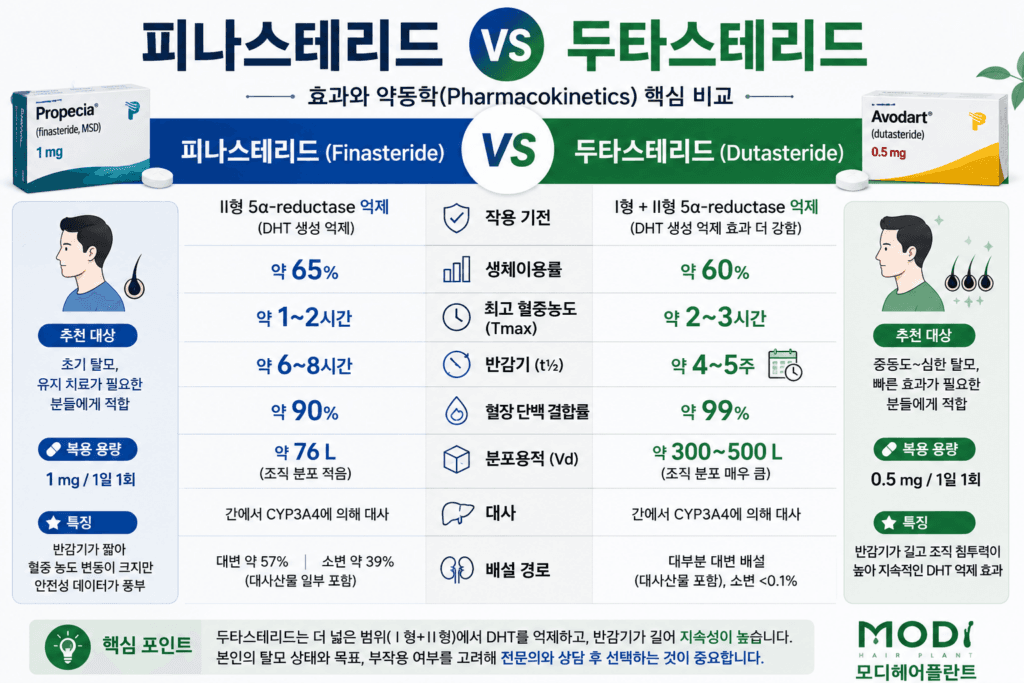
Both drugs dissolve well in fat,
but dutasteride has much higher lipophilicity than finasteride.
| Item | Finasteride | Dutasteride |
|---|---|---|
| LogP | Approx. 3.2 | Approx. 5.1 |
| Volume of distribution (Vd) | Approx. 76L | Approx. 300–500L |
| Half-life | Approx. 6–8 hours | Approx. 4–5 weeks |
| Tissue penetration | Moderate | Very high |
High lipophilicity means that the drug
- Adipose tissue
- Sebaceous glands
- Hair follicles
can remain longer in tissues such as these.
Because of this property,
dutasteride
acts for a long time not only in the blood but also in tissues,
and its DHT-suppressing effect within the hair follicles is also sustained.
More Important Than Dosing Time Is ‘Consistency.’
Many people
wonder, “What time should I take it for the best effect?”
However,
in reality,
taking it consistently is far more important than keeping to a specific dosing time.
The habit of taking it at a regular time every day
is the most important factor in achieving long-term hair loss treatment results.
Suggested Dosing for Different Situations
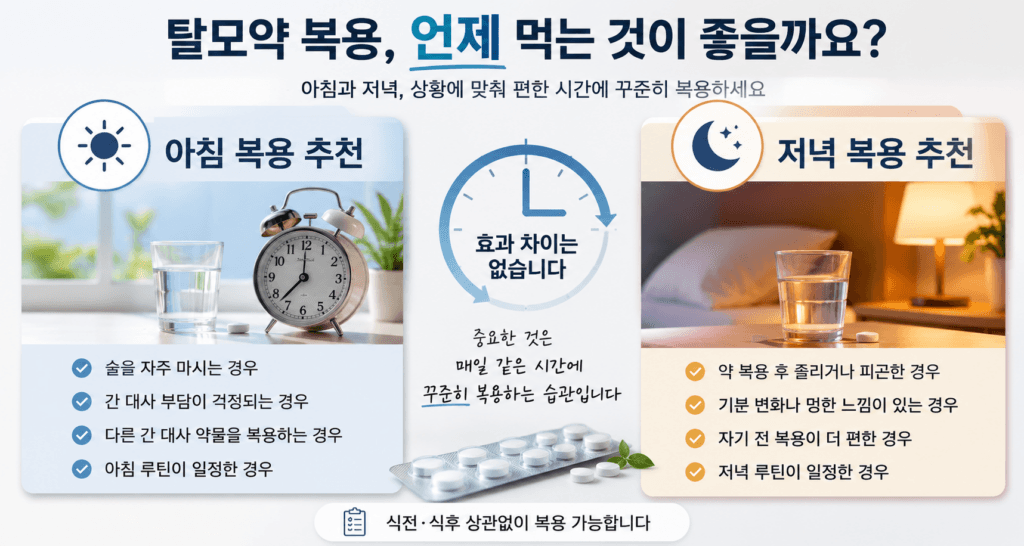
Morning Dosing Recommended
- If you drink alcohol frequently
- If you also take other medications metabolized by the liver
- If you have a consistent morning routine
Evening Dosing Recommended
- If you feel drowsy or tired after taking the medication
- If taking it before bed is more convenient
Modi Hair Plant Clinic's Approach to Care
At Modi Hair Plant Clinic, rather than simply prescribing hair loss medication, we develop a medication treatment plan that takes into account the degree of hair loss progression, age, family history, lifestyle, existing medical conditions, and any future hair transplant plans.
In particular, for patients planning a hair transplant, we also discuss whether to combine it with medication and the need for maintenance treatment, in order to propose a longer-term treatment strategy.
Frequently Asked Questions (FAQ)
Q. Should finasteride be taken on an empty stomach?
No. It can be taken with or without food.
Q. Is dutasteride more effective when taken in the evening?
No. There is little difference in effect between morning and evening.
Q. Is it okay to change the dosing time frequently?
If possible, it is best to take it at the same time every day.
Q. How should I take it on days when I drink alcohol?
It is advisable to allow sufficient time between drinking and taking the medication, and if you drink frequently, you may consider morning dosing.
Q. Do I need to keep taking hair loss medication after a hair transplant?
Transplanted hair is relatively less affected by DHT, but hair loss may continue to progress in your existing hair.
Therefore, in most cases, continuing medication after consulting with your medical team is helpful.
Q. Do I have to take hair loss medication for life?
Male pattern hair loss is a progressive condition, so hair loss may progress again if medication is discontinued.
The treatment period may vary depending on the degree of hair loss progression and treatment goals, so it is best to decide in consultation with your medical team.
🎥 Learn more in our video.
If you prefer video to text, the video below explains the dosing times and differences between finasteride and dutasteride in an easy-to-follow way.
References
- U.S. FDA. PROPECIA (finasteride) tablets prescribing information — Pharmacokinetics (Absorption). DailyMed label (“Bioavailability of finasteride was not affected by food.”)
- U.S. FDA. AVODART (dutasteride) capsules prescribing information — Pharmacokinetics (Effect of Food). DailyMed label (States that peak blood concentration decreases by 10–15% when taken with food, but this is not clinically significant, so it may be taken with or without food)
The above are the U.S. FDA-approved prescribing information (labels) for each drug and are the sources of the food- and absorption-related statements cited in this article.
This content was written based on current medical literature and FDA approval information,
and was published after review by the medical team at Modi Hair Plant Clinic.