“They said this eyelash serum was guaranteed to work, so I splurged on it.”
This is a story we have been seeing more and more often on SNS and social media: high-priced eyelash serums. Reviews claiming lashes grew thicker and faster are accompanied by phrases like “proven results” and “guaranteed effect.”
Today, we will take a careful look, along with the full ingredient list, at whether these products actually work and, more importantly, whether there are any safety concerns.
Key Summary
✔ Some high-priced eyelash serums contain isopropyl cloprostenate, a prostaglandin analogue.
✔ Ingredients in this class may make eyelashes longer and darker, but adverse reactions such as eyelid irritation, pigmentation changes, and a sunken appearance around the eyes have also been reported.
✔ The mere fact that a product is sold as a cosmetic does not mean its safety for long-term use around the eyes has been sufficiently confirmed.
✔ Check the ingredient list, and stop using the product immediately if any abnormal symptoms appear.
Why Are They So Expensive? — Even the Distribution Channels Differ
Typical eyelash serums usually cost around 20,000–30,000 won. However, certain products that have recently drawn attention are considerably more expensive, at over 100,000 won per bottle. Their sales channels are also somewhat different. Rather than being sold openly online, they are often distributed offline through affiliated outlets such as aesthetic clinics and salons, accompanied by strong claims such as “proven results” and “guaranteed effect.”
The higher the price and the stronger the advertising, the more carefully consumers need to check the ingredients and the supporting evidence.
The Key Ingredient to Check in the Full Ingredient List
When I tried to check the full ingredient list of one representative product, I found that it was not displayed on the product website. Fortunately, companies that import and distribute products from overseas are required to disclose the full ingredient list, so I was able to confirm it through import-related documents.
The ingredient list was quite long, and the key ingredient was the very last one: isopropyl cloprostenate.

Cosmetic ingredient lists generally present ingredients in descending order of concentration, but the order of ingredients included in small amounts may vary. Therefore, the exact concentration cannot be determined simply because an ingredient appears at the end of the list. However, because isopropyl cloprostenate may exert pharmacological effects even at very low concentrations, whether it is included at all deserves careful attention.
Prostaglandin Derivatives — A Long-Known Story
Isopropyl cloprostenate belongs to the class of prostaglandin derivatives. The fact that applying prostaglandin derivatives around the eyes makes eyelashes and eyebrows darker and thicker is actually not a new discovery.
For a long time, people using glaucoma eye drops have commonly reported that “my eyelashes got darker.” Building on this observation, the multinational pharmaceutical company Allergan developed Latisse, which uses bimatoprost, a prostaglandin derivative, at a lower dose than in glaucoma treatment, for the purpose of lengthening eyelashes. Latisse is a U.S. FDA-approved prescription drug and was previously introduced in Korea as well.
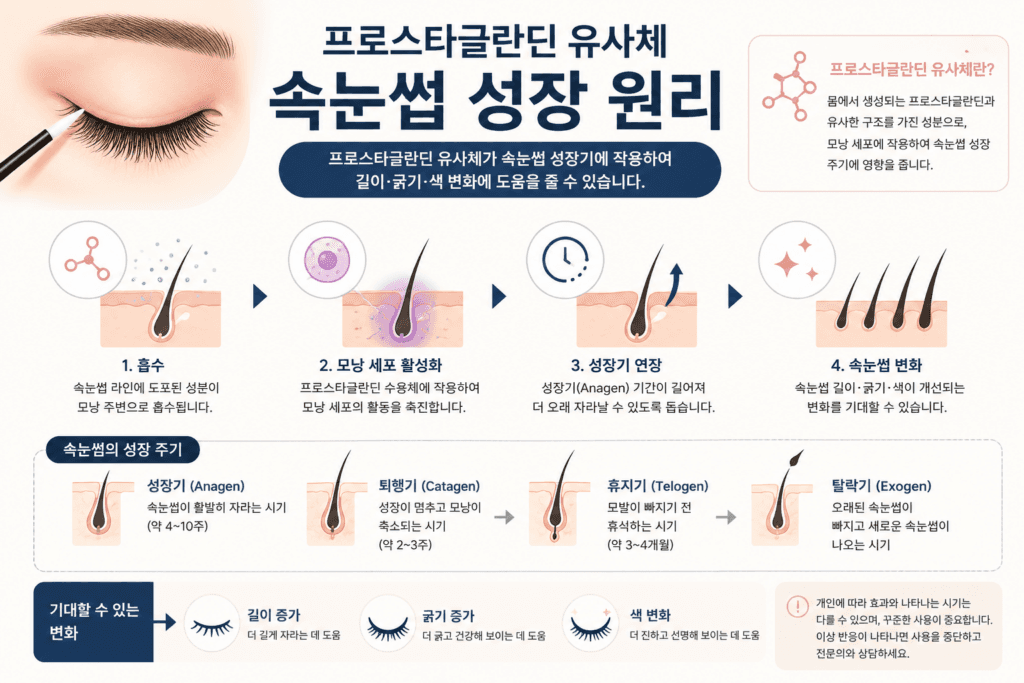
Side Effects of Latisse and Prostaglandin-Class Ingredients
Latisse, which contains bimatoprost, is a prescription drug approved by the U.S. FDA for the treatment of eyelash hypotrichosis. As a drug with confirmed efficacy, it also has known adverse reactions requiring caution, such as itching and redness of the eyelid skin and pigmentation changes. It is currently not generally available in Korea, but it is difficult to attribute the specific reason for the discontinuation of its distribution in Korea to side effects alone.
Why It Is Distributed as a Cosmetic Rather Than a Drug
The ingredients belong to the same class, yet one was a prescription drug and the other is sold as a cosmetic. The difference lies in the laws that apply to each.
- Drugs require supervision and approval from the Ministry of Food and Drug Safety for every ingredient they contain.
- Cosmetics follow what is known as negative regulation: an ingredient may be used as long as it is not on the prohibited list of “ingredients that must not be included.”
Isopropyl cloprostenate is included in very small amounts and is not currently designated as a prohibited ingredient under cosmetic ingredient management standards, so it is used in some products. However, being sold as a cosmetic does not mean its safety for long-term use around the eyes has been sufficiently confirmed.
Which Side Effects Should You Watch For?
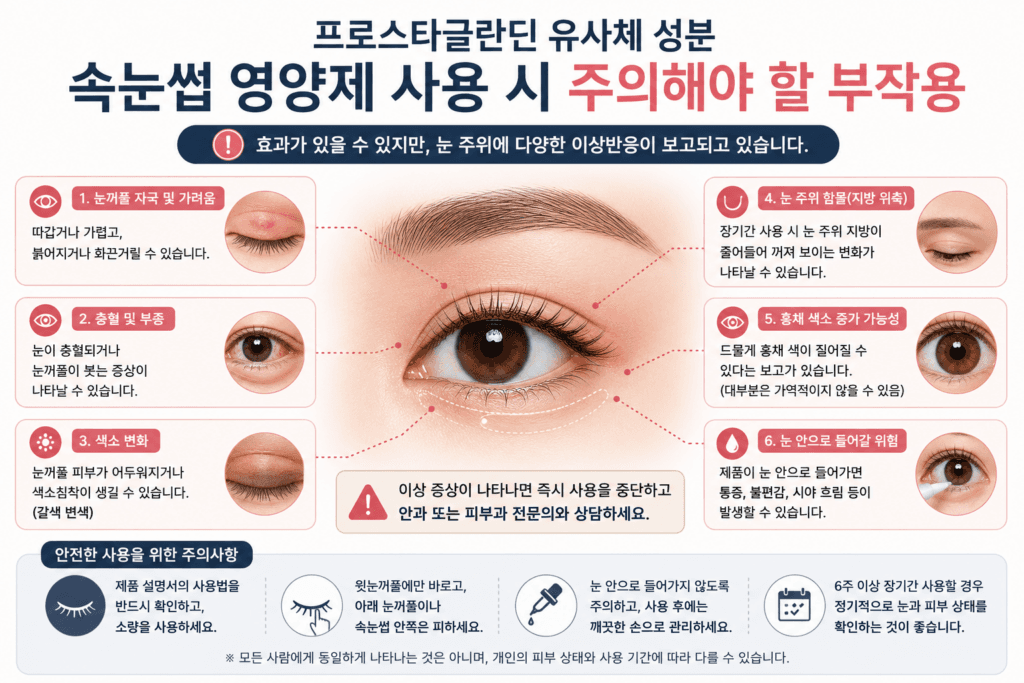
The most common is irritation at the application site. Stinging, itching, redness, or swelling may occur. For eyelashes to grow, the product must be applied consistently for about 6 weeks, not just a day or two, and repeated irritation during that period can lead to persistent inflammation similar to contact dermatitis. Persistent inflammation can lead to pigmentation, which may make you feel that “my dark circles seem darker.” However, pigmentation caused by inflammation often fades gradually once use is discontinued.
A more important concern is atrophy of the fat around the eyes with long-term use. With age, the fat in the upper eyelid area decreases and the eyelid lines deepen; with long-term use, a reduction in periorbital fat and a deeper-looking eyelid sulcus have been reported in some users. There are reports that this change does not fully reverse even after use is stopped. This is known to be a characteristic common to prostaglandin derivatives such as bimatoprost.
This does not mean the effect is “false.” However, since these products are used for cosmetic purposes, I would like to point out that you need to weigh the benefits against the side effects you may have to accept. If you decide to use one, be sure to follow the directions and precautions on the product, and take care that it does not run into the eye or onto the lower eyelid. If any abnormal symptoms appear, it is advisable to stop use immediately and seek medical care.
Frequently Asked Questions
If it is sold as a cosmetic, hasn’t its safety been confirmed?
The fact that a product can be sold as a cosmetic is not the same as its safety for long-term use around the eyes having been sufficiently proven. In particular, prostaglandin analogues may exert pharmacological effects even at low concentrations, so you should check the ingredients and the area of application. If eye redness, eyelid irritation, pigmentation changes, or a sunken appearance around the eyes occurs, it is advisable to stop use and consult an ophthalmologist or dermatologist.
I developed pigmentation. Will it return to normal if I stop using the product?
Skin pigmentation accompanying irritation or inflammation may gradually fade after use is discontinued, but the degree and duration of recovery vary from person to person.
With prostaglandin-class ingredients, reductions in periorbital fat and a deeper-looking eyelid sulcus have been reported. The frequency of occurrence and the likelihood of recovery vary depending on the ingredient, concentration, duration of use, and individual condition, making them difficult to predict precisely.
I still want darker eyelashes. Is there any other option?
If you already have eyebrows and eyelashes, we recommend deciding carefully, taking both irritation and cost into account. If your concern is insufficient eyebrow density itself, you can compare other options such as eyebrow transplant through a consultation. Since the suitability of any method differs depending on individual condition, please discuss it thoroughly with a specialist.
Can I use it during pregnancy or while planning a pregnancy?
If you are pregnant, breastfeeding, or planning a pregnancy, it is advisable not to use products containing prostaglandin analogues on your own. Please check the product ingredients and consult an obstetrician-gynecologist or ophthalmologist.
Which symptoms mean I should stop using it?
If you experience persistent redness, pain, severe itching or swelling, changes in vision, changes in skin color around the eyes, or a sudden sunken appearance of the eyelids, it is advisable to stop use and see an ophthalmologist.
If I use an eyelash serum, will my lashes return to their original state when I stop?
Eyelashes lengthened by prostaglandin analogues may gradually return to their original state according to the eyelash growth cycle once use is stopped. However, there are individual differences, and whether side effects resolve may vary depending on the symptom.
In Summary
- The “effect” of high-priced eyelash serums generally comes from a prostaglandin derivative (isopropyl cloprostenate).
- Latisse, a prescription drug using an ingredient of the same class, is a U.S. FDA-approved product and is currently not generally available in Korea.
- Current products appear to be distributed in a blind spot of the negative regulation system for cosmetics.
- This does not mean they have no effect at all, but you should be aware of the possibility of irritation, pigmentation, and periorbital fat atrophy and make a careful decision.
It is easy to be swayed by phrases like “proven results,” but checking both the ingredients and the side effects is ultimately the way to protect yourself.
References
- Prostaglandin-associated periorbitopathy. Indian Journal of Ophthalmology. 2016. View source
- Periorbital changes associated with topical bimatoprost. Ophthalmic Plastic and Reconstructive Surgery. 2008. View source
- Periorbital fat atrophy — an unfamiliar side effect of prostaglandin analogues. Orbit. 2010. View source
- 💬 Modi Hair Plant KakaoTalk Consultation
- 🌐 Visit the Modi Hair Plant Website
- 📞 Phone consultation: 02-544-8659
This article was adapted from a YouTube video by Director Yoo Hwa-jung of Modi Hair Plant Clinic. It is intended to provide general medical information and does not replace individual diagnosis or treatment.
This article was reviewed by medical staff before being published.