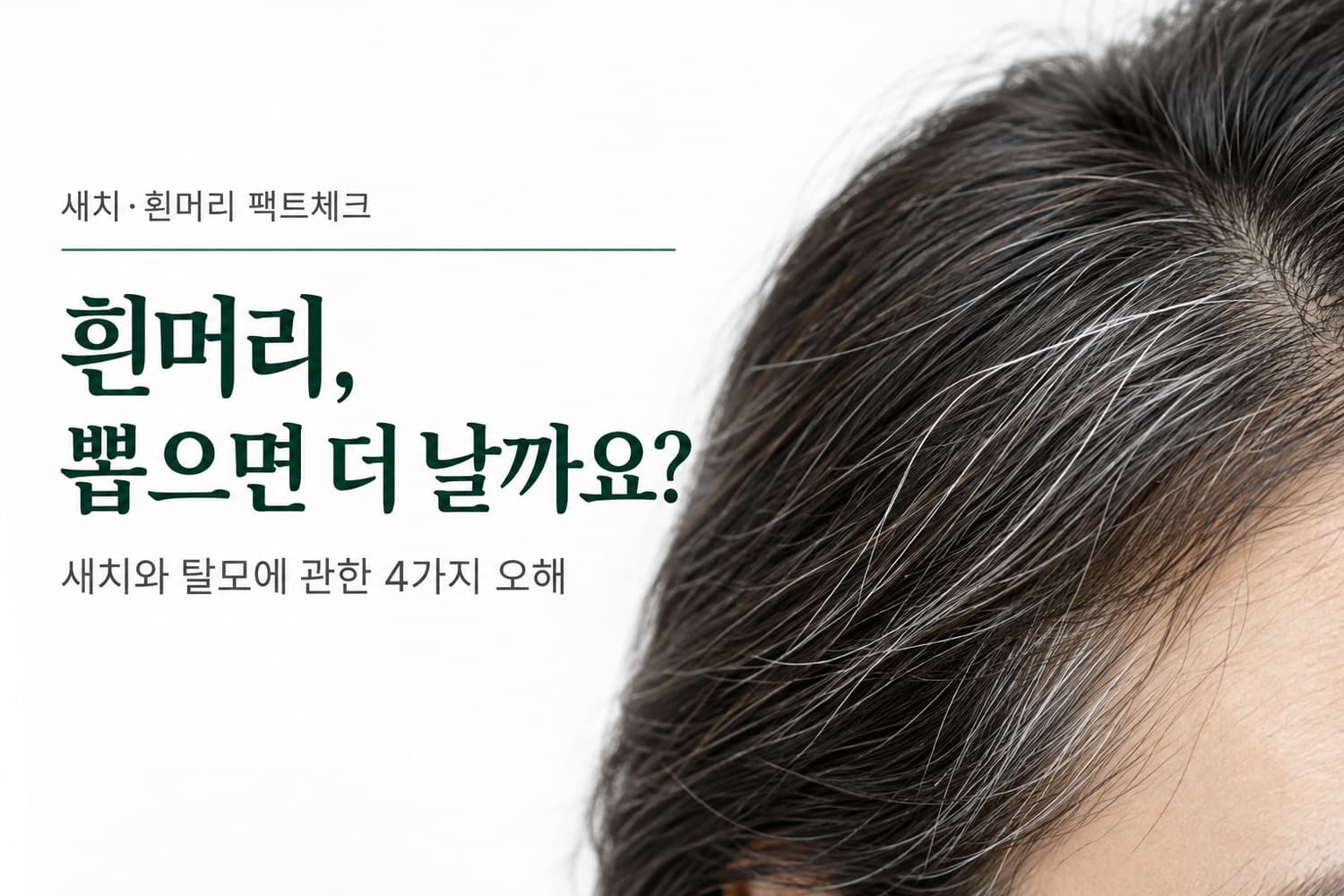
Premature Gray Hair · Gray Hair · Fact Check by Director Yoo Hwa-jung
When You Spot Gray Hair: What to Know Before Plucking
Plucking one gray hair does not make two grow back. Having a lot of premature gray hair also does not mean you will not develop hair loss. When managing gray hair, it is important to distinguish between changes in hair color and changes in hair density, and to understand separately that covering color with a product is different from restoring the pigment function of the hair follicle.
Based on a video by Director Yoo Hwa-jung of Modi Hair Plant, we look at four misconceptions about gray hair, stress, hair loss, and supplements. We have also reviewed related research to summarize what is known and what is difficult to state definitively.
3-Line Summary
- Plucking does not turn one gray hair into two. Repeated plucking can cause irritation and thinning, so it is better to avoid it.
- Gray hair and hair loss should be assessed separately. The amount of gray hair alone cannot tell you whether hair loss will develop or whether your hair density is fine.
- Covering or tinting is different from restoring pigment function. No treatment has been established to reliably reverse ordinary gray hair, but if there is an underlying cause, evaluation and treatment are considered.
Watch the Video First
The video explains whether plucking gray hair makes more grow, whether stress can turn hair white overnight, how gray hair and hair loss are related, and whether black beans or supplements can restore dark hair.
Are Premature Gray Hair and Age-Related Gray Hair Different Phenomena?
White hair that appears at a relatively young age is commonly called premature gray hair, but both premature gray hair and the gray hair that increases with age are related to a decrease in hair pigment. When changes occur in the production and transfer of melanin pigment in the hair follicle, newly growing hair may appear white or gray. [1]
Various factors, including family history, age, and health status, are involved in when graying begins and how it progresses. Therefore, the mere presence of a few gray hairs does not allow a definitive conclusion about a specific disease or nutritional deficiency.
Misconception 1. Will Two Hairs Grow if You Pluck a Gray Hair?
Plucking does not create new hair follicles or increase the number of hairs. Even if gray hairs seem more noticeable nearby after plucking, that alone does not mean plucking increased the gray hair.
That said, a habit of repeated plucking is not recommended either. The American Academy of Dermatology advises that plucking gray hair can cause thinning, and that the hair that grows back may also be gray.
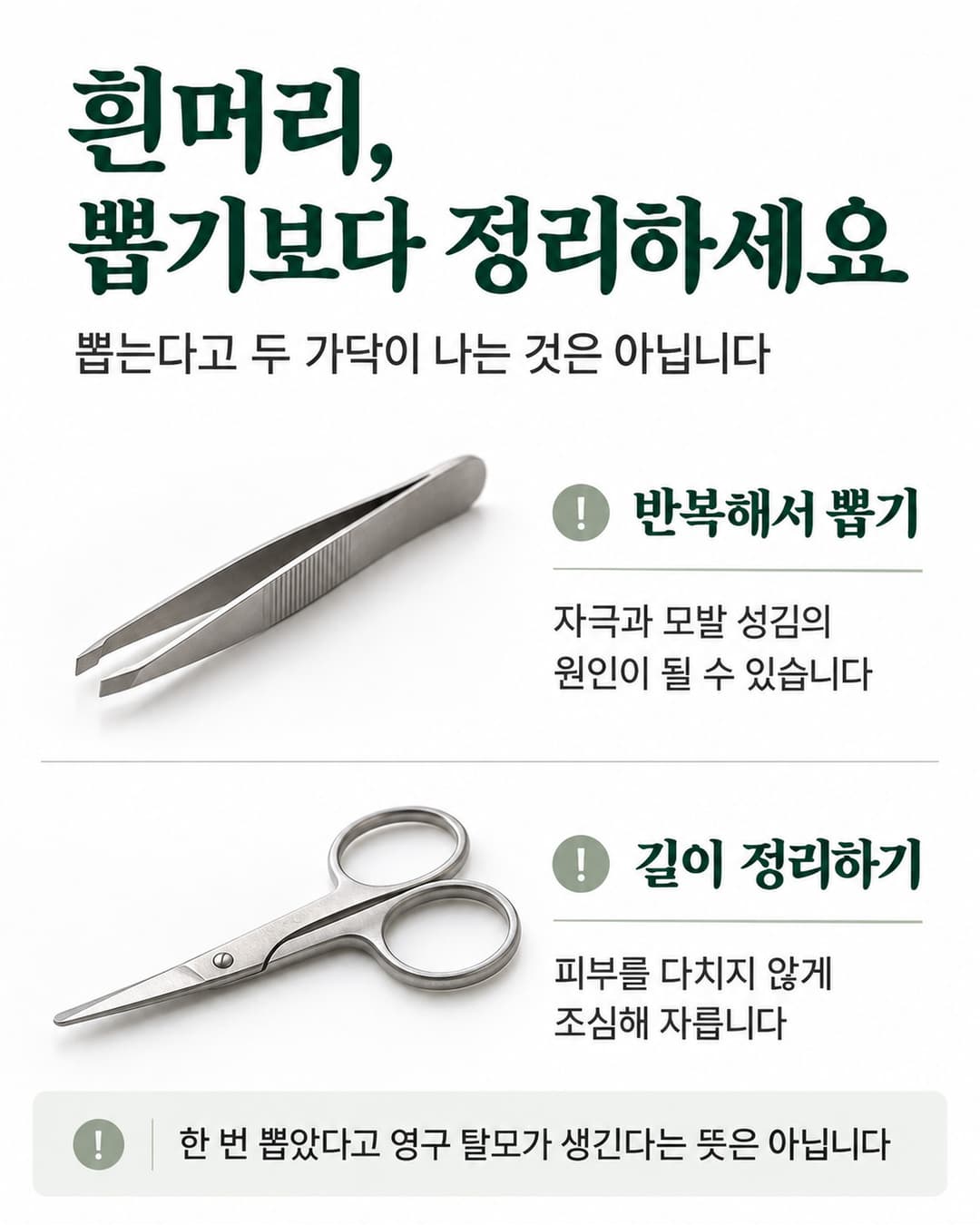
How Should You Manage a Few Bothersome Strands?
In the video, Director Yoo Hwa-jung explains that if one or two gray hairs bother you, trimming their length is preferable to plucking. Take care not to injure the scalp when cutting. If you choose a cover product or hair dye, please check the product's directions and precautions.
There is no need to worry excessively if you have already plucked one or two strands. A single pluck does not mean permanent hair loss. What matters is not plucking the same area repeatedly, and having the area checked if a wound or inflammation develops.
Misconception 2. Can Stress Turn Your Hair White Overnight?
The link between stress and gray hair should be distinguished from the story that all existing hair turns white overnight. Hair pigment is related to the process by which hair is formed in the follicle, so changes in newly grown sections after stress should not be explained as the same phenomenon as sudden discoloration of existing hair.
Mechanism Identified in Mouse Experiments
A 2020 study showed in mice that stress-induced sympathetic nerve activation can lead to depletion of melanocyte stem cells and the development of white hair. This does not mean the same thing occurs in humans at the same speed or to the same degree. [2]
Changes Observed in Humans
A 2021 study of 14 people observed an association between pigment changes and repigmentation in some hairs and experiences of stress. This was a small observational study and did not demonstrate a treatment effect whereby reducing stress makes anyone's gray hair turn dark. [3]
Therefore, definitive statements such as "stress has nothing to do with gray hair" or "rest will always bring back dark hair" should be avoided. If a sudden change in color is accompanied by significant hair shedding, it is advisable to check whether there is another cause.
Misconception 3. If You Have a Lot of Gray Hair, Will You Avoid Hair Loss?
Having a lot of gray hair does not make you exempt from hair loss. A change in hair color and hair becoming thinner or falling out are different changes that need to be observed.
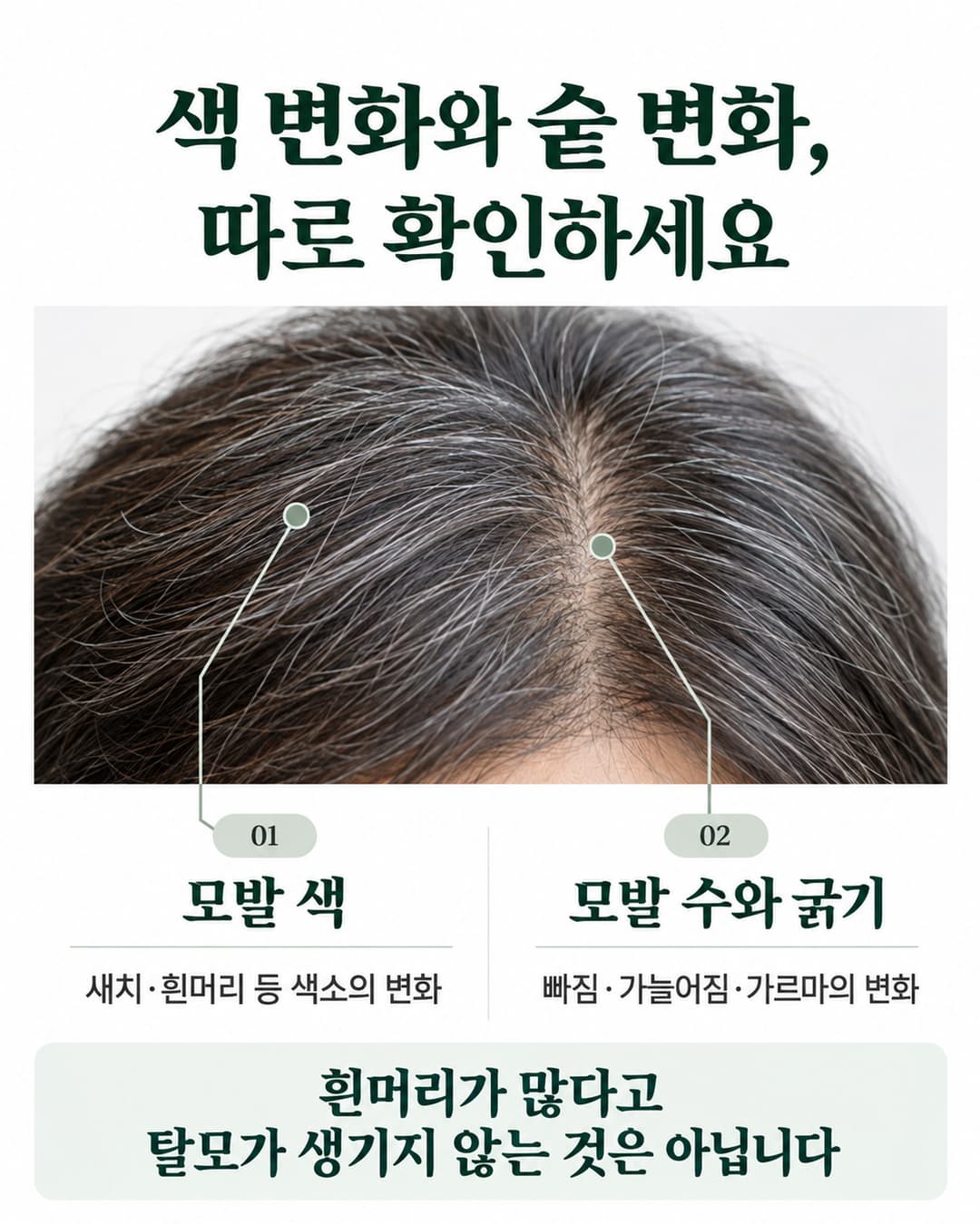
The video also addresses the popular belief that having a lot of gray hair prevents hair loss. Even if your gray hair stays the same, if your part widens, the hair at the front thins, or overall density decreases, hair loss should be evaluated separately.
If you take comparison photos, try to keep the lighting, angle, part position, and whether the hair is wet or dry similar. However, rather than determining the cause from photos alone, if changes persist it is better to have your scalp and hair condition examined at a consultation.
Misconception 4. Will Black Beans or Gray Hair Supplements Turn Hair Dark Again?
Including black beans or black sesame in your diet is different from the treatment claim that eating them will turn gray hair back to dark hair. No reliable effect of specific foods or supplements in reversing ordinary gray hair has been established. The literature on managing gray hair also describes the limitations of treatment options and the importance of evaluating the cause. [1]
The Mechanism of Catalase Is Not the Same as a Supplement's Effect
The fact that catalase and oxidative stress appear in hair pigment research does not mean that taking or applying catalase supplements will restore gray hair. The biological role of an ingredient and the effect of an actual product when used in people must be verified separately. [1]
Treatment of a Confirmed Deficiency Is a Separate Matter
If there is a confirmed cause, such as vitamin B12 deficiency, treatment of that problem may be considered. This does not mean supplements are recommended for everyone without a deficiency, or that taking them will always restore color. The need for testing and treatment is determined based on medical history and symptoms. [4]
Natural Ingredients Also Require Safety Checks
A case series of 25 patients treated for liver injury after ingesting Polygonum multiflorum (He Shou Wu) has been reported. While these data cannot be used to calculate the incidence of adverse effects, they show that herbs and supplements taken in hopes of improving gray hair also need to be checked for safety. If you are taking any products, please let us know at your consultation. [5]
If Gray Hair Shampoo Makes Hair Look Dark, Has Pigment Function Been Restored?
Supplementing color so gray hair is less visible is different from restoring the pigment-producing function of the hair follicle. The video explains how some gray-coverage shampoos change the apparent color by coating and tinting the hair.
However, not all products work with the same ingredients or mechanisms. Rather than judging the effect or level of irritation by the name "gray hair shampoo" alone, check each product's ingredients, directions, and precautions.

| Category | Meaning | What to Check |
|---|---|---|
| Cover / Dye | Supplements apparent color so white hair is less visible. | Check the product's directions and the possibility of irritation or allergy. |
| Treatment of Underlying Cause | If a deficiency or disease is confirmed, that cause is treated. | Individual evaluation is required, and restoration of hair color is not guaranteed. |
| Color Restoration of Ordinary Gray Hair | Related to pigment production in newly growing hair. | There is not yet an established treatment applicable to everyone. |
Have These Changes Checked at a Consultation
Gray hair itself is a common change, and seeing gray hair does not by itself mean testing or treatment is needed. The video advises looking into the cause when the following changes are also present.
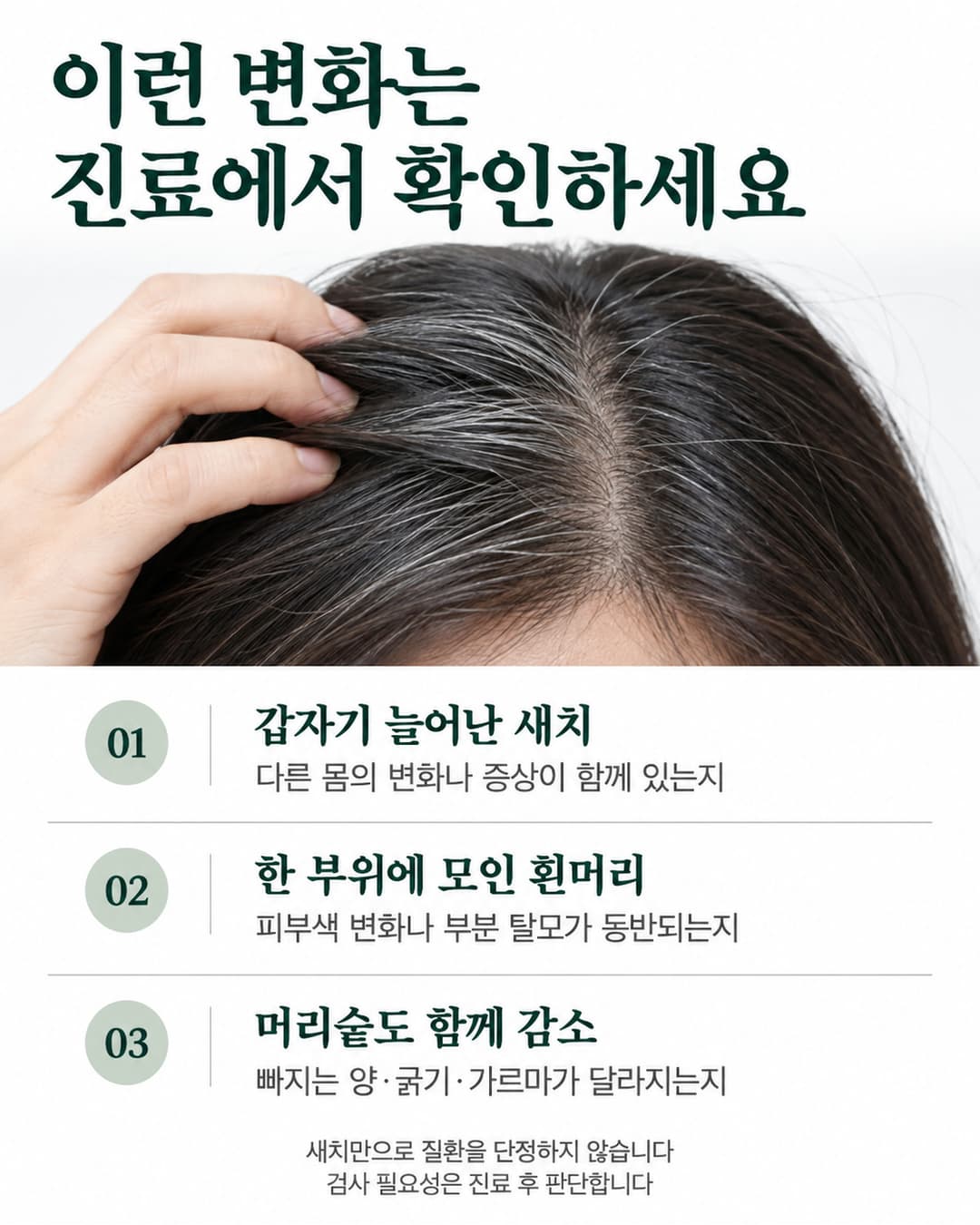
1. When It Increases Rapidly at a Relatively Young Age and Other Symptoms Are Present
A retrospective study of 71 people reported an association between premature graying and vitamin B12 deficiency or hypothyroidism. However, these are small-scale data from a specific region and do not mean that all gray hair is caused by a deficiency or thyroid problem. Family history, diet and health status, and accompanying symptoms are reviewed to decide which tests are needed. [4]
2. When White Hair Clusters in Only One Area or Skin Color Also Changes
It is important to determine whether the change has been present for a long time or appeared recently. If it is accompanied by changes in scalp skin color or patchy hair loss, it may be necessary to differentiate whether the change is related to conditions such as vitiligo or alopecia areata. A specific disease is not diagnosed based on appearance alone. [1]
3. When Hair Density Decreases Rapidly Along with Graying
Separately from color changes, check whether the amount of shedding, hair thickness, part, and hairline are changing. Rather than assuming it cannot be hair loss because you have gray hair, it is better to have the cause of persistent density changes evaluated.
Frequently Asked Questions
I have already plucked a few gray hairs. Is it possible they won't grow back?
Plucking a few hairs does not by itself mean permanent hair loss. Avoid the habit of repeatedly plucking the same area, and have it checked if wounds, inflammation, or thinning in a specific area persist. Rather than continuing to pluck to remove gray hair, you may consider trimming the length.
The tips of my hair are white but the roots are dark. Is this the effect of a supplement?
Pigment reappearing in the newly grown sections of some hairs has been observed. However, a change in a single strand is not enough to conclude that it is the effect of a supplement you are taking. Studies in humans are also small observational data and have not demonstrated the treatment effect of any specific product. [3]
If my gray hair increases, do I need to be tested for both vitamin B12 and thyroid function?
The same tests are not uniformly recommended for everyone. The need for testing is determined after reviewing when it began, how fast it is progressing, family history, diet and medications, and other symptoms. Do not take high-dose supplements on your own or conclude that you have thyroid disease based on gray hair alone.
My scalp itches after using gray hair shampoo. Is it okay to keep using it?
Being in shampoo form does not mean there is no possibility of irritation or allergy. If itching, redness, or similar symptoms occur after use, stop using it for now and check the product's precautions. If symptoms persist or worsen, seek medical care and share information about the product you used with the medical staff.
If Your Hair Density Has Also Changed Along with Gray Hair, Start by Identifying the Cause
A few gray hairs alone do not require treatment. However, if a sudden color change, patchy hair loss, or ongoing decrease in hair density is also present, note when it began and how it has progressed, and seek a consultation.
At Modi Hair Plant, we examine your scalp and hair condition and consult with you on any necessary evaluation and management approach. Please also let us know about any medications or supplements you are taking and scalp products you are using.
Phone inquiries: 02-544-8659
References and Video Source
- Kumar AB, Shamim H, Nagaraju U. Premature Graying of Hair: Review with Updates. International Journal of Trichology. 2018;10(5):198–203. DOI: 10.4103/ijt.ijt_47_18. PMID: 30607038.
- Zhang B, Ma S, Rachmin I, et al. Hyperactivation of sympathetic nerves drives depletion of melanocyte stem cells. Nature. 2020;577(7792):676–681. DOI: 10.1038/s41586-020-1935-3. PMID: 31969699.
- Rosenberg AM, Rausser S, Ren J, et al. Quantitative mapping of human hair greying and reversal in relation to life stress. eLife. 2021;10:e67437. DOI: 10.7554/eLife.67437. Full text (journal).
- Sonthalia S, Priya A, Tobin DJ. Demographic Characteristics and Association of Serum Vitamin B12, Ferritin and Thyroid Function with Premature Canities in Indian Patients from an Urban Skin Clinic of North India: A Retrospective Analysis of 71 Cases. Indian Journal of Dermatology. 2017;62(3):304–308. DOI: 10.4103/ijd.IJD_221_17. PMID: 28584374.
- Jung KA, Min HJ, Yoo SS, et al. Drug-Induced Liver Injury: Twenty Five Cases of Acute Hepatitis Following Ingestion of Polygonum multiflorum Thunb. Gut and Liver. 2011;5(4):493–499. DOI: 10.5009/gnl.2011.5.4.493. PMID: 22195249.
Additional patient information: American Academy of Dermatology. What causes gray hair, and can I stop it?
Video source: Modi Hair Plant, Director Yoo Hwa-jung. Pluck a Gray Hair and Two Grow Back? Lots of Gray Hair Means No Hair Loss? A Doctor Fact-Checks 4 Gray Hair Myths!
This article is intended to provide general medical information and does not replace individual diagnosis or prescription. Related research has been added to supplement the video's explanation; animal studies, small observational studies, retrospective analyses, and case reports are not evidence that establishes an individual's cause or treatment effect. Images in this article are explanatory materials to aid understanding and do not represent before-and-after treatment results of any specific patient. The need for and method of testing and treatment are determined after a consultation, and results vary among individuals.