Post-Hair-Transplant Care · Scalp Folliculitis
Pimples After a Hair Transplant: Is It Okay to Squeeze Them Yourself?
If pimples appear after a hair transplant, do not squeeze them with your fingers or pop them with a needle; check with the clinic that performed your surgery first. It is difficult to judge the cause or the state of graft survival from appearance alone. If the red area spreads quickly, pain worsens, or fever or chills develop, prompt medical care is needed.
In this article, we look in turn at what folliculitis means, its possible causes, what has been found in human studies, how to respond at home, and what information to pass on to the clinic.
Key Points
- Do not squeeze them yourself. Check with the clinic that performed your surgery for care suited to the cause and the stage after surgery.
- A single pimple does not mean graft failure. The incidence of folliculitis and the growth outcome of transplanted hair are different measures.
- Watch for rapid worsening and whole-body symptoms. If you have spreading redness, severe pain, or fever or chills, do not delay seeking care.
1. What Are Pimples and Folliculitis After a Hair Transplant?
"Pimple" is an everyday term for a small bump that appears on the skin. This term alone cannot determine a diagnosis. Folliculitis is inflammation of the hair follicles, where hair grows, and it may be accompanied by red bumps, itching, tenderness, or pus. [1]
If bumps appear on the scalp after surgery, it is necessary to check whether this is inflammation around the hair follicles or another skin change. Whether it is in the recipient area or the donor area, when it started, and how it is changing are also useful information for the consultation.
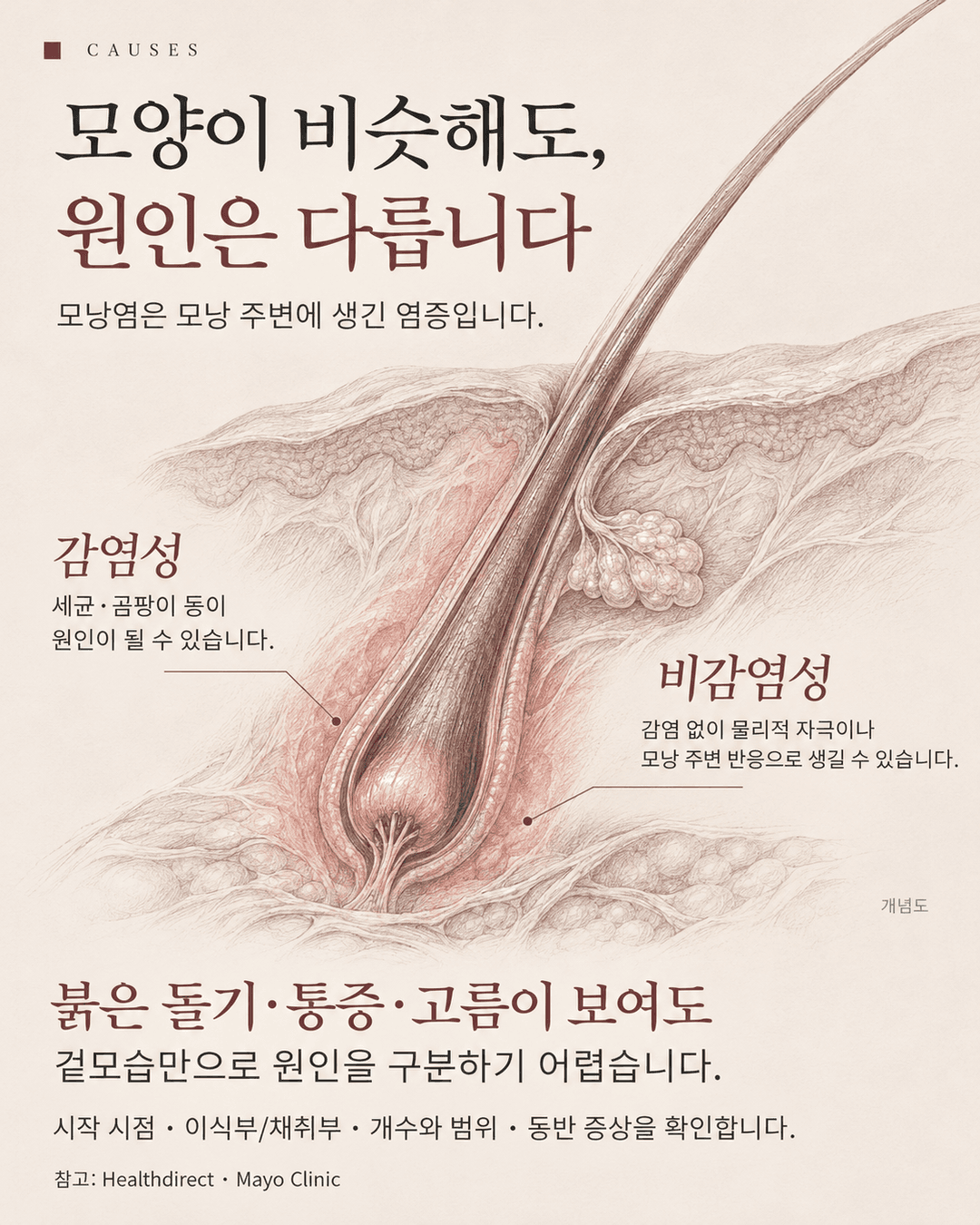
2. They May Look Similar but Have Different Causes
Infectious Inflammation
This may occur in connection with infections such as bacteria or fungi. Because the necessary treatment differs depending on the cause, medication should not be chosen simply because the area looks red or contains pus.
Non-Infectious Inflammation
There is also inflammation related to physical irritation, products that clog hair follicles, certain medications, and so on. The presence of inflammation does not necessarily mean a bacterial infection.
Medical staff review both your medical history and skin condition, and if an infection is suspected, they may consider a specimen test as needed. Therefore, it is difficult to distinguish infectious from non-infectious inflammation based only on the color or shape of bumps in a photo. [1]
3. Does a Pimple Mean the Transplanted Hair Failed to Take?
The appearance of a pimple alone does not establish graft failure. At the same time, it cannot be guaranteed that no inflammation affects the transplanted hair. The populations studied and the outcomes measured in research need to be considered separately.
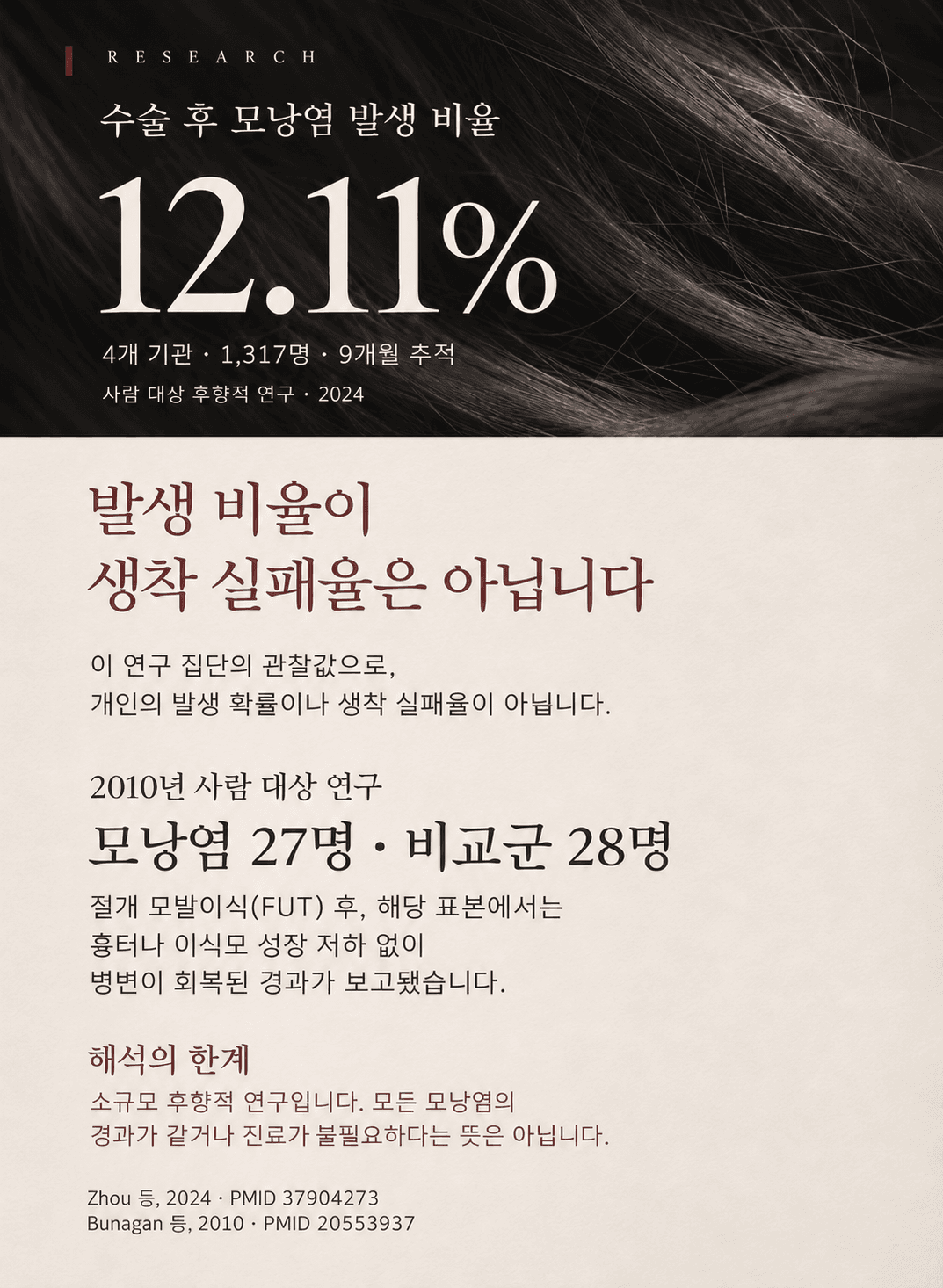
2024 Study: Folliculitis Incidence Observed in 1,317 Patients
The study by Zhou et al. retrospectively analyzed the records of 1,317 patients who underwent hair transplants at four medical institutions and completed 9 months of follow-up. In this group, the incidence of post-surgical folliculitis was 12.11%. [2]
Here, 12.11% is the incidence of folliculitis in that study population. It is not a graft failure rate, the incidence at any particular clinic, or a probability that applies directly to an individual. Because it is an observational study analyzing past medical records, it is difficult to generalize directly to situations with different patients or different surgical and care conditions.
2010 Study: A Recovery Course Was Reported, but It Does Not Represent All Cases
The study by Bunagan et al. retrospectively compared 27 patients who developed folliculitis after strip hair transplantation (FUT) with 28 who did not. In the folliculitis cases included in the study, the lesions were reported to have resolved without scarring or reduced growth of transplanted hair. [3]
However, the sample was small and the study examined the course after a specific surgical method. It should not be interpreted as predicting the same course for folliculitis of every cause and severity, or as evidence that consultation and treatment are unnecessary.
We have distinguished the types of evidence. The two papers above are retrospective studies in humans. Institutional patient information materials were referenced separately from clinical trial results. We have not presented the anecdotal experience of specific practitioners or the results of animal or cell experiments as evidence of treatment effects for folliculitis after a hair transplant.
4. How Should You Respond at Home?
Before the cause is identified, checking the care instructions from the clinic that performed your surgery should take priority over trying to remove the bumps yourself.
- Do not squeeze them with your fingers or prick them with a needle. This risks further damaging the skin or spreading infection. Whether a procedure to drain pus is needed should be decided after a consultation.
- Do not add new ointments or antiseptics on your own. Rather than immediately applying leftover antibiotic or steroid ointment, ask whether you should use it. Use medications already prescribed as directed, and consult medical staff if a change is needed.
- Wash at the time and in the way you were instructed. Do not scratch with your fingernails or rub hard, and confirm the washing method suited to your current stage after surgery.
- Record changes and pass them on. Organize, together with photos, the date you first noticed them, their location, number and extent, and changes in pain and discharge.
The advice to avoid self-squeezing takes into account both the American Academy of Dermatology (AAD)'s general guidance on boil care and the NHS's principles of care after a hair transplant. It does not mean there are clinical trial results comparing the effects of squeezing pimples yourself after a hair transplant. [4] [5]
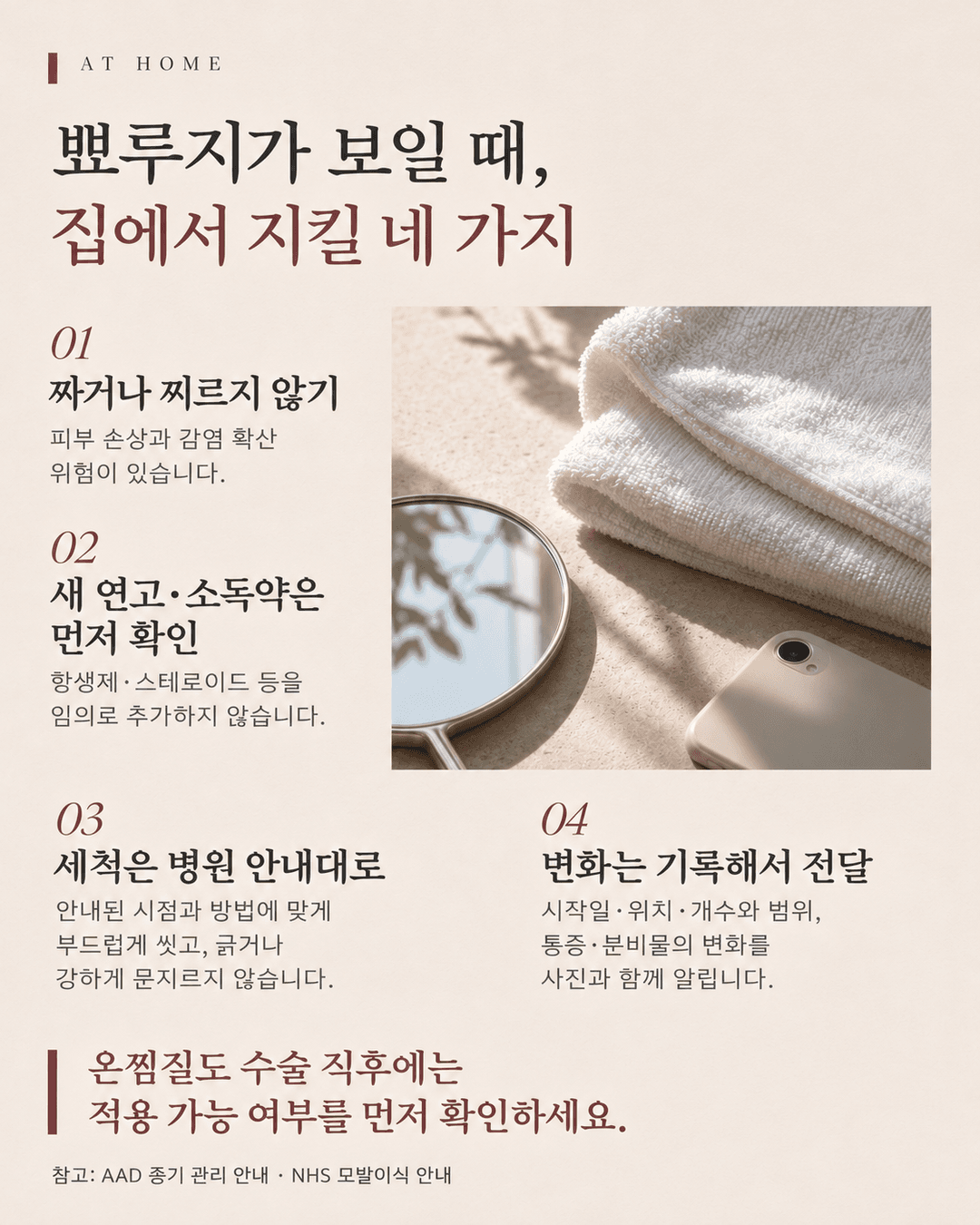
Check first before using a warm compress right after surgery. Care methods for ordinary boils or folliculitis should not be applied as-is to a scalp that has just undergone a transplant. Ask the clinic that performed your surgery whether a compress is allowed and how to use it.
5. Do Not Delay Seeking Care If You Notice These Changes
If the following symptoms newly appear or worsen quickly, contact the clinic that performed your surgery immediately and seek prompt care. If you cannot reach them, you should be evaluated at a nearby medical facility.
- If the red area spreads quickly: Check for redness spreading to the surrounding area and changes in swelling and warmth.
- If pain suddenly worsens or is very severe: Report any pain that was not expected during recovery or that is getting worse.
- If fever, chills, or general malaise occur: Also watch whether your overall condition worsens along with the scalp symptoms.
Mayo Clinic describes a rapid increase in redness or pain, fever, chills, and general malaise as signs that may suggest a spreading infection. The NHS also advises contacting the clinic that performed the surgery promptly if severe pain or unexpected symptoms occur after a hair transplant. [6] [5]
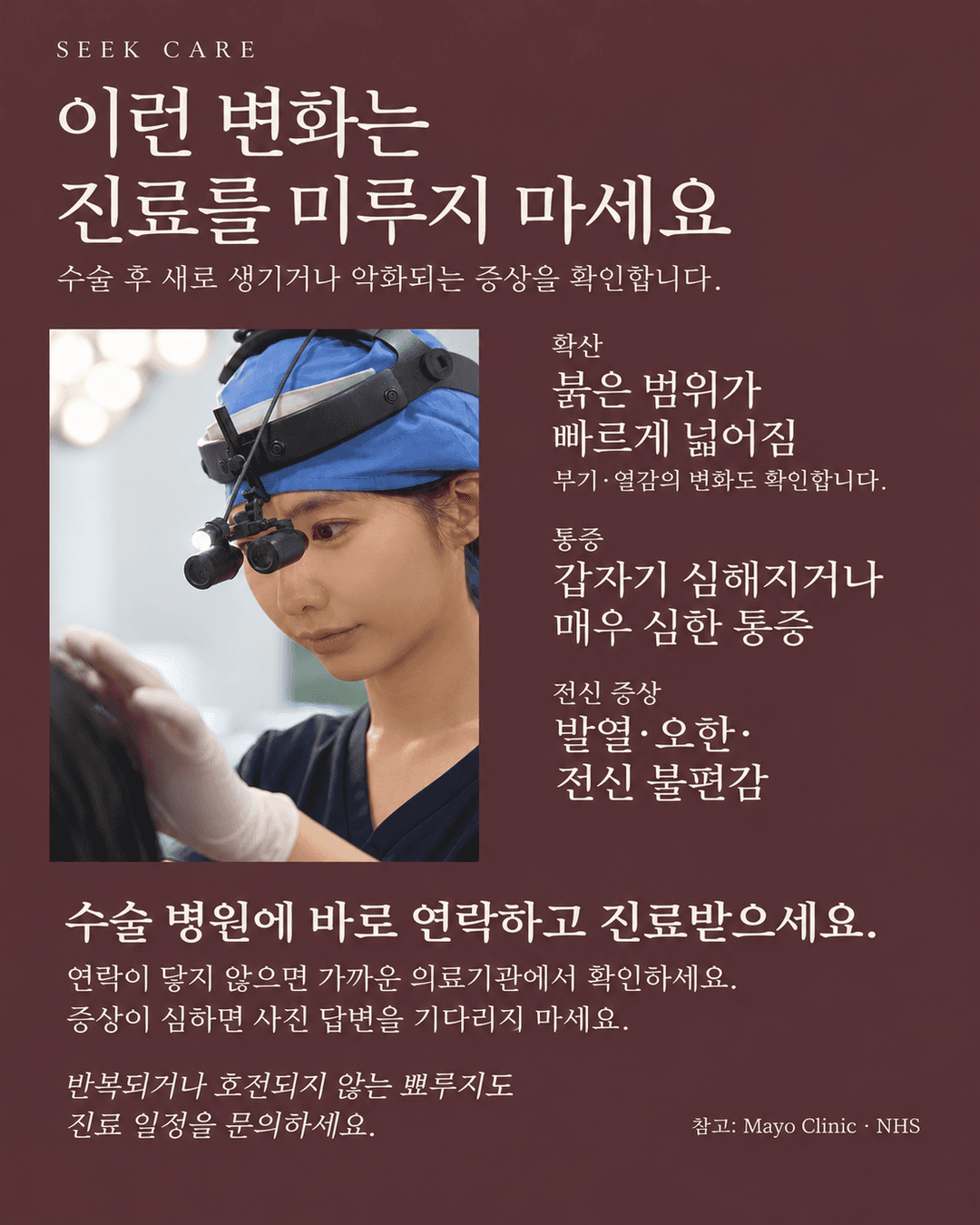
Even without such sudden changes, if pimples keep recurring or do not improve, ask about scheduling a consultation. There is no need to assume it is part of normal recovery just because the bumps are small, nor, conversely, to take every case as graft failure.
6. When Contacting the Clinic, Prepare Photos and This Record
Preparing an overall photo showing which area is affected and a close-up photo showing the bumps and surrounding skin makes it easier to convey location and changes. Take photos in a bright place without filters, and keep comparison photos under the same lighting and angle as much as possible.

- Dates: The surgery date and the date you first noticed the pimples
- Location: Whether it is the recipient area or a donor area such as the back of the head
- Changes: Whether the number or extent has increased, and whether there is discharge
- Symptoms: Whether there is pain, itching, warmth, or fever
- Products used: Prescription medications and any newly applied ointments, antiseptics, shampoos, etc.
Example Inquiry Message
"It is day __ after my surgery. Since __, I have noticed pimples on the __ area. The number and extent are __, and the pain is __. Discharge is __, and fever is __. The medications/products I am currently using are __, and I am sending photos as well."
This list is a guide to help you convey your symptoms completely. If symptoms are severe or worsening quickly, do not delay care to prepare records or photos.
Frequently Asked Questions
If I see pus, can I apply antibiotic ointment right away?
Something that looks like pus does not by itself confirm a bacterial infection. Because treatment differs depending on the cause and the stage after surgery, check with medical staff rather than adding new medication on your own. [1]
If there are only one or two pimples, can I just wait and see?
It is difficult to judge by number alone. Inform the clinic that performed your surgery of when they started, how they have changed, and any accompanying symptoms, and get guidance on how to monitor them. If the red area spreads, pain worsens, or you have fever or chills, you should seek prompt care. [6]
If the pimples subside, does that mean there is no problem with graft survival?
The subsiding of skin lesions and the growth outcome of transplanted hair must be evaluated separately. There is a study reporting a recovery course, but its results alone cannot guarantee graft survival for an individual. Subsequent hair growth should also be checked together with medical staff. [3]
Can the cause and treatment be determined just by sending photos?
Photos are material for conveying location and patterns of change. In some cases, the cause can only be identified through an in-person examination and, if necessary, a specimen test. Online photo consultations do not fully replace in-person care. [1]
If You Would Like to Check Changes in Your Scalp After Surgery
First, inform the clinic where you had surgery of your surgery date and changes in your symptoms to confirm how to care for them and whether a consultation is needed. You can find how to submit a consultation request on the page below. If you have severe pain, rapid worsening, fever, or similar symptoms, do not wait for an online reply; seek prompt care.
References and Resources
- Healthdirect Australia. Folliculitis. Information on the definition, causes, diagnosis, and treatment of general folliculitis.
- Zhou Y, et al. Characterization and Risk Factors of Folliculitis after Hair Transplantation: A Multicenter Retrospective Study. Plast Reconstr Surg. 2024;154(6):1115e–1122e. DOI: 10.1097/PRS.0000000000011175. PMID: 37904273. Published online ahead of print in 2023; published in the journal in 2024.
- Bunagan MJKS, Pathomvanich D, Laorwong K. Recipient area folliculitis after follicular-unit transplantation: characterization of clinical features and analysis of associated factors. Dermatol Surg. 2010;36(7):1161–1165. DOI: 10.1111/j.1524-4725.2010.01601.x. PMID: 20533937.
- American Academy of Dermatology. How to treat boils and styes. A general resource on caring for boils and styes; not a clinical trial on folliculitis after a hair transplant.
- NHS. Hair transplant. Guidance on post-surgical care and on making contact if abnormal symptoms occur.
- Mayo Clinic. Folliculitis: Symptoms and causes. Information on symptoms, causes, and changes that require prompt care.
The papers are presented within the scope of what can be confirmed from publicly available bibliographic information and abstracts. We have not interpreted institutions' general patient information as uniform treatment guidelines applicable to all patients immediately after surgery.
This article provides general medical information and does not replace individual diagnosis or treatment planning. Care methods and recovery courses vary from person to person depending on the surgical method, scalp condition, and the cause and degree of inflammation. Side effects such as pain, swelling, infection, and scarring may occur after a hair transplant, and the need for and method of treatment should be decided after a consultation. The cause or state of graft survival cannot be confirmed from online articles and photos alone, and the studies introduced do not guarantee individual treatment outcomes.