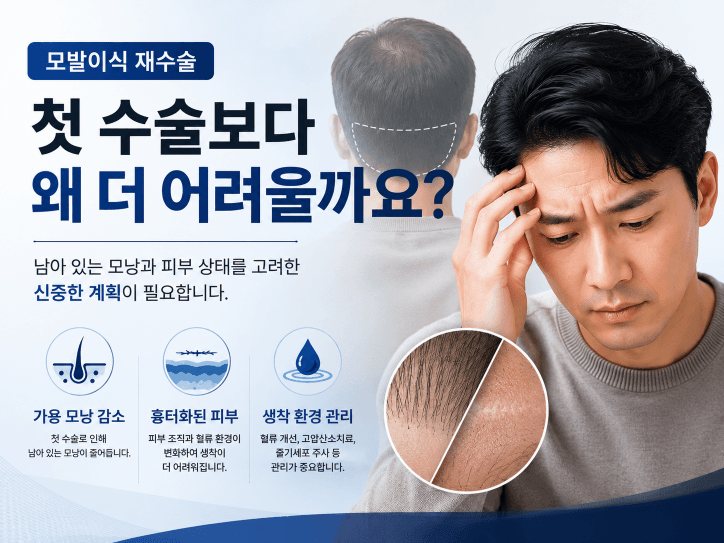
“I have already had a hair transplant, but I am not satisfied with the results. Is hair transplant revision surgery possible?”
Hair transplant revision surgery is possible, but it requires much more careful planning than the first surgery. This is because both the available donor follicles in the occipital area that have already been used and the changes in skin condition caused by the previous surgery must be taken into account. Therefore, in revision surgery, it is very important how efficiently the remaining hair follicles are used and how well an environment favorable to graft survival is created.
As hair transplants have become more common, the number of people visiting clinics to consider revision surgery has also been steadily increasing. I am Dr. Yoo Hwa-jung, Director of Modi Hair Plant Clinic. In this article, I will explain why hair transplant revision surgery is more difficult than the first surgery, when revision surgery is needed, and what factors we consider to support graft survival.
Key Summary
✔ Hair transplant revision surgery is more difficult than the first surgery because of a reduced number of available donor follicles and scarred skin.
✔ Existing scars cannot be removed, but treatments to improve the environment for graft survival can be performed alongside the surgery.
✔ In revision surgery, what matters most is how efficiently the remaining follicle resources are used.
Why Is Hair Transplant Revision Surgery More Difficult Than the First Surgery?
From the surgeon's perspective, there are two main reasons why revision surgery is more difficult than the first surgery.
1) The number of available donor follicles has decreased
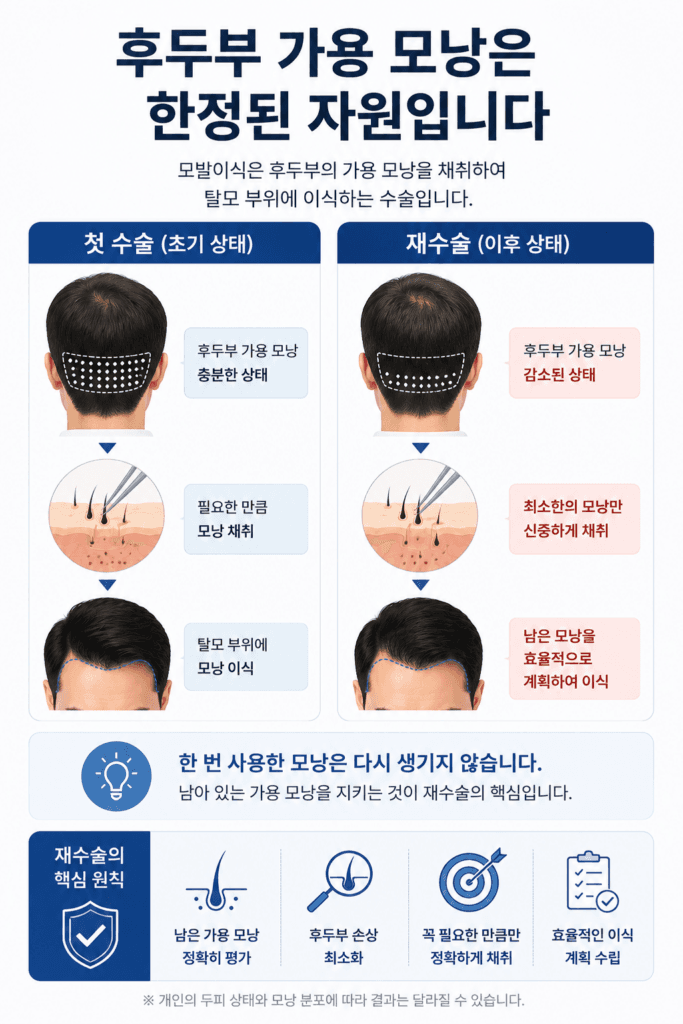
A hair transplant is not a surgery that creates new hair where there was none. It is a surgery in which surplus hair follicles that can be safely extracted from the occipital area (back of the head) — these are called available donor follicles — are harvested and transplanted to the desired area, usually the frontal area or the crown.
For this reason, in people who have already had one surgery, the available donor follicles in the occipital area have already been reduced. In a second or third surgery, even with limited reserves, only the truly necessary follicles must be carefully harvested while minimizing damage to the occipital area.
2) The texture of the skin has changed
| Normal skin | Scarred skin |
|---|---|
| Normal skin structure is maintained | Skin structure may have changed |
| Blood flow environment is relatively stable | Blood flow environment may have changed |
| Tissue flexibility is relatively good | Tissue may be firm or less flexible |
| Standard transplant plan applied | Individual plan needed based on condition |
When you touch a scarred area, it feels different from skin without scars. When light is shone on the surface, it also reflects differently. Normal skin has fine vellus hair, slight roughness, and structures such as sweat glands, but scarred skin shows different characteristics, such as these normal structures not being clearly visible.
Scarred skin like this recovers more slowly than normal skin and is a relatively unfavorable environment for transplanted hair follicles to take hold.
Situations That Lead People to Seek Hair Transplant Revision Surgery
People considering revision surgery have various stories. In some cases, the transplanted density did not turn out as desired; in others, many follicles were transplanted, but for various reasons only scars remained and the follicles did not survive well.
In summary, the first surgery is generally performed on normal skin, but from the second surgery onward, the skin's texture or normal structure may have been changed by the previous surgery. These factors can slow recovery and make graft survival (the transplanted follicles taking hold) more difficult. Accordingly, revision surgery takes more time, and the surgery itself tends to be more difficult.
Can Existing Scars Be Reversed?
To be honest from the outset, scars that have already formed cannot be completely removed. It is difficult to reverse changes that have already occurred. However, the key to revision surgery is making every possible effort, within those conditions, to help the transplanted follicles take hold as well as possible. Transplanting each hair follicle is like transplanting a small piece of tissue, so creating an environment that supports graft survival is very important.
Methods Used Alongside Surgery to Support Graft Survival
At Modi Hair Plant, we use the following methods together to support skin in unfavorable conditions.
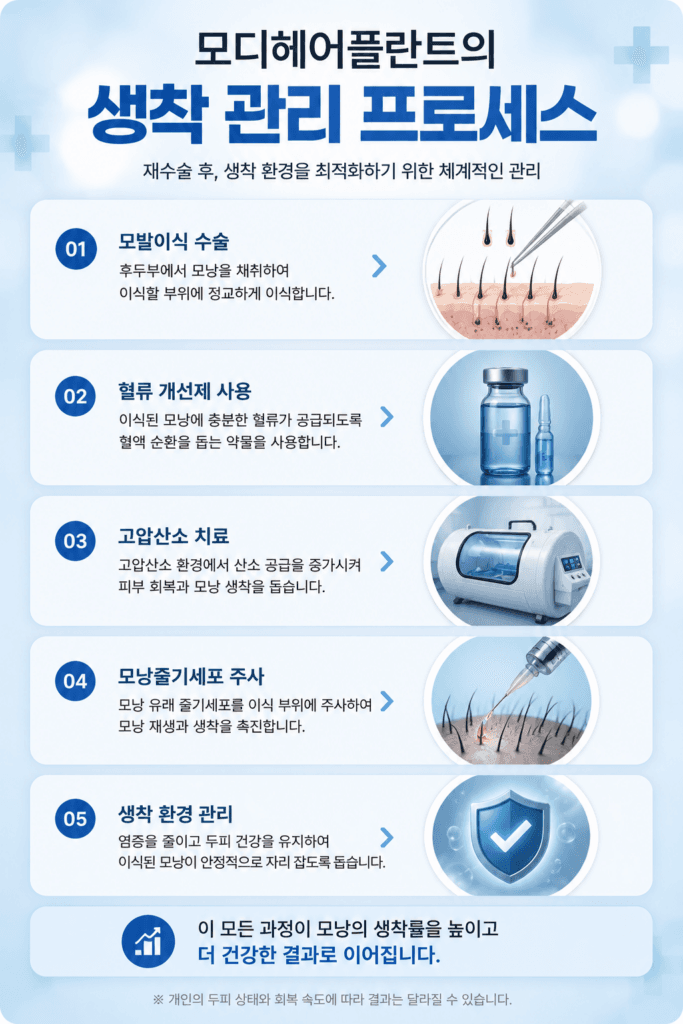
- Use of blood-flow-improving agents immediately after surgery — Helps ensure a smooth blood supply to the transplanted follicles.
- Hyperbaric oxygen therapy on the day after surgery — Intended to aid skin recovery and help the transplanted follicles take hold.
- Simultaneous harvesting and injection of hair follicle stem cells — Follicle-regenerating cells are harvested from tissue that would otherwise be discarded during follicle extraction and injected into the transplant area.
In addition, we apply several other methods to support graft survival. However, response and degree of recovery may vary from person to person, so it is most accurate to determine which methods may help, and to what extent, after examining the actual scalp condition.
Frequently Asked Questions
Are the results of revision surgery always worse than those of the first surgery?
Not necessarily. However, it is true that there are more factors to consider than in the first surgery, because the available donor follicles are reduced and the skin conditions have changed. For this reason, from the second surgery onward, we recommend choosing a clinic even more carefully.
My occipital area was significantly damaged by one surgery. Can follicles be harvested again?
The possible plan depends on the condition of the remaining available donor follicles. The more limited the reserves, the more careful the approach needs to be, harvesting only as many as truly necessary while minimizing damage to the occipital area. Whether it is possible, and to what extent, can be advised after directly examining the scalp.
Can transplants be performed on scarred areas?
Scarred skin recovers slowly and is an unfavorable environment for graft survival, but in some cases transplantation is performed while applying various methods to support graft survival within those conditions. However, it is advisable to understand in advance that existing scars themselves cannot be removed.
When can I have hair transplant revision surgery?
Generally, the decision on revision surgery is made after sufficient recovery from the first surgery. Since recovery speed and scalp condition differ from person to person, it is best to determine the exact timing through a consultation.
Things to Check Before Hair Transplant Revision Surgery
□ Are there enough remaining available donor follicles?
□ How much damage is there to the occipital area?
□ What is the condition of the scarred area?
□ How many grafts are needed?
□ Have realistic goals been set?
For Hair Transplant Revision Surgery, Careful Planning Matters Most
- Hair transplant revision surgery is more challenging than the first surgery for two reasons: a reduced number of available donor follicles and scarred skin.
- Existing scars cannot be reversed, so it is important to make a realistic plan within the remaining resources.
- Modi Hair Plant aims to support graft survival by combining blood-flow-improving agents, hyperbaric oxygen therapy, and injections of follicle-regenerating cells.
- Responses may vary from person to person, so if you are considering revision surgery, we recommend a consultation to first examine your scalp condition.
Because revision surgery involves working with the remaining follicle resources, careful planning is more important than anything else. We encourage you to have a thorough consultation before making a decision.
- 📞 Phone consultation: 02-544-8659
- 🌐 Website
- 💬 KakaoTalk consultation
This article was adapted from a YouTube video by Dr. Yoo Hwa-jung, Director of Modi Hair Plant. This article is intended to provide general medical information and does not replace individual diagnosis or treatment.
This article was reviewed by medical staff before being published.