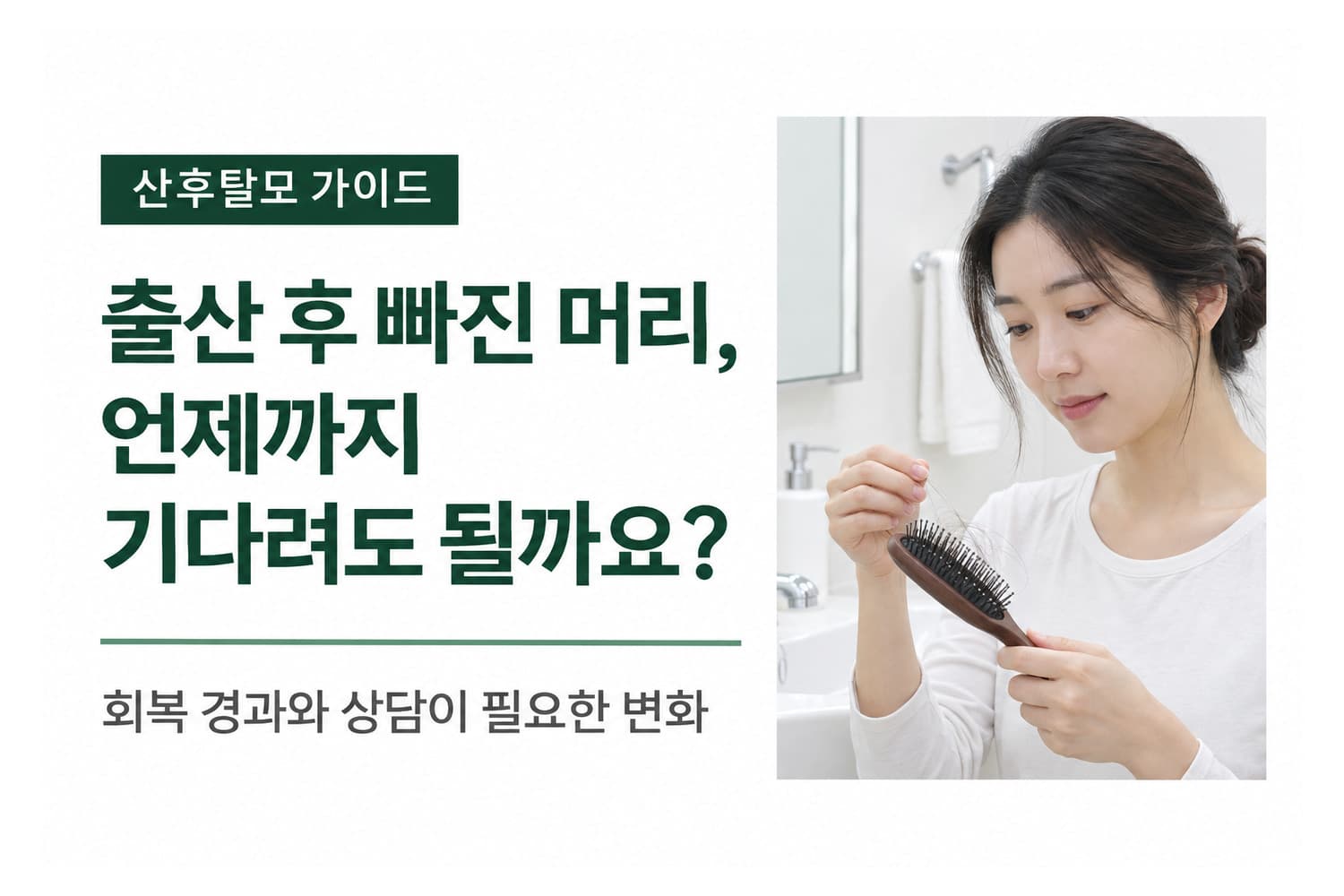
Female Hair Loss · Postpartum Hair Health
Postpartum Hair Loss: Understanding the Recovery Course and When to Seek Consultation
Increased hair shedding after childbirth may appear as temporary telogen shedding and may decrease over time. However, the speed of recovery varies from person to person, and other causes of hair loss may also be present. Rather than waiting until a specific date, it is advisable to look at changes in shedding together with the condition of the scalp.
In this article, we outline the general course of postpartum hair loss, changes worth recording, what is checked during a consultation, and how to prepare for a consultation about medications and supplements while breastfeeding.
3-Line Summary
- Several months after childbirth, telogen shedding related to changes in the hair cycle may become noticeable.
- The general recovery course can serve as a reference, but it is not a standard for determining an individual's recovery date.
- If there are patchy areas, scalp discomfort, or significant concern, seek a consultation regardless of timing, and also review any medications or supplements used while breastfeeding.
Why Does Postpartum Hair Loss Appear a Few Months After Childbirth?
What is commonly called postpartum hair loss includes telogen shedding related to changes in the hair cycle after childbirth. Because hair goes through phases of growth, rest, and shedding, there can be a gap between when changes occur in the body and when hair shedding actually becomes noticeable.
The American Academy of Dermatology explains that hair shedding may increase several months after childbirth in connection with the drop in estrogen. However, not all hair shedding that occurs after childbirth is attributed to the same cause. [Source 1]

When Does Postpartum Hair Loss Tend to Decrease?
The American Academy of Dermatology advises that postpartum hair shedding may become noticeable around 4 months after childbirth, and many women regain their usual hair fullness by their baby's first birthday. This is patient guidance on the general course and is not a recovery schedule that applies to everyone. [Source 1]
The point at which shedding decreases and the point at which hair has grown enough to feel volume may also differ. Rather than looking only at the amount shed at one time, check what changes continue compared with before.
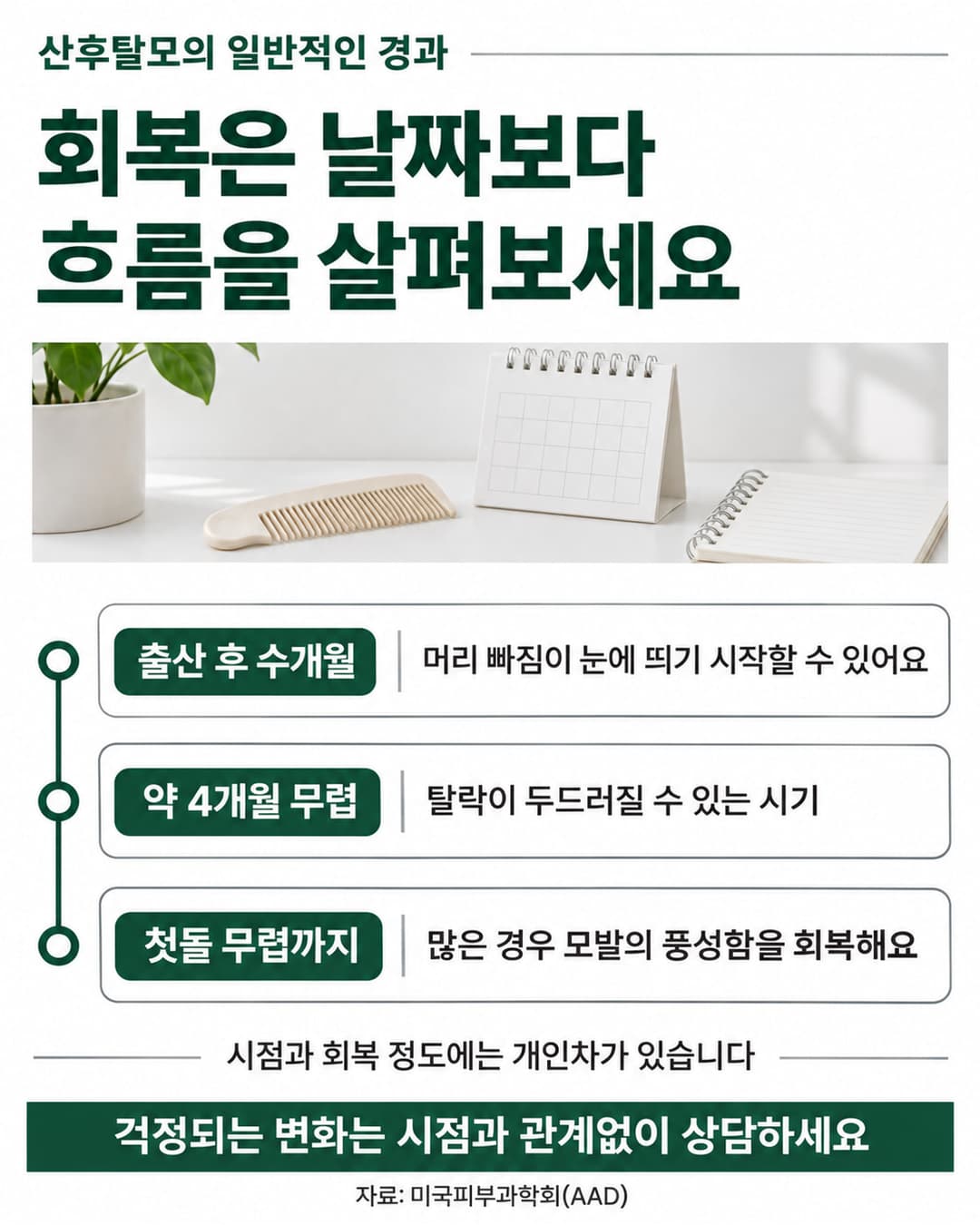
The statement that "many recover by the first birthday" does not mean you should postpone a consultation. If you do not sense a recovery trend, if a particular area continues to look thin, or if you have scalp symptoms, have your current condition checked first.
Timeframes Reported in Studies Are Not Individual Schedules Either
A cross-sectional study analyzing questionnaire responses from 331 women who gave birth at two medical institutions in Japan also examined the onset, peak, and end of postpartum hair shedding. However, because results may be influenced by respondents' recall and by who chose to participate in the survey, it is difficult to apply the study's average values as an individual's recovery date. [Reference 2]
If Areas Continue to Look Thin, Other Causes Are Also Checked
More than one cause may be involved in hair shedding, such as when postpartum shedding occurs together with pre-existing female pattern hair loss. Therefore, when changes along the part or front hairline continue, a clinical examination is needed to distinguish the causes rather than attributing them solely to the timing of childbirth. [Source 4]
In fact, cases of 3 patients have been reported in which pre-existing traction alopecia became apparent after postpartum telogen shedding. This shows the need to check for hair loss that remains in specific areas, but as it is a small number of cases without a comparison group, it does not mean the same problem will occur in all mothers. [Reference 3]
Discuss These Changes During a Consultation
The following changes are topics to raise during a consultation to identify the cause. Please do not self-diagnose a specific condition simply because an item applies to you. [Source 5]
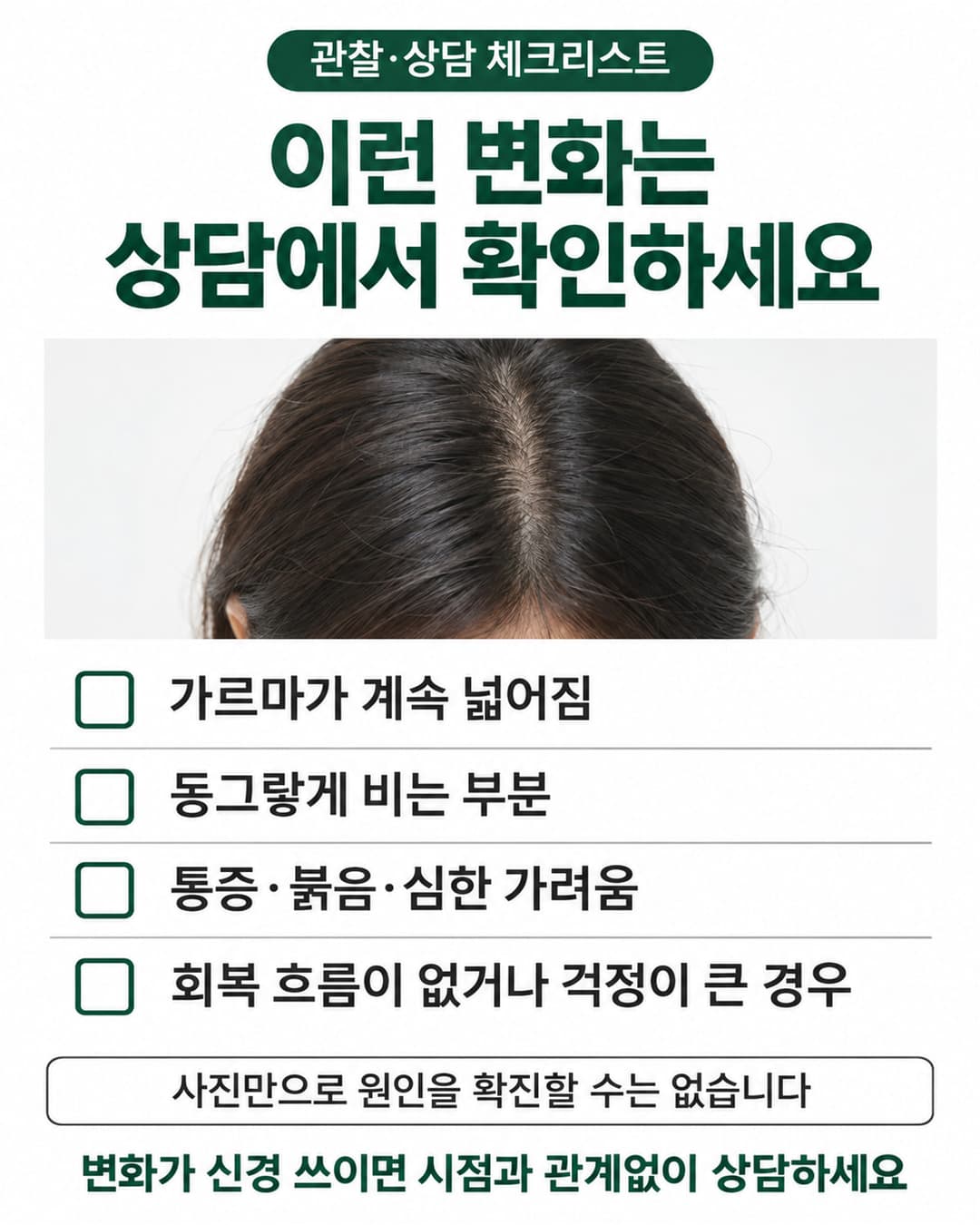
- Changes in extent: When the part keeps widening or a particular area looks noticeably thin
- Patchy shedding: When new round bald patches appear
- Scalp symptoms: When accompanied by pain, redness, severe itching, etc.
- Ongoing concern: When you do not sense a recovery trend or are very worried about hair shedding
Try Recording the Following Before Your Consultation
Note when shedding began to increase and whether it has decreased or worsened. Please also let us know when you gave birth, whether you are breastfeeding, any recent changes in health or diet, and any medications you are taking.
When taking photos, keeping the lighting, angle, and part position similar on dry hair helps with comparison. Also note differences in hair length and styling. During an actual consultation, we conduct a medical interview and examine scalp and hair condition, and consider tests or further care if needed. [Source 4]
If You Are Breastfeeding, Review Medications and Supplements Together
Before looking into hair loss medications or supplements, please inform your healthcare provider whether you are breastfeeding, your baby's age, the products you are currently using, and your health status. It is difficult to decide whether to use a product based solely on its name or on the classification of "topical medication."

For Medications, Including Formulation and Method of Use
LactMed information on minoxidil during breastfeeding addresses oral and topical formulations separately. Whether to use it should be discussed after reviewing the breastfeeding situation, the baby's condition, and the product and method of use. Precautions regarding direct contact between the baby and skin where the medication has been applied are also reviewed. [Source 6]
For Supplements, Current Products and Whether They Are Needed
We do not conclude that biotin, iron, or other supplements need to be added simply because hair is shedding. After reviewing diet, the possibility of deficiency, and the ingredients of products already being taken, we discuss any supplementation that may be needed. [Source 4]
Frequently Asked Questions
Can I seek a consultation even though my baby hasn't reached their first birthday yet?
Yes. The first birthday is a reference point used to describe the general recovery course for many women, not a date before which you cannot begin care. If you have changes in a particular area, scalp discomfort, or significant concern, your current condition can be checked.
The amount of shedding has decreased, but my part still looks wide. Should I wait longer?
There may be a difference between when shedding decreases and when you feel fullness return. However, if the part keeps widening or areas continue to look thin, it is advisable to check both the recovery process and other possible causes. Please bring photos from before and after childbirth and your records of changes to your consultation.
Can I use topical minoxidil while breastfeeding?
It is not judged uniformly simply because it is a topical product. Please inform your physician or pharmacist of your breastfeeding stage, your baby's age and health status, and the product and method you plan to use. If you do use it, you should receive guidance on necessary precautions, such as avoiding direct contact between the application site and your baby.
I'm taking postpartum supplements. Should I add hair loss supplements as well?
Whether to add them is determined by reviewing the ingredients and dosages of your current products, your diet, and the possibility of deficiency. Since ingredients may overlap across multiple products, please bring a list of what you are taking. Not every mother needs the same supplements or tests.
Start by Checking Your Current Condition to See Whether Waiting Is Appropriate
If increased hair shedding after childbirth concerns you, consult with Modi Hair Plant about the current condition of your hair and scalp. Letting us know when you gave birth, whether you are breastfeeding, how the shedding has changed, and any medications or supplements you are using will help with your consultation.
Phone inquiries: 02-544-8659
References and Sources
[Source 1] American Academy of Dermatology. Hair loss in new moms: Dermatologist tips. Updated October 2, 2025. View source. Patient guidance describing the general course of postpartum hair shedding.
[Reference 2] Hirose A, Terauchi M, Odai T, et al. Investigation of exacerbating factors for postpartum hair loss: a questionnaire-based cross-sectional study. International Journal of Women’s Dermatology. 2023;9(2):e084. DOI: 10.1097/JW9.0000000000000084. PMID: 38323220. View full text.
[Reference 3] Samrao A, Mirmirani P. Postpartum Telogen Effluvium Unmasking Traction Alopecia. Skin Appendage Disorders. 2022;8(4):328–332. DOI: 10.1159/000521705. PMID: 35983466. View full text.
[Source 4] American Academy of Dermatology. Hair loss: Diagnosis and treatment. View source. General guidance on identifying causes and necessary tests and treatments.
[Source 5] American Academy of Dermatology. Hair loss: Signs and symptoms. View source.
[Source 6] National Institute of Child Health and Human Development. Minoxidil. In: Drugs and Lactation Database (LactMed®) [Internet]. Bethesda (MD): National Institute of Child Health and Human Development; 2006–. Updated May 15, 2026. View source. A literature summary on medication use during breastfeeding; it does not provide blanket approval for individual use.
This article is intended to provide general medical information and does not replace individual diagnosis or prescription. The causes and recovery course of hair shedding after childbirth vary from person to person, and decisions on tests, treatment, and whether and how to use medications or supplements are made after examination and consultation with a healthcare provider.