
“I've heard hair transplants hurt a lot. Could I still go through with one?”
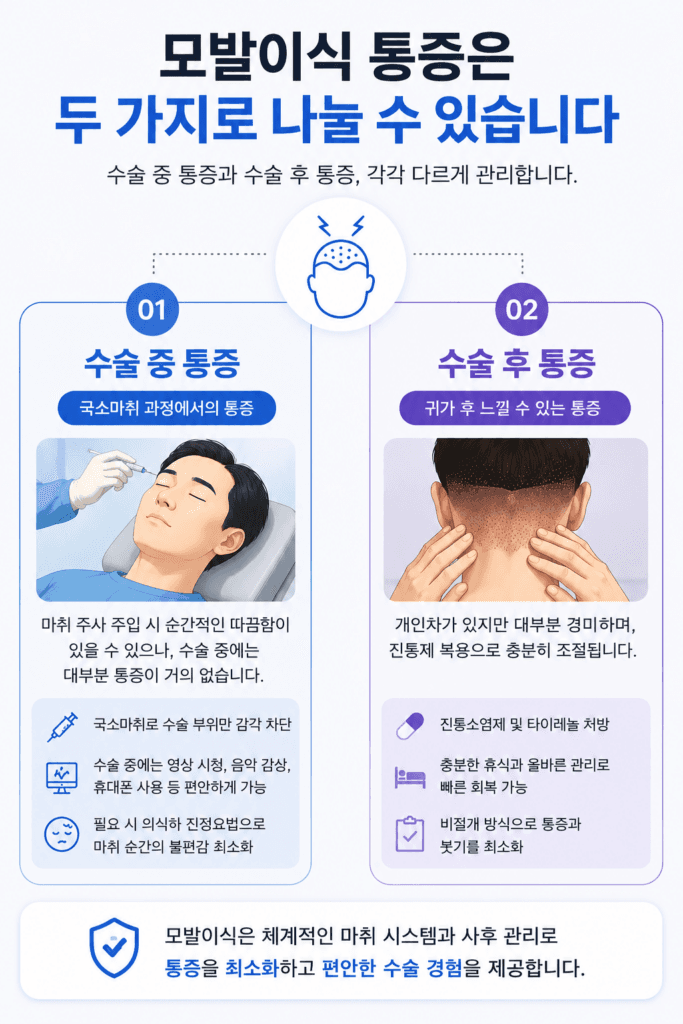
Many people hesitate to undergo surgery because of concerns about hair transplant pain. “Does a hair transplant hurt a lot?” is one of the questions we are asked most often during consultations. Today, we will answer this question. It helps to think of pain in two broad categories: one is pain during surgery, and the other is pain after you return home.
Key Summary
✔ A hair transplant is performed under local anesthesia, so pain during surgery can mostly be controlled.
✔ Modi Hair Plant uses dual anesthesia, combining lidocaine and ropivacaine.
✔ We strive to minimize tissue irritation and discomfort by reducing additional anesthesia during surgery.
✔ Pain after surgery varies from person to person, but in most cases it can be managed with anti-inflammatory pain relievers and Tylenol.
Does It Hurt During Surgery?
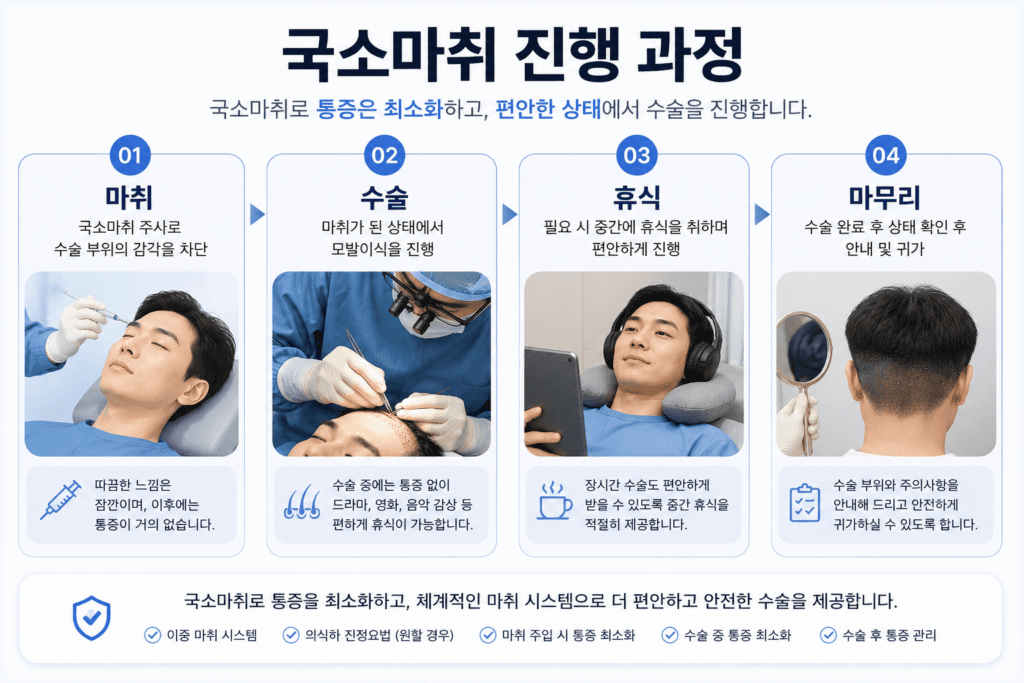
A hair transplant is a procedure in which local anesthesia is standard. Because local anesthesia numbs only the area being operated on, prolonged sedation (sleep sedation) is not necessarily required. That is why many patients spend the time comfortably during surgery, wearing earphones and watching dramas or movies on an iPad placed in front of them, or texting friends on their phones.
About the Drugs Used for Local Anesthesia
The most widely used drug for local anesthesia is 2% lidocaine. However, lidocaine has a relatively short duration of action. To compensate for this, a small amount of epinephrine is usually added to the lidocaine.
Epinephrine is a potent vasoconstrictor. When blood vessels constrict, the injected lidocaine does not spread quickly through the bloodstream and stays in the area longer, providing a relatively longer duration of anesthesia. 2% lidocaine with epinephrine typically lasts about 2 hours, though this varies from person to person. The scalp in particular has a rich blood supply, so the anesthesia tends to wear off somewhat sooner.
If the Anesthesia Wears Off Midway
The problem is that hair transplant surgery usually takes about 4–5 hours, so it is rarely completed within a 2-hour anesthesia window. As a result, the anesthesia may wear off during surgery, and the pain experience differs depending on how this is handled.
- Re-injecting midway — Injections are given again each time the anesthesia wears off. Reviews saying “It was fine at first, but it hurt because they kept giving me injections midway” refer to this approach.
- Injecting a large amount at the start — A generous amount is injected early on so it lasts longer. However, lidocaine itself can irritate tissue, and excessive vasoconstriction from epinephrine places stress on the tissue, which can cause swelling after surgery.
Dual Anesthesia at Modi Hair Plant
| Category | Lidocaine | Ropivacaine |
|---|---|---|
| Onset | Fast | Somewhat slower |
| Duration | About 2 hours | About 6–8 hours |
| Role | Initial anesthesia | Maintaining anesthesia in the later stage |
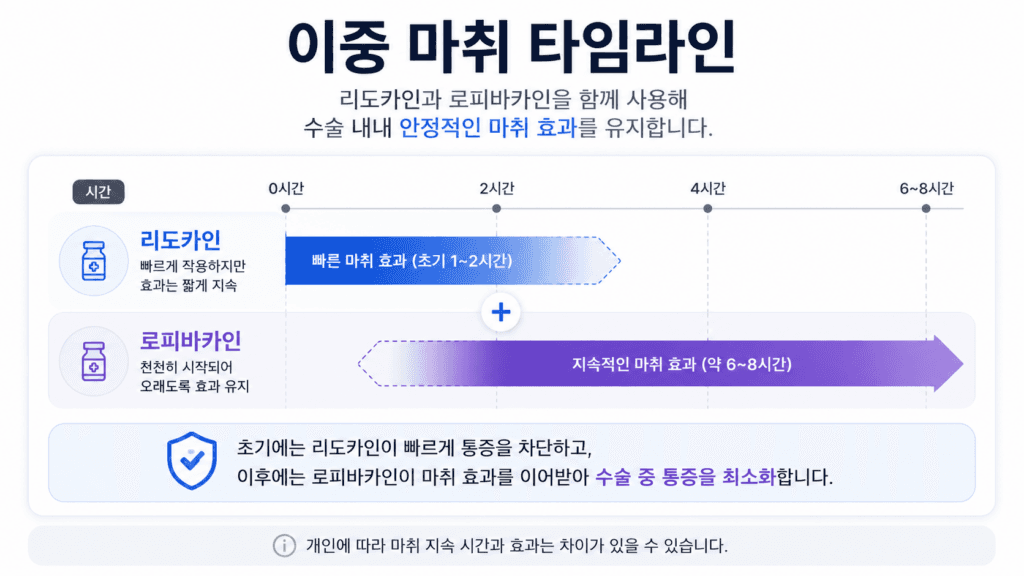
At Modi Hair Plant, we use a local anesthetic called ropivacaine together with lidocaine. Lidocaine acts quickly but wears off quickly, whereas ropivacaine takes effect slowly and wears off slowly, with its anesthetic effect lasting about 6–8 hours.
In the early part of the surgery, lidocaine provides the anesthesia, and as its effect diminishes, ropivacaine takes over. This way, there is no need to inject additional anesthetic midway, nor to inject excessive lidocaine at the start. This helps reduce irritation to the tissue accordingly.
In addition, because epinephrine is a potent vasoconstrictor, injecting too much into the recipient area can interfere with the settling of the transplanted hair follicles. For this reason, we aim to use both epinephrine and lidocaine only as much as needed. With this dual anesthesia approach, complaints of pain during surgery have decreased, and because less local anesthetic is used, swelling after surgery also tends to be relatively milder. However, responses may vary from person to person.
Momentary Pain When the Anesthetic Is Injected
No matter how good the local anesthetic, the stinging pain during the first 3–5 minutes when the anesthetic is injected is difficult to resolve through the type of drug alone. For patients who wish, we may therefore apply conscious sedation during this time. This method uses a small dose of sedative to induce a brief drowsy state, helping patients get through the moment of injection comfortably. Most patients wake up so quickly that they ask, “When did you give me the anesthesia?” and then undergo the rest of the surgery comfortably while watching videos.
Some patients come to us feeling anxious about pain because of past surgical experiences, and we would like to reassure them that there is no need to worry excessively.
What If It Hurts After I Go Home?
The second type of pain is pain after returning home. Since we began using ropivacaine, pain felt at home has decreased considerably.
With the older incision method, some patients complained of pain at home, and we sometimes prescribed stronger painkillers in addition. With the non-incision method, however, the number of patients complaining of pain in the evening has dropped significantly, and it is now usually managed with anti-inflammatory pain relievers plus Tylenol. As those who have received the prescription will know, take additional Tylenol if it hurts, and even if there is no pain, we recommend taking it before bed, since pain may occur while sleeping. Many patients come back to the clinic the next day smiling for their shampoo. Of course, the degree of pain may vary from person to person.
Frequently Asked Questions
Is the local anesthetic injection the most painful part?
Most patients feel the stinging sensation most strongly at the moment the anesthetic is first injected, after which the pain tends to decrease considerably. There are individual differences.
Is sleep sedation required for a hair transplant?
Local anesthesia is standard for a hair transplant. Because only the surgical area is numbed, prolonged sedation is not necessarily required. However, if you wish, conscious sedation can be applied at the moment the anesthetic is injected.
Won't it hurt if the anesthesia wears off during surgery?
When surgery runs long, the anesthesia may wear off midway. Modi Hair Plant extends the duration of anesthesia through dual anesthesia combining lidocaine and ropivacaine, reducing cases of pain complaints midway through. Responses may vary from person to person.
Does it hurt a lot at home after surgery?
Since the adoption of the non-incision method and ropivacaine, pain at home has decreased considerably and is usually managed with anti-inflammatory pain relievers and Tylenol. Simply take them according to the prescription instructions; the degree of pain may vary from person to person.
In Summary
- It helps to think of hair transplant pain as pain during surgery and pain at home.
- Local anesthesia is standard for a hair transplant, and many patients undergo surgery comfortably while watching videos.
- Modi Hair Plant aims to extend anesthesia duration and reduce drug usage through dual anesthesia combining lidocaine and ropivacaine.
- Pain is managed with conscious sedation at the moment of anesthetic injection, and with anti-inflammatory pain relievers and Tylenol after surgery. Responses may vary from person to person.
Rather than having vague worries about pain, it is important to receive a thorough consultation about your hair loss condition and surgical options. If you are concerned about pain or the anesthesia process, we encourage you to find out which approach suits you through a consultation.
References
- Liu S, Carpenter RL, Chiu AA, McGill TJ, Mantell SA. Epinephrine prolongs duration of subcutaneous infiltration of local anesthesia in a dose-related manner. Correlation with magnitude of vasoconstriction. Reg Anesth. 1995;20(5):378–384. PubMed
- Moffitt DL, De Berker DA, Kennedy CT, Shutt LE. Assessment of ropivacaine as a local anesthetic for skin infiltration in skin surgery. Dermatol Surg. 2001;27(5):437–440. PubMed
Modi Hair Plant Consultation and Related Pages
If you have any questions about hair transplants or hair loss treatment, please feel free to contact us. Because the appropriate treatment may vary depending on your hair loss condition and donor area, we recommend receiving an accurate consultation.
- 📞 Phone consultation: 02-544-8659
- 🌐 Website
- 💬 KakaoTalk consultation
This article is medical information adapted from YouTube content by Director Yoo Hwa-jung of Modi Hair Plant Clinic.
This article is intended to provide general health information and does not replace diagnosis or treatment based on individual symptoms.
This article was reviewed by our medical staff before publication.